

 United States
 Macau, China
 France
 Philippines
 Singapore
 Netherlands
 United Kingdom
 Canada
 Argentina
 Germany
 Estonia
 Peru
Peru Russia
 Australia
 South Africa
 Nigeria
 Malaysia
 Singapore
 India
India Finland
 China
China Ukraine
 Hong Kong
 Cyprus
 Turkey
 Greece
 Sweden
 South Korea
 Mexico
 Poland
 Ireland lottery results
 New Zealand lottery results
 Puerto Rico lottery results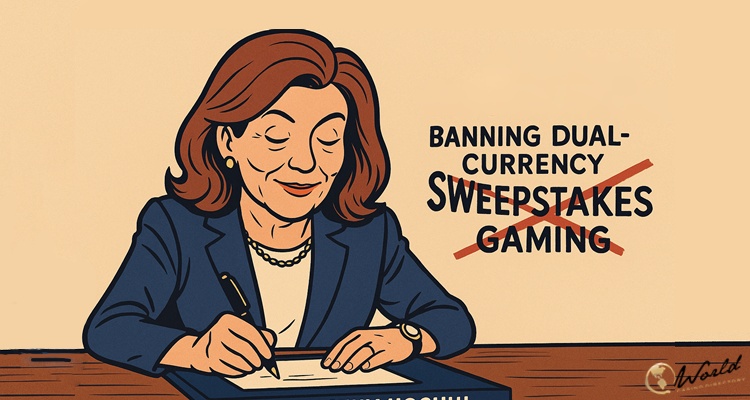
New York has moved decisively against online sweepstakes casinos and sportsbooks. With S5935A now in effect, the state has formalized a prohibition on operating, promoting, or supporting dual-currency sweepstakes gaming, bringing an immediate shift for platforms serving residents. The enactment follows months of legislative activity and earlier enforcement measures targeting these services.
Enforcement Authority and Core Restrictions
Lawmakers framed S5935A around blocking the online sweepstakes model built on dual-currency systems and cash-redeemable rewards. The legislation requires the New York State Gaming Commission and the attorney general to intervene when individuals or affiliated entities knowingly earn revenue connected to prohibited sweepstakes games. The bill’s language specifies that regulators must prevent such entities from starting or continuing operations and impose penalties when violations occur.
The legislative text defines a prohibited online sweepstakes game as an internet-based promotion or contest, accessible through devices such as smartphones and computers, that uses two types of in-game currency and offers players the possibility of cash prizes or cash equivalents. The definition covers activities that simulate casino or sports betting formats.
As published on the New York State Senate’s website, regulators may pursue fines ranging from $10,000 to $100,000 for each breach, and those holding or seeking gaming licenses could face additional consequences. Sweepstakes games without cash-redeemable rewards fall outside the scope of the ban.
Rapid Market Response and National Context
Gov. Kathy Hochul’s signature brought immediate effects. Several operators responded within hours by cutting off New York users. Both Novig and ProphetX informed customers by email that their services were no longer available in the state, paralleling social-media reports of sudden access restrictions. One customer reacted publicly, posting: “man, thanks for nothing @GovKathyHochul. was it really necessary to ban @Novig & @PlayProphetX in New York? terrible news waking up and seeing this.”
The bill’s arrival on Hochul’s desk on December 1 triggered a 30-day window for action. Legislators had already approved the measure earlier in the year, with the final Senate return occurring in June. Had the governor taken no action, the bill would still have taken effect. The margin of passage was sufficient to sustain a potential veto override.
New York’s decision places the state alongside New Jersey, California, Connecticut, Montana, and Nevada, which have already enacted comparable prohibitions. Thirteen states have issued cease-and-desist orders, while other jurisdictions have explored legislative or legal channels to curb the same model. California’s recent bill banning dual-currency sweepstakes games, which takes effect on January 1, 2026, reflects a similar approach. That measure includes penalties such as fines between $1,000 and $25,000 and potential jail time.
Implications for Future Gambling Policy
The Empire State had already taken preliminary enforcement action before the passage of S5935A. In June, Attorney General Letitia James announced that 26 operators offering sweepstakes-style casino games halted activity in response to cease-and-desist demands. The new law expands the state’s authority to prosecute violations more directly.
Sen. Joseph Addabbo Jr., who sponsored S5935A, has long advocated for broader iGaming discussions. In a previous interview, he remarked: “The guardrails and the safeguards that we painstakingly take efforts to do when we do mobile sports betting or iGaming are not there with most of these sweepstakes casino sites.” With downstate casino licensing advancing and the sweepstakes question now settled in state statute, those conversations may gain additional traction.
Some observers see the legislation as part of an effort to create clear separation between unregulated sweepstakes casinos and potential pathways for authorized online casino gaming. As the bill targets simulated casino games, dual-currency systems, and associated revenue streams, state officials now have a more defined framework to enforce boundaries around legal and illegal online gambling activity.