

 United States
 Macau, China
 France
 Philippines
 Singapore
 Netherlands
 United Kingdom
 Canada
 Argentina
 Germany
 Estonia
 Peru
Peru Russia
 Australia
 South Africa
 Nigeria
 Malaysia
 Singapore
 India
India Finland
 China
China Ukraine
 Hong Kong
 Cyprus
 Turkey
 Greece
 Sweden
 South Korea
 Mexico
 Poland
 Ireland lottery results
 New Zealand lottery results
 Puerto Rico lottery results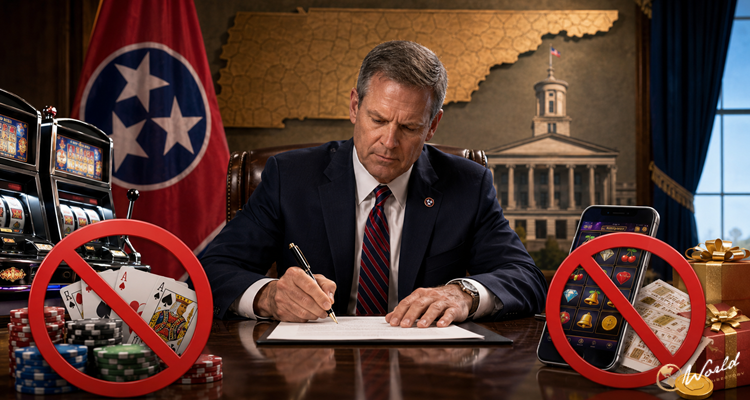
Tennessee has officially outlawed online sweepstakes casinos after Governor Bill Lee signed legislation targeting dual-currency gaming platforms and casino-style online products operating outside the state’s regulated gambling framework. The measure became law after the governor approved the bill on the final day available for action following its passage through the legislature earlier this year.
Lawmakers approved HB 1885/SB 2136 on the final day of Tennessee’s legislative session on April 23 before sending it to the governor on May 11. The legislation received final approval on May 22, before the expiration of the state’s 10-day decision period.
The new law bans online sweepstakes games that replicate traditional gambling products through virtual or multi-currency systems. Tennessee’s legislation specifically targets online products tied to slot-style games, table games, bingo, lottery products, video poker, and unlicensed sports wagering.
Under the new law, violations fall under the Tennessee Consumer Protection Act of 1977. Legislators also amended the language during negotiations to give state regulators authority to investigate operators and enforce the rules.
Operators Already Leaving Tennessee
The legislation follows months of growing pressure on sweepstakes operators in Tennessee. In late 2025, Tennessee Attorney General Jonathan Skrmetti issued cease-and-desist letters to multiple companies offering sweepstakes-style gaming products in the state.
Several major operators withdrew or reduced services following that action, including Chumba Casino, Fortune Coins, Global Poker, Hello Millions, High 5 Casino, Stake, WOW Vegas, Sportzino, Luckyland, McLuck, Modo, and Zula Casino.
A1 Development later joined the list of operators leaving Tennessee, shutting down access to brands including NoLimitCoins, Fortune Wheelz, Tao Fortune, FunzCity, Funrize, and Storm Rush for Tennessee users.
Other companies also began scaling back sweepstakes offerings. VGW, which operates Chumba Casino, LuckyLand Slots, and Global Poker, started phasing out Sweeps Coin gameplay in the state. Stake.us announced plans to remove Tennessee from its service list, while social sportsbook operators such as Thrillzz, KicKr, and Rebet also exited the market.
The coordinated withdrawals came amid growing uncertainty around how Tennessee would regulate prize-based gaming platforms. Industry observers pointed to mounting legal and regulatory scrutiny as operators adjusted their positions in the state.
AG Skrmetti previously criticized the sector in a public statement, saying: “The only thing you can be sure about with an online sweepstakes casino is that it’s going to take your money.”
He also added: “They work hard to make these sweepstakes casinos look legitimate, but at the end of the day they are not. They avoid any oversight that could ensure honesty or fairness. Our Office was glad to chase these shady operations out of Tennessee and will keep working to protect Tennesseans from illegal gambling.”
Another section of the statement warned that operators considering entry into Tennessee should understand that “illegal gambling will not be tolerated.”
Part of a Wider National Trend
Tennessee joins a growing number of states that have moved against sweepstakes casinos and dual-currency gaming systems. Legislators and regulators across the country have increasingly argued that the products function as unregulated gambling despite relying on virtual currencies instead of direct cash wagering.
The new Tennessee law follows similar bans approved in California, Connecticut, Louisiana, Montana, New Jersey, New York, Oklahoma, Indiana, Maine, and Nevada.
Louisiana recently enacted its own legislation targeting sweepstakes casinos after Governor Jeff Landry signed House Bill 883 into law. That measure takes effect on August 1.
According to SBC Americas, the conference committee report tied to Tennessee’s legislation described sweepstakes casinos as platforms that “utilize a system allowing players to play casino-style games with virtual currency and exchange the virtual currency for cash or other real-world prizes.” The report further stated that these systems act as “a façade to hide the fact that players may engage in real-money gambling through the purchase and use of virtual currency.”
Supporters of the Tennessee ban argued that the law closes gaps that allowed operators to function outside traditional gambling oversight. Legislative staff reviewing the measure previously concluded the ban would have no negative impact on state revenue.
Questions remain about how additional states may approach sweepstakes gaming moving forward, especially as more legislatures and regulators continue examining the dual-currency model used by operators across the sector.
