

 United States
 Macau, China
 France
 Philippines
 Singapore
 Netherlands
 United Kingdom
 Canada
 Argentina
 Germany
 Estonia
 Peru
 Russia
 Australia
 South Africa
 Nigeria
 Malaysia
 Singapore
 India
 Finland
 China
 Ukraine
 Hong Kong
 Cyprus
 Turkey
 Greece
 Sweden
 South Korea
 Mexico
 Poland
 Ireland lottery results
 New Zealand lottery results
 Puerto Rico lottery results
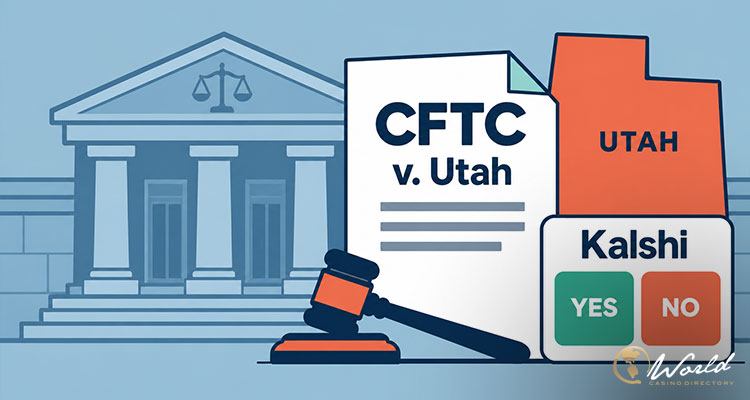
The Commodity Futures Trading Commission (CFTC) and the U.S. Department of Justice (DOJ) have sued Utah over its efforts to restrict prediction market operator Kalshi, arguing that the state’s enforcement actions threaten federal regulatory authority over derivatives exchanges.
Filed in federal court on Monday, the 33-page complaint (pdf) seeks to prevent Utah Attorney General Derek Brown from applying state gambling restrictions to exchanges registered with the CFTC. The agencies claim that Utah’s actions cause “irreparable injury” to federal interests and require preliminary and permanent injunctive relief.
The case follows Utah’s lawsuit against Kalshi and two Susquehanna trading firms on Oct. 20. It also marks the CFTC’s 10th legal challenge against a state seeking to restrict prediction markets and its first against a state led by a Republican governor.
The dispute reflects a wider disagreement over whether event contracts offered by platforms such as Kalshi fall under federal financial regulation or state gambling laws. The CFTC maintains that Congress granted it exclusive authority over regulated commodity derivatives, while states have argued that certain prediction market contracts amount to unauthorized betting.
Federal agencies challenge Utah’s enforcement powers
The federal complaint asks the court to declare that Utah’s gambling statutes, prohibition on election betting and public nuisance law cannot apply to CFTC-regulated designated contract markets. It also seeks orders barring the state from investigating or enforcing those laws against registered exchanges, their affiliates and their partners.
The CFTC argues that state-level restrictions could undermine the operation of federally regulated exchanges. Its complaint states that “Supremacy Clause violations are always irreparable,” adding that damage to federal “sovereign interests and regulatory jurisdiction could not be undone after final judgment.”
CFTC Chairman Michael Selig said the state was attempting to restrict a broad range of prediction market activities.
“Utah seeks to shut down prediction markets across a wide variety of markets,” Selig said according to SBC Americas. “As I’ve said before, the CFTC has the expertise and responsibility to defend its exclusive jurisdiction over commodity derivatives, and that’s exactly what we’ll do.” He added that Congress had assigned the commission sole responsibility for overseeing the markets.
The agency also contends that requiring exchanges to exclude Utah residents would conflict with a federal rule mandating “impartial access” for eligible participants across the country. According to the complaint, allowing individual states to regulate these contracts could leave exchanges facing “the prospect of 50 regulators across the country.”
The CFTC’s legal argument also draws on historical disputes over derivatives trading. The complaint references 19th-century state efforts to prohibit futures trading as gambling and cites Justice Oliver Wendell Holmes‘ 1905 opinion that “the natural evolutions of a complex society are to be touched only with a very cautious hand.”
Utah’s case against Kalshi and the earlier court ruling
Utah filed its own civil lawsuit in Third District Court in Salt Lake County six days before the federal complaint. The state alleges that the defendants operate an illegal gambling business and characterizes Kalshi’s activities as a public nuisance. Utah is among the few states that prohibit all forms of gambling.
Brown summarized the state’s position in a statement accompanying the lawsuit: “Kalshi runs an online casino in Utah and calls it a prediction market. That violates Utah law,” he said.
The state wants the court to prohibit Kalshi from offering contracts involving sports, elections, politics, culture and mentions to Utah residents. Its proposed restrictions would rely on a court-approved geolocation provider. Utah is also seeking restitution and disgorgement, estimating that Kalshi collected between $30.6 million and $61.2 million in fees from accounts in the state.
The latest federal action follows an earlier lawsuit Kalshi filed in February against Utah Governor Spencer Cox and Brown, seeking to prevent potential enforcement measures. In March, Cox signed House Bill 243, which treats proposition bets as gambling.
On Aug. 4, U.S. District Judge Robert Shelby granted Utah summary judgment, ruling that the Commodity Exchange Act (CEA) does not override the state’s gambling laws. Kalshi appealed the decision, but the Tenth Circuit Court of Appeals rejected its request for an injunction pending appeal on Sept. 8. The appeal remains unresolved.
The CFTC’s new complaint does not discuss Shelby’s ruling or the appeals court’s decision. Instead, it points to legal developments elsewhere that support federal oversight of prediction markets. These include an April ruling by the Third Circuit in Kalshi’s favor in New Jersey and preliminary injunctions obtained by federal authorities in Illinois and Minnesota.
The commission also references an August Ninth Circuit decision concerning Nevada, which held that the CEA expressly preempts state laws regulating swaps traded on federally regulated exchanges. However, the same panel ruled against Kalshi, finding that its sports contracts likely did not qualify as swaps.
The latest case is before the same federal district that previously ruled in Utah’s favor. Any appeal would go to the Tenth Circuit, which is already considering Kalshi’s challenge to the earlier judgment.
Nationwide litigation heads toward the Supreme Court
Utah joins Arizona, Connecticut, Illinois, Kentucky, Minnesota, New Mexico, New York, Rhode Island and Wisconsin among the states sued by the CFTC since April. Federal judges have granted preliminary injunctions supporting the commission in Arizona, Illinois and Minnesota. In Wisconsin, however, U.S. District Judge William Griesbach rejected the CFTC’s request in July, concluding that the agency would not suffer “irreparable harm” from state gambling laws.
The disagreement has also reached the federal appeals courts. The Third Circuit ruled 2-1 in Kalshi’s favor in April, while the Ninth Circuit ruled against the company on Aug. 28. On Sept. 25, the Sixth Circuit issued a unanimous ruling supporting Ohio and Tennessee.
New Jersey petitioned the U.S. Supreme Court on Sept. 2 in Flaherty v. KalshiEX. Robinhood and Crypto.com have filed separate petitions arising from the Nevada proceedings, while Kalshi has asked the full Ninth Circuit to rehear its case.
Ohio, 38 other states and the District of Columbia have filed a brief supporting New Jersey’s position. The NFL, the American Gaming Association and 145 tribal governments and organizations have also backed the state’s petition. Kalshi’s response to New Jersey’s filing is due Nov. 9.
The CFTC is pursuing regulatory changes alongside its court actions. On Oct. 19, it issued an interim final rule excluding state-licensed sportsbook and casino wagers from the definition of a swap. The commission also proposed a rule that would expressly classify event contracts covering sports, politics, culture and weather as swaps.
