

 United States
 Macau, China
 France
 Philippines
 Singapore
 Netherlands
 United Kingdom
 Canada
 Argentina
 Germany
 Estonia
 Peru
Peru Russia
 Australia
 South Africa
 Nigeria
 Malaysia
 Singapore
 India
India Finland
 China
China Ukraine
 Hong Kong
 Cyprus
 Turkey
 Greece
 Sweden
 South Korea
 Mexico
 Poland
 Ireland lottery results
 New Zealand lottery results
 Puerto Rico lottery results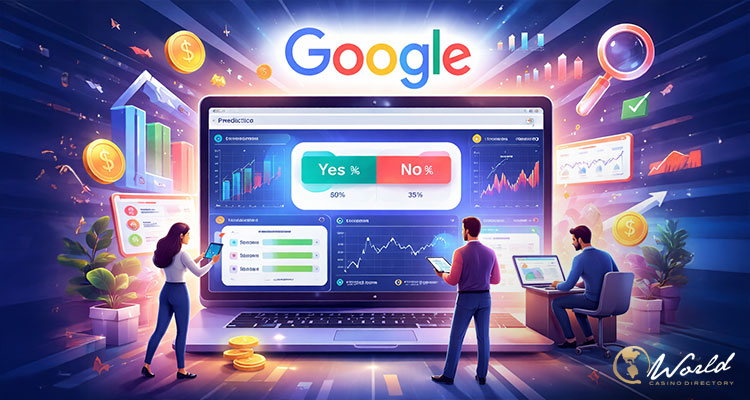
Google will begin allowing advertising for prediction markets in the United States starting Jan. 21, marking a shift in how the company categorizes these platforms. Under the updated policy, prediction markets will fall under Google’s financial services advertising rules rather than its gambling restrictions.
The change applies only to what Google defines as “platforms that facilitate the listing of or provide customer access Exchange-Listed Event Contracts related to economics, sports or current events”. The policy does not represent a broad opening of the advertising platform. Instead, Google has set detailed eligibility requirements that significantly narrow which companies may participate.
Advertising Access Limited to Federally Supervised Firms
Only prediction market operators authorized at the federal level will qualify to run ads, according to SBC Americas. Eligible advertisers must either be approved by the Commodity Futures Trading Commission as a designated contract market for event-based contracts, or registered with the National Futures Association as a brokerage that provides third-party access to contracts listed on an approved exchange.
Google emphasized that regulatory status, rather than the subject matter of the contracts, serves as the primary qualification standard. Platforms that operate outside this structure, including offshore providers or those working in regulatory gray areas, are excluded regardless of their size or popularity.
A Google spokesperson confirmed that the policy update is not connected to the company’s recent partnership with Kalshi and Polymarket. That agreement involved the integration of prediction market data into Google Finance and search tools, allowing users to query figures such as GDP growth estimates or election probabilities using aggregated market positions.
Both Kalshi and Polymarket have argued that their offerings consist of event contracts that should be regulated as commodities rather than gambling products. At the same time, that position has drawn objections from some state attorneys general and federal lawmakers who view the platforms as closely resembling traditional betting.
Certification, Geographic Limits, and Ongoing Restrictions
Even companies that meet federal regulatory standards will not gain automatic access to Google Ads. Advertisers must apply for certification, demonstrating compliance with Google’s advertising policies as well as applicable financial regulations, local laws, and industry standards. Separate applications are required for each jurisdiction in which ads are targeted, and campaigns may run only in approved locations.
The updated policy explicitly excludes Nevada. The state is currently involved in legal disputes with prediction market operators, and Kalshi faces a court order preventing it from offering sports-related contracts there.
Google also reinforced boundaries around prohibited products. Binary options remain fully banned from the advertising platform, including promotions from affiliates, review sites, educational resources, and signaling services. Unregulated prediction platforms, tokenized prediction services, and advisory or analysis-focused businesses are likewise ineligible.
According to Google, maintaining these restrictions is intended to address past issues involving deceptive advertising practices, fraud, and consumer losses associated with high-risk financial products.
Industry Impact and Broader Implications
Industry observers view the policy as a step toward greater mainstream visibility for regulated prediction markets, even as it imposes strict compliance hurdles. RAAS Lab co-founder Thomas Ives described the change as an extension of Google’s earlier integration of prediction data into its products.
“The reclassification of prediction markets as financial instruments rather than gambling products represents the commercialization of Google’s partnership with Kalshi and Polymarket last year,” Ives told SBC Americas.
He added, “By integrating real-time odds into Google search and finance, Google validated that users want this data, which is highly aligned with American culture and social media activity. Now it’s letting these providers bid for that attention.”
Ives suggested that federally regulated prediction markets could see accelerated growth compared with traditional sportsbooks. “This update is a potential green light for prediction markets to potentially outpace traditional sportsbooks in growth,” he said, noting that the category is often viewed as a “cleaner alternative to gambling”.
He also pointed to the national scope of federal oversight, saying, “As it falls under CFTC jurisdiction, prediction market ads should be able to be run nationally, leapfrogging the state-by-state compliance patchwork that standard gambling brands need to go through.”
While the immediate policy change applies only to the U.S., Ives said it may influence global interest. “While the U.K. has flirted with peer-to-peer betting, there is currently no domestic predictions market offering,” he said, adding that international operators are already monitoring the space.
