

 United States
 Macau, China
 France
 Philippines
 Singapore
 Netherlands
 United Kingdom
 Canada
 Argentina
 Germany
 Estonia
 Peru
Peru Russia
 Australia
 South Africa
 Nigeria
 Malaysia
 Singapore
 India
India Finland
 China
China Ukraine
 Hong Kong
 Cyprus
 Turkey
 Greece
 Sweden
 South Korea
 Mexico
 Poland
 Ireland lottery results
 New Zealand lottery results
 Puerto Rico lottery results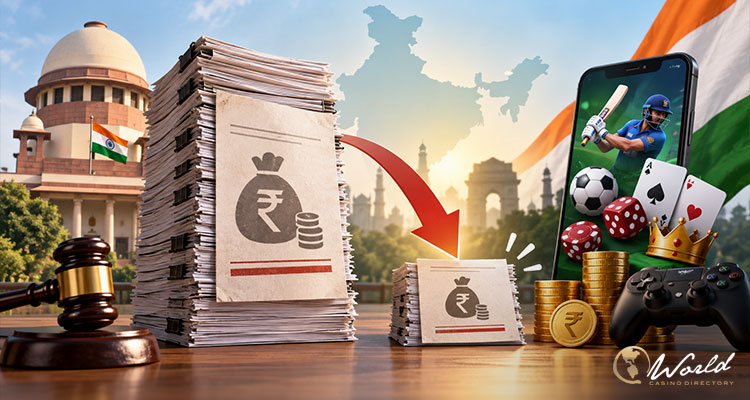
Indian tax authorities have reduced Goods and Services Tax (GST) demands against Dream11 operator Sporta Technologies, Gameskraft Technologies and Play Games24x7 by approximately ₹52,915 crore following a Supreme Court ruling on the taxation of online money gaming.
The combined principal demands declined from approximately ₹70,212.87 crore to ₹17,297.62 crore, representing a reduction of 75.4%.
The revised assessments follow the Supreme Court’s May 27, 2026 judgment, which upheld retrospective taxation while requiring authorities to calculate liabilities using verified player deposits.
Under the revised method, winnings reused in subsequent games without being withdrawn do not count as additional deposits. Earlier calculations had repeatedly included these amounts, substantially increasing the taxable value.
Despite the reductions, all three companies remain liable for confirmed principal taxes, with applicable interest and penalties assessed separately.
Dream11 and Gameskraft Record Substantial Reductions
As reported by Exchange4Media, Sporta Technologies, which operates Dream11, received the largest reduction in absolute terms.
The Mumbai East Commissionerate lowered its proposed GST demand from approximately ₹28,294.18 crore to ₹6,690.87 crore, removing ₹21,603.31 crore from the original assessment.
The confirmed liability covers transactions between July 2017 and March 2023 and includes ₹5,671.60 crore in integrated GST, alongside ₹509.64 crore each in central and state GST.
Authorities also directed the recovery of applicable interest after accounting for previous payments. The company faces a penalty under Section 73(9) of the Central Goods and Services Tax Act, although several additional proposed penalties were withdrawn.
Gameskraft recorded the largest percentage reduction among the three operators, at 76.7%.
Its demand fell from approximately ₹20,989.31 crore to ₹4,887.05 crore after officials reassessed transactions involving the RummyCulture and Gamezy platforms.
The review covered activity between August 2017 and June 2022, establishing a taxable value of ₹20,261.97 crore based on verified deposits.
Authorities credited ₹20 crore previously paid by Gameskraft toward its liability and imposed a penalty equal to the confirmed principal tax.
The adjudicating authority also withdrew proposed personal penalties against five individuals and removed overlapping penalties relating to the same conduct.
Play Games24x7, operator of RummyCircle and My11Circle, received a 72.7% reduction, bringing its principal demand to ₹5,719.70 crore.
The company’s revised assessment covers transactions from July 2017 through the 2022-23 financial year. Authorities credited ₹1,407.38 crore in earlier GST payments and imposed an additional penalty matching the confirmed tax.
A separate integrated GST demand of ₹32.52 crore concerns foreign expenditure and remittances associated with the company’s US branch.
Deposit-Based Valuation Changes GST Calculations
The tax dispute originated in 2022 and 2023, when the Directorate General of GST Intelligence challenged the methods gaming companies used to calculate their tax obligations.
Operators had paid GST on platform fees or commissions, arguing that their products, including rummy and fantasy sports, involved skill-based gaming.
Tax authorities maintained that the applicable levy should cover the full taxable value of gaming transactions.
In 2023, the Karnataka High Court quashed the GST notice issued against Gameskraft. The Supreme Court subsequently overturned that decision, upholding the retrospective application of the tax framework.
However, the May 2026 judgment clarified how authorities must determine the taxable amount.
For example, when a player deposits ₹10,000 and subsequently wins ₹2,000, reusing the resulting ₹12,000 balance without withdrawing it does not create another taxable deposit.
If the player later withdraws funds and makes a fresh deposit, that additional payment counts toward the calculation.
The distinction significantly affected Gameskraft’s assessment because the earlier methodology had repeatedly counted winnings used for further participation.
The Supreme Court also upheld Rule 31A and treated Rules 31B and 31C as clarificatory provisions with retrospective application.
Historical Tax Claims Continue After Gaming Ban
The revised demands concern transactions completed before India introduced the Promotion and Regulation of Online Gaming Act in August 2025.
That legislation prohibited online money games, fundamentally changing the operating environment for the country’s real-money gaming companies.
The outstanding GST proceedings nevertheless remain relevant because they address historical liabilities accumulated under the previous regulatory framework.
Although the principal amounts have fallen considerably, the confirmed assessments do not represent a full waiver.
Gameskraft and Play Games24x7 each face penalties equivalent to their revised principal liabilities, while authorities will calculate applicable interest separately.
The latest adjudication orders establish lower tax demands based on player deposits and recognise amounts the companies previously paid.
The combined reduction of approximately ₹52,915 crore represents a substantial adjustment to India’s historical online gaming tax claims, while leaving significant financial obligations for the three operators.
