

 United States
 Macau, China
 France
 Philippines
 Singapore
 Netherlands
 United Kingdom
 Canada
 Argentina
 Germany
 Estonia
 Peru
Peru Russia
 Australia
 South Africa
 Nigeria
 Malaysia
 Singapore
 India
India Finland
 China
China Ukraine
 Hong Kong
 Cyprus
 Turkey
 Greece
 Sweden
 South Korea
 Mexico
 Poland
 Ireland lottery results
 New Zealand lottery results
 Puerto Rico lottery results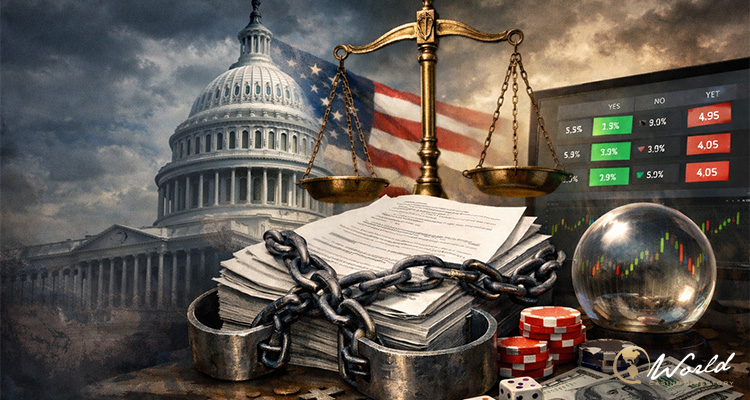
Nevada Representative Dina Titus has introduced federal legislation that would block prediction market platforms from listing contracts tied to sporting events and casino-style gaming outcomes. The proposal marks the latest attempt by lawmakers to address the rapid expansion of sports-related event contracts offered on federally regulated exchanges.
Titus, a Democrat who co-chairs the Congressional Gaming Caucus, filed the Fair Markets and Sports Integrity Act on Tuesday. The bill, numbered HR 7477, has been referred to the House Committee on Agriculture, which oversees commodity exchanges. It seeks to amend the Commodity Exchange Act to prohibit registered entities from engaging in transactions involving sporting event or casino-style gaming contracts.
In a statement announcing the measure, Titus wrote: “Prediction markets should not be able to circumvent state gaming laws. Consumers deserve transparency, accountability, and protection against such predatory practices. That is why I introduced the Fair Markets and Sports Integrity Act to prevent entities from engaging in transactions involving sporting or casino-style event contracts.”
In a separate press release cited by SBC Americas, she added, “These prediction markets are rapidly expanding around the world without the same guardrails that apply to licensed, regulated gaming operators. Consumers deserve transparency, accountability, and protections against predatory practices.”
Federal Proposal Enters Ongoing Regulatory Clash
The legislation arrives as prediction market operators and multiple states remain locked in legal disputes over whether event contracts tied to sports outcomes fall under federal derivatives law or state gaming authority. Platforms such as Kalshi, Polymarket, and Crypto.com have argued in court that their offerings qualify as swaps regulated at the federal level, which they contend pre-empts state gaming rules.
State regulators, including those in Nevada, have taken the position that contracts based on game results function as sports wagers. Following the Supreme Court’s decision to overturn PASPA, states maintain that they control sports betting within their borders and that event contracts linked to athletic competitions fall within that jurisdiction.
The Commodity Futures Trading Commission (CFTC), the federal agency responsible for overseeing derivatives markets, has played a central role in the dispute. Less than two weeks before Titus announced her bill, CFTC Chair Mike Selig said the agency would establish new rules to allow contracts on sporting events. Under recently appointed Chair Michael Selig, the CFTC has begun withdrawing prior prohibitions on certain event contracts and signaled plans to craft a regulatory framework specific to them. The agency is also expected to defend prediction markets in ongoing federal court cases against states.
Industry observers widely believe the U.S. Supreme Court may ultimately determine whether exchanges can legally offer contracts on events such as the Super Bowl, the NCAA Tournament, or regular-season games. Court proceedings remain in early stages in both state and federal venues, and similar high-profile gambling litigation has taken years to resolve.
Political dynamics add another layer of uncertainty. Titus, a Democrat, introduced her measure in a House controlled by a narrow Republican majority. Congressional passage would require bipartisan support and presidential approval. The Trump administration has taken a position allowing prediction markets to offer sports contracts, a stance that emerged after the president’s eldest son became an adviser to Kalshi. While gambling policy has often drawn cross-party backing, some industry analysts have suggested that the debate over prediction markets is taking on a more partisan tone.
Another Democratic lawmaker, New York Rep. Ritchie Torres, introduced separate legislation in early January. His Public Integrity in Financial Prediction Markets Act would bar federal elected officials, political appointees, and executive branch employees from trading on contracts tied to government policy or political outcomes when they possess or could obtain nonpublic information through their roles.
Sen. Richard Blumenthal is expected to introduce companion legislation in the Senate similar to Titus’ proposal.
States Advance Their Own Restrictions
Lawmakers across several states have also introduced measures aimed at restricting or banning prediction markets.
In New York, multiple bills address the issue. Assemblymember Phil Steck proposed legislation limiting the use of prediction markets by certain public officials when using information gained through their duties. Assemblymember Clyde Vanel’s A9251 would prohibit prediction markets involving “catastrophic events, politics, deaths, securities and athletic events.” His proposal would also impose requirements such as a minimum age of 21, self-exclusion options, deposit and spending limits, and a ban on credit card use. Vanel titled the measure the Oversight and Regulation of Activity for Contracts Linked to Events Act, or ORACLE Act. It was referred to an Assembly committee in November. In the state Senate, Sen. Jeremy Cooney’s S8889 would require operators seeking to offer event contracts to obtain a license from the Department of Financial Services.
Hawaii lawmakers recently advanced House Bill 2198, which would add the buying and selling of securities and commodities tied to sports, games of skill and chance, politics, catastrophe, and death to the state’s definition of gambling, which is prohibited there. A House committee approved the bill unanimously.
In Illinois, Rep. Daniel Didech filed HB 5142 to classify sports-related prediction markets as sports wagering, requiring operators to obtain a sports wagering license. Rep. Edgar Gonzalez introduced HB 5059 to ban sports prediction markets and impose limitations on other event contracts. Iowa lawmakers have proposed requiring platforms to pay $10 million for a license and remit 20% of revenue from event contracts, while a measure backed by Connecticut’s governor would restrict trading to individuals 21 and older.
Rapid Growth Fuels Debate
The legislative activity follows sharp growth in prediction markets’ sports offerings over the past year. After expanding into athletic competitions, platforms such as Kalshi shifted from primarily political forecasting to sports exchanges. Since launching sports contracts a year ago, Kalshi’s trading volume has increased more than 1,971.5% to $37.3 billion, with over 86.7% tied to sports markets. Political and economic forecasting combined for less than 5% of the platform’s volume during that period.
Major gaming companies, including FanDuel, DraftKings, Fanatics, PrizePicks, and Underdog, have offered sports event contracts in certain states, often through partnerships with marketplaces such as Kalshi.
Some industry figures have suggested that exchanges could eventually explore contracts tied to casino-style outcomes. During an earnings call last year, PENN Entertainment CEO Jay Snowden speculated about offerings “on the next spin of a slot machine, the next hand of blackjack.”
As federal agencies adjust their oversight and courts weigh competing claims of authority, Titus’ bill represents one of the most visible congressional efforts to define the boundaries between financial exchanges and state-regulated gambling. The outcome remains uncertain, with both legislative and judicial paths likely to unfold over an extended period.
