

 United States
 Macau, China
 France
 Philippines
 Singapore
 Netherlands
 United Kingdom
 Canada
 Argentina
 Germany
 Estonia
 Peru
Peru Russia
 Australia
 South Africa
 Nigeria
 Malaysia
 Singapore
 India
India Finland
 China
China Ukraine
 Hong Kong
 Cyprus
 Turkey
 Greece
 Sweden
 South Korea
 Mexico
 Poland
 Ireland lottery results
 New Zealand lottery results
 Puerto Rico lottery results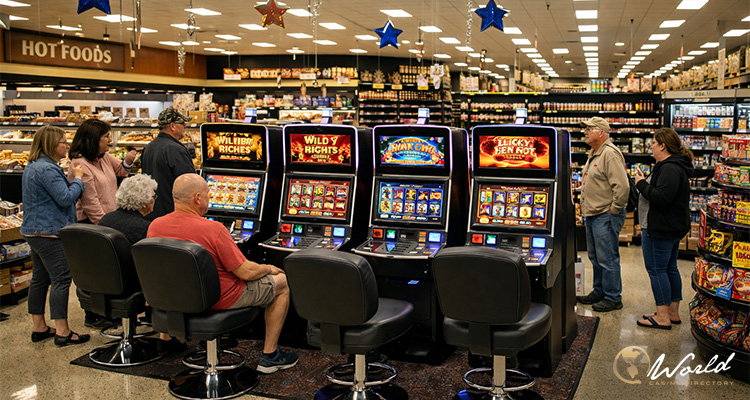
Kroger has installed gambling machines inside several of its Georgia grocery stores, prompting complaints from customers and renewed debate about the spread of betting across the United States.
The machines, known as coin operated amusement machines (COAMs), appeared last year in select locations in Macon, Milledgeville, Warner Robins, South Fulton, and Powder Springs. Some shoppers described the setup as resembling a small casino placed inside a supermarket, an addition that critics say conflicts with the purpose of a grocery store.
Georgia law prohibits traditional cash-payout gambling, yet COAMs operate under a different framework. Instead of dispensing cash winnings, the machines provide non-cash rewards such as store credit, prepaid gift cards, and other prizes. That structure allows them to function within state regulations.
Kroger addressed concerns about the placement of the machines in a statement cited by The Sun. A spokesperson said they “were placed in partitioned areas of the store” that “are separated from store traffic.” The company added that proceeds from the machines support the Hope Scholarship Program, which funds scholarships and grants for young people in Georgia. In a separate statement cited by local coverage, a spokesperson said the locations were selected with the “customers’ convenience and safety in mind.’”
Community Backlash in Several Cities
Despite the company’s explanation, some residents say gambling devices do not belong in grocery stores.
Felicia Conn-Payton, a shopper in South Fulton, said that the machines send the wrong message for her community. She called them a “bad image” for the town and urged the company to focus on improving store conditions instead. “Upgrade the store and that will probably increase the revenue here. That’s what we are looking for,” she said. “We’re not looking to have gaming slot machines inside a grocery store where families are trying to shop for groceries.”
In Macon, resident L.J. Malone questioned the company’s direction. “If a grocery store’s main job is to alleviate hunger and to give people fresh food options, why are they becoming casinos? It doesn’t make sense,” Malone said.
Residents in Powder Springs organized a petition seeking removal of the machines. The petition argues that the devices attract crime and exploit vulnerable individuals. “Kroger’s profit in 2024 was over $33 Billion. Adding these COAM machines is not helping our community,” the petition’s description read. “Kroger is taking advantage of people who have gambling addictions for profit.”
On social media, a photo of a gambling section inside a Georgia Kroger circulated widely after one X user posted it while visiting family. The post drew hundreds of reactions. “Really blows my mind that there isn’t coherent political pushback to this. A way in which American life is getting rapidly worse,” one comment read. Another user wrote, “They have popped up everywhere in the Pittsburgh area. Drives me nuts!”
Some commenters focused on the signage above the machines. ““Skill games” might be the most absurd part of this,” one person wrote. Others viewed the machines as similar to existing forms of gambling. A former Nevada resident commented, “I remember seeing these at stores when I lived in Reno as a kid. It’s jarring but tbh it’s not a whole lot different from people dumping money on lottery tickets, at least not from the gambler’s/buyer’s perspective.”
Another X user, reacting to coverage of the machines, wrote: “They had sfuff [sic] like this in Oregon and it was insane. I always thought it was weird to ban gambling, but nope, I was wrong. It should definitely be illegal or relegated to a few heavily regulated areas.”
Gambling’s Expanding Reach Nationwide
The controversy unfolds during a period of significant growth in the gambling industry. According to data compiled by Statista, the online gambling market in the United States expanded from $2.5 billion in 2018 to nearly $20 billion in 2025.
Participation has also increased. Statista found that 43 percent of Americans reported gambling in 2019. By 2024, that figure rose to 55 percent. The broader commercial gaming industry generated $71.92 billion in gross revenue in 2024, with casino slots and table games accounting for the majority of that total.
While gambling contributes substantial revenue to the economy, experts warn about addiction risks. Shane Kraus, director of the Behavioral Addictions Lab at the University of Nevada, told the American Psychological Association that vulnerability is especially high among low-income individuals, young people, and men.
The installation of COAMs in everyday retail settings highlights how gambling has become more visible in daily life. In Georgia, where cash payouts remain illegal, the debate over grocery store gaming machines continues as residents weigh economic benefits against community concerns.
