

 United States
 Macau, China
 France
 Philippines
 Singapore
 Netherlands
 United Kingdom
 Canada
 Argentina
 Germany
 Estonia
 Peru
Peru Russia
 Australia
 South Africa
 Nigeria
 Malaysia
 Singapore
 India
India Finland
 China
China Ukraine
 Hong Kong
 Cyprus
 Turkey
 Greece
 Sweden
 South Korea
 Mexico
 Poland
 Ireland lottery results
 New Zealand lottery results
 Puerto Rico lottery results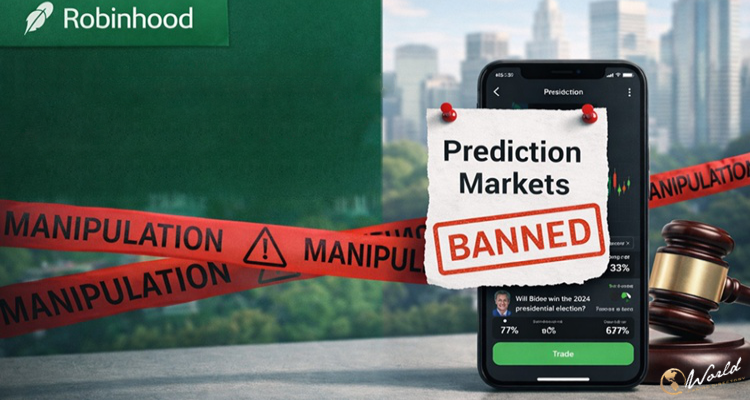
Robinhood has narrowed the range of prediction market contracts available on its platform, citing concerns that some types of wagers could enable insider trading or other forms of market abuse. The decision reflects growing unease across the industry as event-based trading gains traction among retail investors.
The brokerage’s leadership said the company has deliberately avoided offering certain contracts it considers too risky. Jordan Sinclair, president of Robinhood UK, stated that the firm is “very focused on market abuse, insider trading”, according to AFR.
He added: “We don’t necessarily offer all prediction markets or all event contracts. There are some we’ve chosen aren’t right for our customers and that is, I think, the way you can kind of navigate that world.”
Selective Approach to High-Risk Contracts
Prediction markets allow users to trade on the likelihood of future outcomes, ranging from elections to sports results and even unconventional topics such as whether governments will confirm extraterrestrial life. Robinhood currently offers access to such markets through partnerships with regulated platforms including Kalshi and ForecastEx.
However, the company has taken a cautious stance toward specific categories, particularly “mention markets.” These contracts enable traders to bet on whether certain words or phrases will appear in speeches, earnings calls, or public events. Sinclair said Robinhood excludes these offerings “for exactly some of those concerns.”
The move comes as incidents linked to prediction markets have raised red flags. Reports have highlighted suspiciously timed trades, including unusually large bets placed shortly before geopolitical developments. In another case, Israeli authorities charged two individuals earlier this year for allegedly using classified information to place wagers on military operations.
Concerns have also emerged in other contexts. Activity surrounding Venezuela’s opposition leader María Corina Machado drew scrutiny after a surge in bets occurred shortly before a Nobel Peace Prize announcement, prompting organizers to investigate a possible leak. Separately, a former editor associated with a major YouTube channel was fined and reported to regulators over insider trading tied to prediction contracts.
Industry Faces Rising Scrutiny
Robinhood’s restrictions align with broader concerns that prediction markets could be vulnerable to misuse. Kalshi chief executive Tarek Mansour acknowledged the risks in a recent interview, saying: “prediction markets are likely to attract fraud and insider trading.” He stressed the need for strong compliance systems and indicated that federal oversight is likely to intensify.
The regulatory environment remains complex, particularly in the United States. Robinhood is currently involved in a legal dispute with Massachusetts regulators, who attempted to block its event-based contracts on the grounds that they constitute unregistered securities. The company has challenged that position, arguing the products are federally regulated derivatives under the jurisdiction of the Commodity Futures Trading Commission.
Outside the US, authorities have taken a stricter stance. Countries including France, Germany, and the Netherlands have limited access to major prediction platforms. France’s gambling regulator warned that such services “were not authorised in France and are considered illegal gambling services” and noted they exhibit “addictive characteristics like those found in online gambling – but amplified by the absence of the protective mechanisms that exist in the legal gambling market”.
At the same time, some jurisdictions are exploring ways to regulate the sector. Gibraltar has issued a license to a prediction market operator, while Malta is considering a legal framework focused on transparency and user protection. Malta’s Economy Minister Silvio Schembri said: “We recognised early on that users need to feel safe if this industry was going to grow, which means it needed to uphold the highest standards of transparency and compliance”.
Rapid Growth Drives Caution
Robinhood’s move comes despite strong growth in the segment. The company reported that prediction markets became its fastest-expanding business line in 2025, with more than 12 billion contracts traded. Chief executive Vlad Tenev described the trend as part of a broader expansion, stating: “We’re just at the beginning of a prediction market super cycle that could drive trillions in annual volume over time.”
The brokerage, which serves millions of retail investors and has expanded into a wider range of financial services, views prediction markets as a significant revenue opportunity. It expects the segment to generate hundreds of millions of dollars annually.
Even so, the company appears to be balancing growth ambitions with reputational and regulatory risks. By limiting access to certain contracts and prioritizing regulated partners, Robinhood aims to avoid scenarios where traders might exploit non-public information or manipulate outcomes.
The broader debate over prediction markets continues as their popularity rises. While some see them as innovative tools for forecasting, regulators and industry participants remain concerned about their potential to blur the line between informed speculation and illicit trading.
