

 United States
 Macau, China
 France
 Philippines
 Singapore
 Netherlands
 United Kingdom
 Canada
 Argentina
 Germany
 Estonia
 Peru
Peru Russia
 Australia
 South Africa
 Nigeria
 Malaysia
 Singapore
 India
India Finland
 China
China Ukraine
 Hong Kong
 Cyprus
 Turkey
 Greece
 Sweden
 South Korea
 Mexico
 Poland
 Ireland lottery results
 New Zealand lottery results
 Puerto Rico lottery results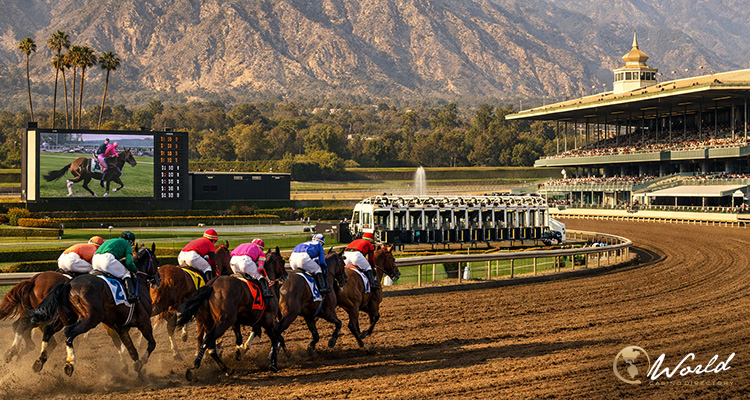
State law enforcement officials removed newly installed betting machines from Santa Anita Park over the weekend, bringing a swift end to an unannounced rollout that immediately drew scrutiny from regulators and tribal gaming interests. The confiscation occurred less than two days after the terminals were activated inside the Arcadia racetrack’s grandstand.
According to Bloodhorse, photographs shared on social media on Jan. 17 and later confirmed by veteran racing reporters Kevin Modesti and John Cherwa showed officers disconnecting and transporting the machines. According to Modesti, agents from the California Department of Justice carried out the removal on Saturday afternoon, shortly after racing concluded. The terminals had been introduced quietly on Thursday as part of what track officials described as a soft opening.
Law Enforcement Steps In After Quiet Rollout
Witnesses described a coordinated operation involving roughly 15 officers. Representatives from the Arcadia Police Department and officers wearing patches identifying the California Department of Justice Attorney General’s office entered the grandstand area, unplugged the machines, placed them on handcarts, and escorted them out of the building. Employees nearby were instructed to leave during the process, and officials also removed the cash contained in the terminals.
Two Santa Anita officials confirmed that the Racing On Demand machines were confiscated by the state. The terminals had replaced the former Horse Wizard Lounge on the ground floor of the grandstand and allowed patrons to wager on previously run horse races through a slot-style interface.
Santa Anita did not promote the machines publicly, nor did it announce their installation in its fan newsletter. The California Horse Racing Board also received no advance notice, despite having approved the specific wager type used by the machines earlier in 2024.
Legal Dispute Over Pari-Mutuel Wagering
The machines were developed by PariMAX, a subsidiary of 1/ST Racing, which owns Santa Anita through The Stronach Group. Track officials have consistently argued that Racing On Demand complies with California’s pari-mutuel wagering statutes. The terminals offered a $1 “Three-by-Three” bet, an exotic wager approved by the Horse Racing Board in April 2024, though regulators were not informed at the time that the bet would be applied to historical races.
Scott Daruty, senior vice president of 1/ST Racing, said the company anticipated regulatory review but maintained confidence in its legal position. “We stand firmly behind our legal analysis,” Daruty said in a statement. “Racing On Demand operates under California’s longstanding pari-mutuel wagering laws using a wager that regulators already approved. Attorney General Bonta received our comprehensive legal analysis nearly a year ago. His office had ample time to raise concerns. They did not. We proceeded on solid legal ground, and since the state is choosing to challenge that now, we’re fully prepared to defend ourselves. We’re confident the law is clear.”
Daruty previously told BloodHorse that the product was designed to help California racing compete with states that benefit from alternative gaming revenue. California remains the only major Thoroughbred racing state without supplemental gaming income to support purses.
Tribal Opposition and Financial Stakes
California’s federally recognized tribes responded quickly to the installation, arguing that the machines violated long-standing agreements granting them exclusive rights to operate slot machines under Class III gaming compacts. A tribal representative revealed that a “full-throated” response was forthcoming, asserting that the terminals amounted to illegal gambling.
Victor Rocha, conference chair of the Indian Gaming Association, said the outcome was inevitable. “There was always only one outcome out of this,” Rocha said. “They know it. I know it. Especially after what happened with sweepstakes and what’s currently happening with prediction markets.” Rocha said he was not informed ahead of time that the state would seize the machines.
Track officials counter that Racing On Demand wagers involve skill rather than chance because the betting pools operate between players rather than against the house. State officials, however, contend the slot-like presentation places the terminals outside permissible pari-mutuel activity.
Business activity during the brief trial was limited. Over three days, the 26 machines handled $26,600 in wagers, including $11,281 on the first day, $11,465 on Friday, and $3,854 on Saturday. Santa Anita has not disclosed what share of the handle would have gone to purses. Using Kentucky’s formula for similar wagering, the total would have generated about $532 for purses.
The dispute now appears headed toward litigation, with courts likely to decide whether historical horse racing games can operate in California without explicit legislative approval.
