

 United States
 Macau, China
 France
 Philippines
 Singapore
 Netherlands
 United Kingdom
 Canada
 Argentina
 Germany
 Estonia
 Peru
Peru Russia
 Australia
 South Africa
 Nigeria
 Malaysia
 Singapore
 India
India Finland
 China
China Ukraine
 Hong Kong
 Cyprus
 Turkey
 Greece
 Sweden
 South Korea
 Mexico
 Poland
 Ireland lottery results
 New Zealand lottery results
 Puerto Rico lottery results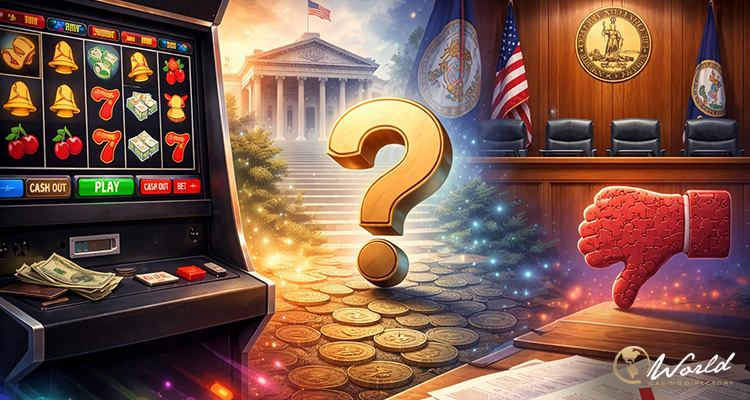
Virginia lawmakers revisited gambling policy this week as Senate subcommittees declined to advance proposals addressing both skill gaming machines and online casino gaming, signaling continued unease over expansion even as supporters argue regulation would replace inconsistent enforcement and unregulated play.
The debates unfolded Friday before the Senate General Laws and Technology Gaming Subcommittee, where members considered measures dealing with in-person skill game machines and digital casino platforms. While neither proposal received a favorable recommendation at this initial stage, both remain eligible for further consideration by the full committee in the coming days.
Skill game proposal advances despite subcommittee opposition
A bill sponsored by Sen. Aaron Rouse, a Democrat from Virginia Beach, sought to legalize and regulate skill gaming machines currently operating illegally across the state. The proposal would allow the machines in locations such as convenience stores and bars, cap the statewide total at 35,000 units, and impose an $800 monthly fee per machine. Individual wagers would be limited to $5.
“The reality is that skill games exist across the commonwealth now,” Rouse said before the subcommittee.
The panel voted 5–3 against recommending the bill, though it will still move to the full Committee on General Laws and Technology, likely without additional public testimony. Rouse framed the legislation as a response to an entrenched underground market that continues despite a Supreme Court ruling upholding Virginia’s 2020 ban. According to Rouse, roughly 90,000 illegal machines remain in operation, with enforcement varying widely across localities.
“Small businesses — especially convenience stores, restaurants, bars, truck stops — are operating within tighter margins every day,” he said according to The Virginian-Pilot. “Rising inflation and workforce challenges mean that supplemental income can be the difference between keeping the lights on and closing the doors.”
Supporters included trade groups representing machine operators and retailers, along with franchise owners. Speaking for 7-Eleven franchisees, Sukhi Sandhu said, “Our franchises want to operate in full compliance with the law, and we support clear rules and strong oversight.” Sandhu added that “for many neighborhood convenience stores often operated by immigrants working hard to earn a living and achieve the American dream, skilled games provide meaningful supplemental revenue that helps sustain jobs and community investments.”
Opposition came from organizations spanning ideological lines. Rhena Hicks of Freedom Virginia cited placement data from the brief period when skill games were legal, saying, “During their brief period of legalization between 2020 and 2021, 70% of these skill games were placed in ZIP codes with household incomes below the state median of $87,000.” She argued the system “enriches out-of-state corporations on the backs of hard-working Virginians falling victim to these predatory slot machines.”
Michael Huffman of the Virginia Assembly of Independent Baptists echoed concerns about social costs, saying the system delivers only “despair, debt and broken homes.”
Online casino bill stalls amid addiction and oversight concerns
Lawmakers also rejected an online casino gaming bill sponsored by Sen. Mamie Locke, a Democrat from Hampton. The measure, SB 118, failed on a 3–4 vote, with one abstention. The bill would have authorized digital slot, table, and poker games operated by third-party companies partnering with Virginia’s five existing casinos, potentially allowing up to 15 platforms statewide.
Locke argued regulation would acknowledge existing activity rather than ignore it. “We can sit here and clutch our moralistic pearls all we want to. But it’s already being done,” she said. “So we can keep it illegal. Or we can put up some guardrails.”
Supporters, including Caesars, Boyd Gaming, and the Sports Betting Alliance, said legal platforms would generate revenue and steer players away from unregulated providers. Opponents countered that constant smartphone access could intensify gambling addiction and questioned whether Virginia has sufficient regulatory infrastructure.
Brianne Doura-Schawohl of the Campaign for Fairer Gambling warned, “The societal negative impacts greatly outweigh any purported benefits.” She added, “Research is clear these are the single most addictive gambling products by about 10 times the rate. … Is this body prepared to turn every Virginian’s hand into a casino?”
Committee Chairman Jeremy McPike abstained but suggested the issue will return. “Appreciate the patron’s work, it is something that needs to be regulated, at some point. We gotta figure this out,” he said, adding that lawmakers need the “toughest and most stringent” protections.
Gaming commission bill gains traction as debates continue
While the two high-profile proposals stalled, senators unanimously advanced a separate bill creating a Virginia Gaming Commission. The body would eventually take over regulation from the Virginia Lottery, which currently oversees casinos and sportsbooks.
“I think it’s important to make it very clear that this bill does not authorize any new forms of gaming,” said Sen. Lashrecse Aird, a co-patron of the measure. “It is a clean, direct gaming commission bill.”
The fate of both the skill games and online casino bills now rests with the full General Laws and Technology Committee. Without majority support there, Virginia will again postpone decisions on whether to expand or formally regulate these forms of gambling during a short legislative session that ends March 14.
