

 United States
 Macau, China
 France
 Philippines
 Singapore
 Netherlands
 United Kingdom
 Canada
 Argentina
 Germany
 Estonia
 Peru
Peru Russia
 Australia
 South Africa
 Nigeria
 Malaysia
 Singapore
 India
India Finland
 China
China Ukraine
 Hong Kong
 Cyprus
 Turkey
 Greece
 Sweden
 South Korea
 Mexico
 Poland
 Ireland lottery results
 New Zealand lottery results
 Puerto Rico lottery results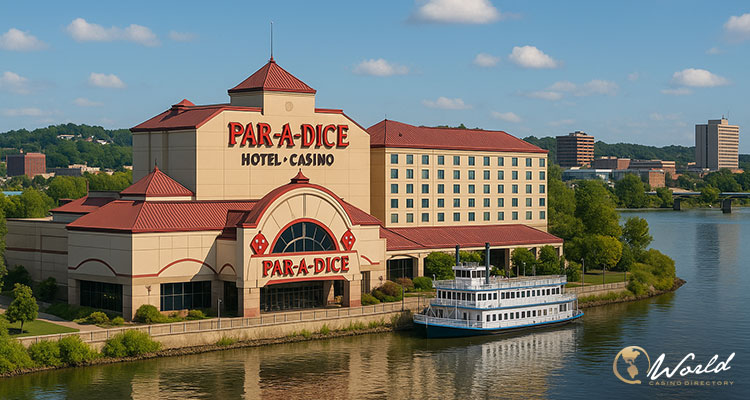
Boyd Gaming has formally presented plans to replace the Par-A-Dice Casino in East Peoria, Illinois, with a larger, modernized facility, outlining a $160 million project that would remain on the east side of the Illinois River while attempting to comply with long-standing legal constraints. The proposal was introduced Thursday, December 11, during a presentation to the Illinois Gaming Board, marking the first time many Peoria officials became aware of the company’s detailed intentions.
Casino design centers on riverboat interpretation
According to the materials shown to regulators, Boyd intends to remove the iconic riverboat and construct a permanent structure connected to the existing Par-A-Dice Hotel. The company refers to the project as a “riverboat modernization,” a term that reflects its effort to reconcile the new building with Illinois’ riverboat gaming framework. The replacement casino would expand gaming space to approximately 29,000 square feet and include a ballroom measuring about 20,500 square feet. New amenities outlined in the proposal include an upscale steakhouse and a gastropub.
A central element of the plan involves a 1,000-gallon manmade water basin positioned beneath the building’s concrete foundation. The basin would be filled with water drawn from the Illinois River, a design Boyd argues satisfies statutory language allowing riverboat gambling on waters within the state. The Illinois Gambling Act does not define how much water must be involved for a facility to qualify as a riverboat, a gap Boyd believes allows for this interpretation.
The proposed casino would be built against the existing Par-A-Dice Hotel, primarily along the hotel’s south-facing side. Boyd’s presentation to regulators described the structure as larger and more functional than the current riverboat, while remaining physically tied to the existing resort complex.
The announcement immediately reignited disagreements linked to a 1991 agreement between Peoria and East Peoria. That agreement established that water-based gaming would remain in East Peoria, while land-based casino operations would be located in Peoria. At the time, Illinois law did not allow land-based casinos, but that changed in 2019 when state lawmakers approved them.
Several Peoria City Council members said Boyd’s approach conflicts with both the agreement and state law. At-Large Councilman Zach Oyler stated, “My interpretation of the legality of it is that they are wrong, and it’s very unfortunate that they have tried to outmaneuver an agreement made decades ago by the two cities.” He later added, “There are sewers and pipes under homes, but no one says they are on the water. They are on land.”
Third District Councilman Tim Riggenbach questioned whether the proposal meets statutory intent. “The frustrating thing from my perspective is that we have an intergovernmental agreement, and we have a state statute that says that it is licensed in East Peoria but it must be on the Illinois River,” he said. “I don’t understand how you justify pumping water and call it the Illinois River.”
At-Large Councilman Mike Vespa also raised concerns, saying, “if words are to have any meaning, then this proposal is not a ‘riverboat’ on the ‘Illinois River’ as required by Section 10/6 of the Illinois Gambling Act.”
As reported by 25 News Now, City Manager Patrick Urich said Peoria officials learned of the plan only during the Illinois Gaming Board meeting. “We need time to digest this. It’s the first time we have seen the presentation, and we need some time to digest it,” he said.
Second District Councilman Alex Carmona described the plan as a technical maneuver rather than a good-faith effort. “Whether they’re going to put a water mattress in the basement or tubes with water in it from the Illinois River or whatever, it’s a technicality,” he said. “They know they’re screwing us, and so do we.”
East Peoria highlights economic impact and future investment
East Peoria officials offered a different perspective, emphasizing the casino’s regional economic contributions. Mayor John Kahl said during Boyd’s presentation that, “Both sides of the river have been the recipients of nearly $225 million in gaming revenue since the Par-A-Dice came to town.”
Kahl also praised Boyd Gaming and its workforce, stating, “I cannot say enough wonderful things about Boyd Gaming and the folks that work for Boyd Gaming. Not only has it enhanced our region, but they’ve also been a valued member of our business community here regionally.”
Boyd’s presentation indicated that Peoria alone has received $103 million in tax revenue since 1991. While Peoria and East Peoria split the 5% local share of state gaming taxes, East Peoria retains additional revenue tied to hotel operations, dining, entertainment, and events. Earlier this year, East Peoria established a Tax Increment Financing district around the Par-A-Dice campus, a move commonly used to encourage redevelopment and potentially support the proposed project.
The company also pointed to declining gaming revenue as a factor behind the modernization effort, with Par-A-Dice revenue dropping from $82.5 million in 2006 to $60.5 million last year. The current riverboat features 550 slot machines, 18 table games, and a FanDuel sportsbook, while the proposed facility would allow for expanded gaming capacity and additional amenities.
Peoria officials say discussions with Boyd are ongoing, and the Illinois Gaming Board is expected to revisit the proposal when it reconvenes in February.
