

 United States
 Macau, China
 France
 Philippines
 Singapore
 Netherlands
 United Kingdom
 Canada
 Argentina
 Germany
 Estonia
 Peru
Peru Russia
 Australia
 South Africa
 Nigeria
 Malaysia
 Singapore
 India
India Finland
 China
China Ukraine
 Hong Kong
 Cyprus
 Turkey
 Greece
 Sweden
 South Korea
 Mexico
 Poland
 Ireland lottery results
 New Zealand lottery results
 Puerto Rico lottery results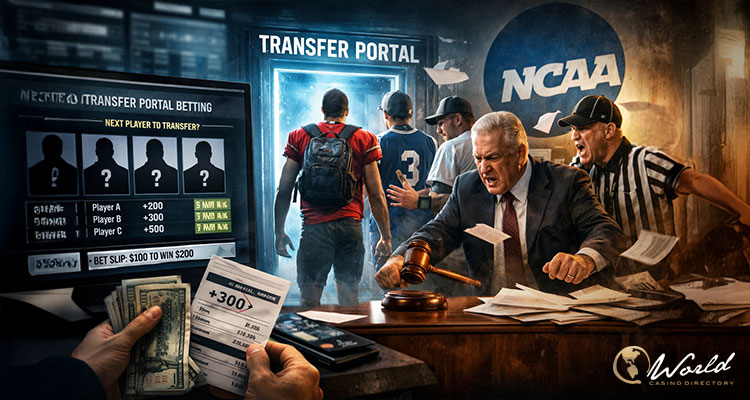
Kalshi’s decision to notify federal regulators that it intends to self-certify prediction markets tied to the NCAA transfer portal has triggered swift and forceful opposition from college sports officials, even as the company maintains that the filings do not guarantee the markets will appear for trading.
The Commodity Futures Trading Commission received Kalshi’s filings earlier this week for contracts that would allow users to trade on whether specific Division I football or basketball players enter or withdraw from the transfer portal within defined periods. Additional contracts would focus on whether a player transfers to a particular school. According to the filings, Kalshi stated that it could begin listing such markets as early as Dec. 17, though no transfer portal contracts were visible on the exchange as of Wednesday evening, according to InGame.
How Kalshi’s self-certification process works
Under CFTC rules, self-certification allows an exchange to list a new contract by informing the regulator and providing the applicable terms and safeguards. If the agency does not object by the stated listing date, the contract may be offered, even though it is not formally “approved.” This process accounts for nearly all contracts introduced on CFTC-regulated exchanges.
The CFTC retains the authority to initiate a 90-day public interest review if it finds cause for concern. However, that step has historically been rare. Earlier this year, Acting CFTC Chairman Caroline Pham noted that the agency has not rejected a self-certification during its 50-year history, and it has not opened a public interest review into any of the thousands of contracts self-certified in 2025.
Kalshi’s filings specify that transfer portal outcomes would be resolved using “public announcements,” including statements from players on social media, as well as communications from athletic departments, agents, recruiting services, or major sports media outlets. The rules also state that once a player announces entry into the portal, the contract settles as a “yes,” even if the athlete later decides to remain at their current school.
Strong response from NCAA leadership
NCAA President and CEO Charlie Baker responded publicly to the filings with a sharply worded statement posted to social media site X.
“The NCAA vehemently opposes college sports prediction markets,” Baker wrote. “It is already bad enough that student-athletes face harassment and abuse for lost bets on game performance, and now Kalshi wants to offer bets on their transfer decisions and status — this is absolutely unacceptable and would place even greater pressure on student-athletes while threatening competition integrity and recruiting processes. Their decisions and future should not be gambled with, especially in an unregulated marketplace that does not follow any rules of legitimate sports betting operators.”
Baker has consistently argued against college player prop betting, pointing to documented cases of athlete harassment and integrity risks. The NCAA has continued to investigate illicit wagering and insider information sharing, issuing penalties that have included lifetime bans from college sports in 2025.
Kalshi pushes back on immediate plans
Kalshi, for its part, emphasized that self-certification does not always lead to a market launch. In a statement shared on X before Baker’s comments, the company said, “We certify markets all the time that we do not end up listing.” The statement added, “We have no immediate plans to list these contracts. Like all markets on Kalshi, users with material nonpublic information would be prohibited from trading on potential transfer portal markets. We have in-house and third-party surveillance systems that monitor for suspicious activity and if necessary, we refer cases to the CFTC for enforcement.”
The exchange noted that it prohibits trading by individuals with inside knowledge and relies on internal monitoring along with third-party oversight from Integrity Compliance 360. If suspicious activity emerges, Kalshi says it refers cases to the CFTC.
Integrity concerns and enforcement questions
Despite those assurances, the proposed contracts have drawn scrutiny due to the breadth of people who might possess nonpublic information about transfers. Kalshi’s filings list extensive trading prohibitions, including the athletes themselves; coaches and athletic staff at the player’s school; agents, NIL representatives, and attorneys; NCAA employees with access to the portal database; and immediate family members of those groups.
However, enforcement remains opaque. Kalshi has previously declined to detail how it polices violations, and during unrelated court proceedings in Nevada, its attorneys said evidence of anti-manipulation measures is filed confidentially with regulators.
Prediction markets, unlike state-regulated sportsbooks, operate under federal oversight and are available nationwide. While traditional sportsbooks have avoided transfer portal wagers, prediction markets’ expansion into sports has raised alarms across college athletics and among some regulators. At a recent National Council of Legislators from Gaming States meeting, panelists warned that such markets pose risks to athlete well-being and competitive integrity.
In separate remarks last week, Baker summarized his broader concerns by saying prediction markets’ growth in sports “feels catastrophic.” He added, “This whole thing is going to get worse unless somebody does something about it. You’re basically talking about no rules, no oversight, no nothing. And that just feels catastrophic to me. Not just for us, but for everybody.”
As the January transfer portal window approaches, Kalshi’s filings have placed prediction markets and college sports governance on a collision course, even if the proposed contracts never reach the trading screen.
