

 United States
 Macau, China
 France
 Philippines
 Singapore
 Netherlands
 United Kingdom
 Canada
 Argentina
 Germany
 Estonia
 Peru
Peru Russia
 Australia
 South Africa
 Nigeria
 Malaysia
 Singapore
 India
India Finland
 China
China Ukraine
 Hong Kong
 Cyprus
 Turkey
 Greece
 Sweden
 South Korea
 Mexico
 Poland
 Ireland lottery results
 New Zealand lottery results
 Puerto Rico lottery results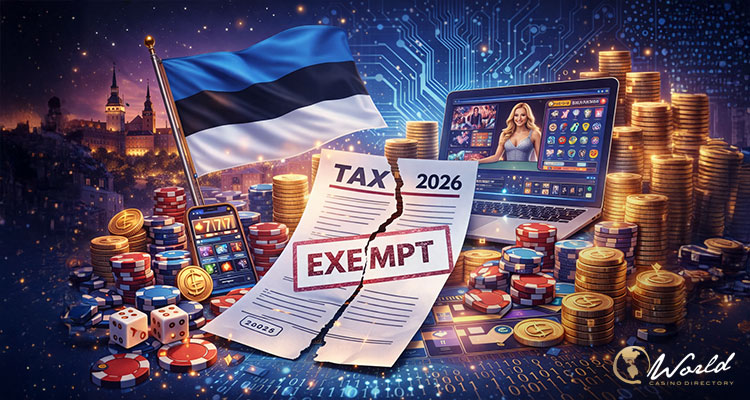
Estonia’s multi-year restructuring of gambling taxation has encountered an unexpected detour after officials confirmed that new legislation inadvertently excluded online casino operators from the country’s 2026 tax framework. A procedural error buried in legal phrasing temporarily categorized online casino activity under a different gambling type, resulting in a tax exemption that lawmakers describe as accidental rather than intentional.
Lawmakers Plan a Fast Fix
Floor discussions around the 2026 budget reforms revealed that remote gambling had been referred to as “skill games” in the final text. Under Estonian law, this designation applies to a separate category distinct from “games of chance,” which includes online casino play. The terminology shift opened a loophole that would have shielded online casinos from the tax system scheduled to apply from 2026 onward.
Committee members determined that the omission would have created a significant gap in the sector’s fiscal obligations had it not been caught. A legal counsel for an operator signaled the inconsistency to officials and emphasized that the legislature’s intent was unambiguous, noting that “the intent of the legislature is obvious — no one expected that games of chance would be untaxed. It’s universally understood to be a clerical error.”
Members of the Finance Committee confirmed that the correction will be implemented promptly and will not halt other planned measures tied to the 2026 budget cycle. MP Aivar Kokk stated that “games of chance and remote gambling were left out of this year’s taxation,” describing the development as a technical lapse.
ERR reports that Reform Party MP Nelly Akkermann explained that two procedural avenues are under consideration to amend the language. “One option is to attach the fix as an amendment to another bill. The other is to submit a separate bill to remove the word ‘skill games’ from the text,” she said. Akkermann added that the faster approach is likely to prevail due to the need to close the loophole quickly. “We’re more likely to go with the fastest option and bundle it with another bill,” she said.
Akkermann remarked that this was the first time in her decade-plus in parliament that such an issue had appeared in legislation she had sponsored. “No one noticed it. I personally read through the bill. Everyone read it — lawyers at the Ministry of Finance, our committee staff, members of parliament, all the way up to the president,” she said. She indicated that fixing the wording within weeks should prevent budget disruption and alleviate concerns about tax liabilities. “Absolutely,” she said when asked whether swift action would avoid financial fallout.
A Larger Reform Effort Remains on Track
The temporary loophole surfaced during a broader reform effort that alters Estonia’s taxation of gambling licences over a multi-year period. At the end of 2025, lawmakers approved a phased reduction in the gambling licence tax rate, dropping from 6% to 4% by 2028. The tax rate declines by half a percentage point per year, with 5.5% applying this year. The measure drew debate within the coalition formed by the Reform Party and Eesti 200 before ultimately receiving approval.
The tax adjustment is part of an economic pact negotiated between the coalition partners at the beginning of 2025 and originally championed by former Prime Minister Kaja Kallas as a tool to enhance competitiveness in IT-driven and digital industries. Her successor, Kristen Michal, has kept the strategy intact. The government emphasizes that the changes concern economic conditions for operators and do not constitute amendments to the Gambling Act or indicate new market liberalization.
Policymakers aim to establish a tax environment comparable to European jurisdictions already favored by international iGaming firms. Officials familiar with the effort point to Malta’s licensing ecosystem as a reference for Estonia’s intended position by 2028, echoing earlier achievements that helped attract crypto-focused businesses.
With legislative committees now working to resolve the tax wording glitch, officials say the underlying economic strategy remains unchanged. Closing the gap created by misplaced terminology is viewed as essential for maintaining confidence among operators that Estonia’s fiscal planning continues as intended, even as lawmakers confront the bookkeeping challenges that accompany complex regulatory adjustments.
