

 United States
 Macau, China
 France
 Philippines
 Singapore
 Netherlands
 United Kingdom
 Canada
 Argentina
 Germany
 Estonia
 Peru
Peru Russia
 Australia
 South Africa
 Nigeria
 Malaysia
 Singapore
 India
India Finland
 China
China Ukraine
 Hong Kong
 Cyprus
 Turkey
 Greece
 Sweden
 South Korea
 Mexico
 Poland
 Ireland lottery results
 New Zealand lottery results
 Puerto Rico lottery results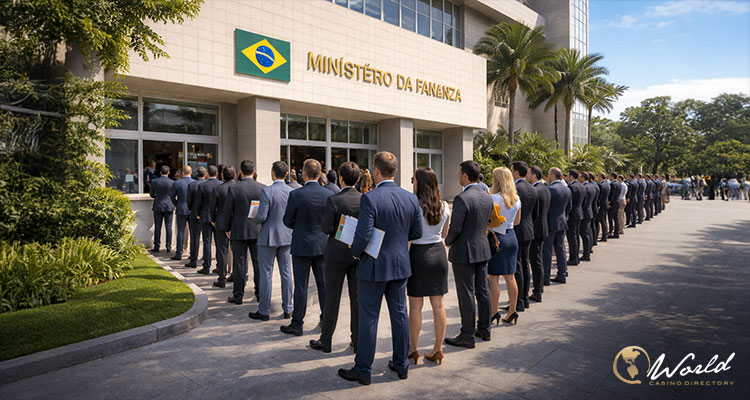
Brazil’s regulatory transformation of online betting has entered a new phase as the Ministry of Finance reviews 25 applications from companies seeking permission to operate legally in the country. The volume of requests reflects heightened interest in entering a market that has rapidly grown into a multi-billion-real segment of the digital economy.
Regulatory Structure and Financial Conditions for Operators
The licensing framework requires operators to demonstrate compliance across several regulatory categories before receiving authorization. Requirements include proof of financial capacity, proprietary technological infrastructure, mechanisms for anti-money laundering, and clear responsible gaming policies. The Secretariat of Prizes and Bets of the Ministry of Finance (SPA/MF) formalized these conditions through Ordinance SPA/MF No. 827, issued on May 21, 2024, which establishes rules for the commercial operation of the fixed-odds betting lottery modality across the national territory.
The process also includes a financial component: each authorized operator must pay a R$ 30 million concession fee for a five-year license. Officials argue that the fee supports state revenue goals, establishes operational credibility among licensees, and discourages participation by companies lacking sufficient structure. The legal basis for fixed-odds betting authorization is provided under Law 14.790 (articles 4 to 13), which assigns the Ministry of Finance responsibility for evaluating applications and supervising operator compliance.
Expanding Market Data Highlights Sector Scale
SPA/MF expects to issue the first authorizations by the end of the second half of 2024 but has not disclosed how long the full review process may take or how many companies will ultimately receive licenses. Operators that were already active when Law No. 14.790 entered into force in December 2023 have until the end of 2024 to obtain authorization. Beginning January 1, 2025, any company offering betting without approval will be subject to penalties defined in regulation.
Recent performance indicators illustrate the scope of Brazil’s regulated betting economy. In 2025, sports betting and online gaming generated an estimated gross revenue of R$ 36 billion. Analysts estimate a base of between 25 and 30 million active bettors — roughly 12% of the national population. Survey data from TIC.BR 2025 further details participation patterns, showing that one in five Brazilians over 18 placed bets online during the final three months of the year. According to the survey, participation reached 14% among women and 25% among men in that period, amounting to an estimated 32.5 million individuals engaging with online betting at least once in the quarter.
The TIC.BR study involves a national sample of nearly 25,000 in-person interviews conducted by Ipsos-Ipec. The methodology allows tracking across an annual historical series, reinforcing the credibility of findings related to bettor demographics. As reported by iGaming Brazil, the survey indicates that Brazilian bettors are predominantly men, young, urban, and have above-average education and income levels, underscoring the role of betting as a form of digital entertainment rather than a phenomenon concentrated among lower-income groups.
International comparisons also provide context for Brazil’s figures. In 2023, Las Vegas recorded 41 million visitors, with approximately 78% engaging in gambling, reaching a total of around 32 million players per year — a number comparable to Brazil’s domestic online betting engagement.
Government Oversight and Market Consolidation
The approval process is centralized within the Ministry of Finance, which retains oversight of compliance and enforcement. Operators must meet requirements in five categories: legal standing, tax and labor compliance, integrity, economic and financial qualification, and technical qualification. Authorized companies may manage up to three trademarks in Brazil and must maintain headquarters and customer service channels inside the country.
As regulation advances, the sector has transitioned away from informal practices toward formalization, tax collection, and consumer protections. At present, there are 82 authorized companies and 85 licenses for fixed-odds betting and online gaming, 82 regular and three via Federal Court decision, totaling 192 brands.
