

 United States
 Macau, China
 France
 Philippines
 Singapore
 Netherlands
 United Kingdom
 Canada
 Argentina
 Germany
 Estonia
 Peru
Peru Russia
 Australia
 South Africa
 Nigeria
 Malaysia
 Singapore
 India
India Finland
 China
China Ukraine
 Hong Kong
 Cyprus
 Turkey
 Greece
 Sweden
 South Korea
 Mexico
 Poland
 Ireland lottery results
 New Zealand lottery results
 Puerto Rico lottery results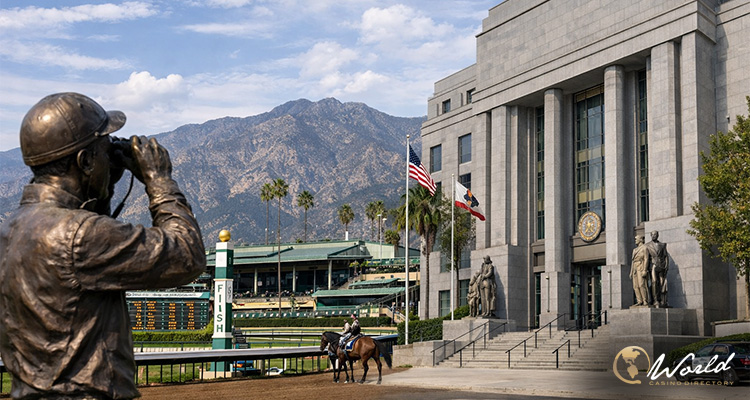
Santa Anita Park has taken its dispute with California law enforcement to court following the weekend seizure of 26 Racing On Demand betting machines from its grandstand. The racetrack’s operator, the Los Angeles Turf Club, filed a writ of mandate and civil complaint in Los Angeles Superior Court, asking a judge to block the destruction of the terminals and declare the wagering system behind them lawful under state law.
State Department of Justice officers removed the machines during live racing, wheeling them out of the facility in a highly visible operation. The terminals had been operating since Jan. 15 and allowed $1 bets on a pari-mutuel format that required players to select the first three finishers in three previously run six-horse races. In total, the machines were available to patrons for roughly two days before their confiscation.
Court filing challenges warrantless seizure
According to the lawsuit, DOJ agents carried out the seizure without a warrant and without citing a specific statute that the machines allegedly violated. The complaint states that 21 DOJ employees and two armed officers arrived at Santa Anita for what officials described as a surprise inspection. When track staff asked for a warrant, the suit claims officers said none was required.
In a “notice of intention to destroy machines and devices” dated Jan. 17, the DOJ warned Santa Anita that the terminals would be destroyed after 30 days unless a court intervened. The notice further states that any money seized alongside the machines would be transferred to the treasury of the city or county where the confiscation occurred. Santa Anita Park sits within the City of Arcadia.
The lawsuit describes the seizure as unconstitutional and argues that it damaged the business by taking place in full view of customers. The track also questioned why state officials opted for a raid rather than issuing a cease-and-desist notice.
Dispute centers on approved 3×3 wager
At the core of Santa Anita’s argument sits the 3×3 wager, also referred to as a triple trifecta. The bet requires a gambler to correctly identify the top three finishers across three races, producing pari-mutuel payouts. The California Horse Racing Board approved the wager in 2024, and Santa Anita says it has offered the same format for about 18 months on live racing.
In its filing, the track argues that delivering the wager through a self-service tote terminal and using previously run races does not change its legal status. According to Thoroughbred Daily News, the complaint states: “Neither the Attorney General’s office, nor the CHRB, ever disputed written legal analysis or stated that Santa Anita did not have the legal right to offer the 3X3 wager on concluded races.”
Santa Anita also emphasized that it communicated extensively with regulators before installing the machines. Court documents cite meetings with CHRB officials and representatives from Gov. Gavin Newsom’s office, including a Nov. 25 discussion with CHRB Executive Director Scott Chaney. Additional meetings occurred on Dec. 11 and Dec. 21, and the lawsuit claims no objections were raised during those conversations.
Legislative history cited in legal defense
The track’s legal position relies heavily on a 2006 opinion from the California Office of Legislative Counsel addressing Instant Racing, a form of wagering on completed races through specialized terminals. That opinion concluded that such machines would be “considered to be predominantly a game of skill, that the outcome is not made unpredictable by the operation of the machine, and, consequently, that the Instant Racing machines are no more slot machines than the machines currently used to place bets on live horse races.”
The same opinion also stated, “Additionally, because there is no requirement in the California Constitution that races be live or simultaneous to be considered horse races under subdivision (6) of Section 19 of Article IV, it is our view that the historic races used by the Instant Racing machines would be considered horse races that may be regulated by the Legislature… Accordingly, it is our opinion that the California Constitution permits the Legislature to authorize wagering on historical horse races using Instant Racing machines as described above.”
Santa Anita included that opinion as an exhibit and argued that California’s parimutuel wagering law does not limit betting to live or simulcast events. The California Constitution states, “The Legislature may provide for the regulation of horse races and horse race meetings and wagering on the results.”
The DOJ has taken the opposite view, classifying the Racing On Demand terminals as illegal slot machines and asserting that the racetrack qualified as an “open business with ongoing criminal activity,” which it says justified the warrantless seizure. Critics of historical horse racing machines share that position, while supporters argue the format remains pari-mutuel and essential to the sport’s financial stability.
Santa Anita’s lawsuit seeks a declaration that the 3×3 wager on both live and concluded races is legal, an injunction to prevent the destruction of the machines, and the return of the terminals and seized funds. Los Angeles Turf Club senior vice president Scott Daruty said the track hopes for swift judicial review given the 30-day destruction window.
