

 United States
 Macau, China
 France
 Philippines
 Singapore
 Netherlands
 United Kingdom
 Canada
 Argentina
 Germany
 Estonia
 Peru
Peru Russia
 Australia
 South Africa
 Nigeria
 Malaysia
 Singapore
 India
India Finland
 China
China Ukraine
 Hong Kong
 Cyprus
 Turkey
 Greece
 Sweden
 South Korea
 Mexico
 Poland
 Ireland lottery results
 New Zealand lottery results
 Puerto Rico lottery results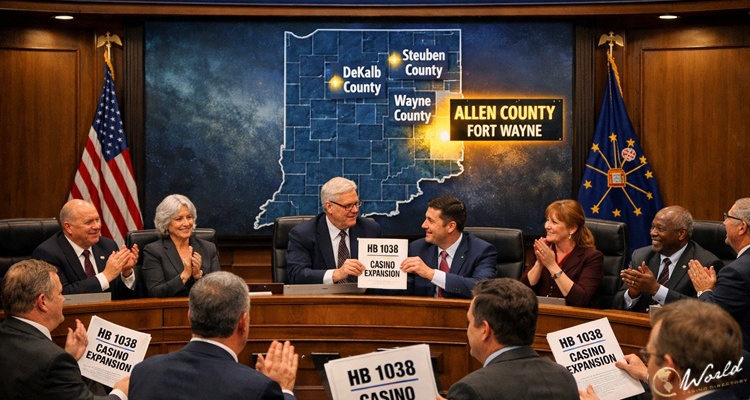
Indiana lawmakers are advancing a proposal that could shift one of the state’s existing casino licenses away from Ohio County and into a new inland market. An amendment to House Bill 1038, approved by the House Public Policy Committee, would allow the license now used for the riverboat casino in Rising Sun to be relocated to Allen, DeKalb, Steuben or Wayne counties instead of creating a new license.
Under the revised approach, the Ohio County riverboat license would be “put up for bid” among current casino owners. “The existing casino license, currently located in Rising Sun, will essentially be put up for bid … we can say we are not expanding gaming. We’re relocating an existing license through that competitive process,” Public Policy Chair Rep. Ethan Manning said when he outlined the amendment. The goal, supporters argue, is to open a new market without increasing the number of licenses in the state.
Applicants would need local backing to proceed. Any operator seeking to move the license into a particular county would have to secure formal support from the county commissioners and the mayor of the host city. For example, a project in Allen County would require sign-off from the Allen County Board of Commissioners and Fort Wayne Mayor Sharon Tucker before it could move forward.
Investment Rules, Payments and Licensing Timeline
The legislation sets strict financial and development conditions for any company that wins the bidding process. Prospective operators must commit to at least $500 million in investment for the casino and associated nongaming facilities, described in the text as “nongaming amenities onsite,” and must present a detailed development plan. At least 60% of that investment would need to occur in the initial phase of construction. The remaining spending and completion of the casino and amenities would have to take place no later than five years after gaming operations begin at the new site.
The Indiana Gaming Commission (IGC) would accept relocation applications beginning October 1, 2026. The commission would then release the applications and an informational summary to the public by January 15, 2027, and it would have to issue final approvals or denials on each bid by April 15, 2027.
Financial obligations are layered. The successful applicant would pay $50 million to the IGC, spread across five annual installments. In addition, the winning license holder would be required to make a $30 million payment to the City of Rising Sun and Ohio County to help offset the loss of local casino tax revenue.
State law would also require the IGC to hire an independent third-party consultant to determine the fair market value of the Ohio County license. If a company other than the current licensee secures the relocation, that operator would have to pay the fair market value to the present owner, Full House Resorts, which operates Rising Star Casino. If Full House itself wins the competitive process and relocates its own license, that payment would not apply. Separate fee provisions would govern any sale or transfer of the interest in the license within 10 years.
The bill allows the existing riverboat operation in Ohio County to continue until one day before the IGC authorizes the start of gambling at the new inland location.
Counties Pitch for a New Casino Destination
Rising Star Casino, located on the Ohio River, has seen attendance, workforce numbers and revenue fall in recent years, particularly after casinos opened in Ohio and gambling expanded in Kentucky. The proposed relocation framework gives counties in other parts of Indiana a chance to attract a major gaming development.
Steuben County officials were among the most vocal at the Public Policy Committee hearing. Steuben County Commissioners President Wil Howard told lawmakers that the county’s position in the far northeastern corner of the state, near both Michigan and Ohio, and its access to I-69 and the Indiana Toll Road make it a strong candidate. “We are uniquely, geographically located for a casino based on the history of where licenses have been located in the state,” he said. Howard also noted that, in the previous month, local leaders had rallied behind the prospect. “In the past month, we’ve gained a lot of ground in terms of community support and cohesion for Steuben County being included,” he told the committee, citing letters of support from the Angola mayor, local chambers of commerce and the county council.
Wayne County, anchored by the city of Richmond, has also signaled interest. State Rep. Brad Barrett spoke for supporters who see a casino as an economic opportunity between Indianapolis and Columbus, Ohio. He pointed to geography and community backing as core arguments in favor of bringing the relocated license to that part of eastern Indiana.
Allen County remains a central focus of the discussion. A separate study commissioned by local economic development officials examined the potential impact of a casino in the Fort Wayne area, and Greater Fort Wayne released that analysis in December. As reported by WANE 15, on the same day, Allen County Council held a public forum to gather feedback from residents. Mayor Sharon Tucker said at the time that the chance to host a casino was “too big to pass up,” while later emphasizing that her main priority is developing a shelter for people experiencing homelessness, since the casino decision lies with state lawmakers and regulators.
Impact on Rising Sun and Next Steps at the Statehouse
The proposed move raises concerns in the community that currently hosts the license. Representatives for Rising Sun and for Full House Resorts addressed the committee about what a departure would mean locally. They questioned how to prevent the current riverboat site from deteriorating and stressed the importance of managing the transition. Rising Sun’s city attorney argued that the $30 million compensation figure falls short of replacing the roughly $5 million a year in casino tax revenue that the city and county have received in recent years. He suggested tying future payments to a share of revenue from the new casino and called for specific provisions to guide the redevelopment of the riverfront property “to ensure an abandoned lot and riverboat aren’t the first thing you see when entering our city.”
Full House Resorts and the bill’s supporters said they have already started discussions with the Indiana Economic Development Corporation to address the future of the Rising Sun site if the license moves. The company also maintains that shifting the license away from southeast Indiana could ease competitive pressure in that region.
The broader debate includes questions about where a relocated casino would bring the most benefit statewide. An Indiana Gaming Commission study released in October concluded that the Indianapolis area would generate the highest tax revenue from a new casino, with northeast Indiana ranked next. However, the same report found that a casino in the Indianapolis region would likely erode business at existing casinos in Shelbyville and Anderson that support the state’s horse racing industry. Committee member Rep. Blake Johnson remarked, “That remains very difficult for me to square, based on the evidence as studies have consistently shown Indianapolis would be the most productive location for a casino,” while acknowledging the competing policy concerns.
The current bill does not authorize a casino in Indianapolis and instead centers on Allen, DeKalb, Steuben and Wayne counties. Local elected officials would have to endorse any project, but the proposal does not include a requirement for a local referendum, which had been part of earlier casino debates in Indiana.
The House Public Policy Committee advanced the amended bill on a 9-1 vote. The measure now moves to the House Ways and Means Committee, which will examine its fiscal implications under a tight deadline before it can proceed to a full House vote. In parallel, a separate Senate proposal that would directly allow Full House to relocate its casino to Allen County has stalled in the appropriations process.
House leaders have indicated they favor the relocation model over broader gambling expansions. “You’re talking about a major, hundreds of millions of dollars economic impact in northeast Indiana,” House Speaker Todd Huston told reporters, adding, “I think that’s different than somebody playing on their phone.”
