

 United States
 Macau, China
 France
 Philippines
 Singapore
 Netherlands
 United Kingdom
 Canada
 Argentina
 Germany
 Estonia
 Peru
Peru Russia
 Australia
 South Africa
 Nigeria
 Malaysia
 Singapore
 India
India Finland
 China
China Ukraine
 Hong Kong
 Cyprus
 Turkey
 Greece
 Sweden
 South Korea
 Mexico
 Poland
 Ireland lottery results
 New Zealand lottery results
 Puerto Rico lottery results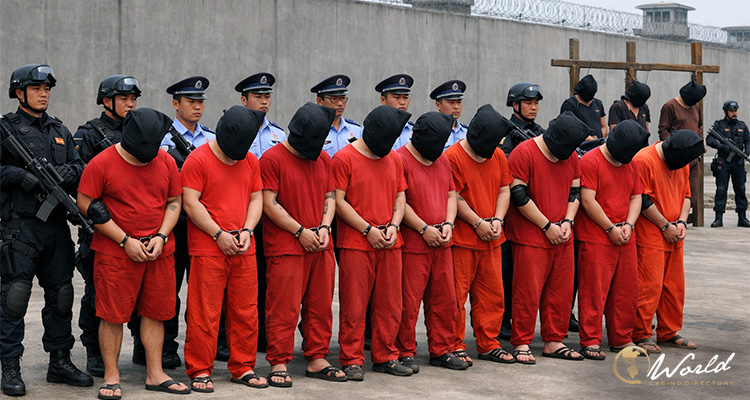
In a significant development, China has executed 11 people linked to organized crime operations based in Myanmar, marking the culmination of a years-long legal battle. These individuals, whose crimes spanned telecom fraud, human trafficking, and illegal gambling, were sentenced to death following a series of court hearings and appeals. The executions were confirmed by state media, underscoring China’s commitment to cracking down on international crime syndicates.
The convicted individuals were sentenced in September 2025 by a court in Wenzhou, Zhejiang Province, for a range of crimes including homicide, fraud, and operating gambling dens. These activities were primarily associated with criminal gangs that had set up bases in northern Myanmar, an area known for its lawlessness and its central role in illicit activities. In particular, the criminal groups involved had operated large-scale telecom fraud schemes, extracting billions from victims across the globe, many of whom were tricked into fake romantic relationships or fraudulent investment opportunities. The crimes had resulted in the deaths of 14 Chinese citizens, with several others sustaining injuries due to assaults and illegal detentions.
Ming Family’s Role in the Global Scam Network
The convicted individuals included key members of the infamous Ming family criminal group, which had exerted considerable control over the Laukkaing area, a key border town. The Ming family’s operations were not limited to fraud; they also ran gambling establishments that attracted victims, many of whom were trafficked into the region. Over the years, the family’s activities generated an estimated CNY 10 billion (approximately $1.4 billion), making them one of the largest players in Southeast Asia’s criminal underworld.
As reported by Xinhua, the execution of these criminals comes after a lengthy legal process, with their appeal against the death sentence being rejected by the Higher People’s Court of Zhejiang Province in November 2025. This ruling was then submitted for review by the Supreme People’s Court (SPC), which ultimately approved the sentences. According to Chinese officials, the executions were necessary to serve as a warning to other criminal enterprises operating along the China–Myanmar border.
Broader Crackdown on Southeast Asian Scam Centers
This latest move is part of China’s broader crackdown on telecom fraud and online gambling operations that have flourished in the border regions of Myanmar, Laos, and Cambodia. These scams, often dubbed “pig-butchering,” target victims globally, especially in the West, and have been responsible for an estimated $40 billion in stolen funds annually. Chinese authorities have ramped up their efforts to curb the illegal trade, increasing cooperation with Southeast Asian countries, including Myanmar and Thailand, to shut down these operations.
The involvement of trafficked individuals, many of whom are forced into working in online scam centers under duress, has drawn widespread international criticism. The United Nations estimates that hundreds of thousands of individuals are working in these centers across Southeast Asia, often under coercion. Many of these workers are recruited from vulnerable populations and are subjected to grueling conditions while operating sophisticated online scams.
In Myanmar, where instability and armed conflict have created a fertile ground for illicit businesses, the government has faced criticism for not doing enough to tackle these operations. However, in recent months, Myanmar’s military government has intensified its efforts to raid scam centers, partly due to pressure from China. These raids, while significant, have been criticized as propaganda efforts meant to placate international pressure without making substantial changes to the underlying issues.
The United Nations Office on Drugs and Crime (UNODC) has warned that the expansion of these online scam centers is a growing global concern. In response to the UN’s findings, countries like the United States and the United Kingdom have imposed sanctions on several organizations tied to the scam industry, including the Prince Group, which operates across Cambodia and Myanmar.
Despite the crackdown, the illegal telecom fraud and gambling operations continue to thrive in the region, raising questions about the effectiveness of the measures taken by both national governments and international bodies.
