

 United States
 Macau, China
 France
 Philippines
 Singapore
 Netherlands
 United Kingdom
 Canada
 Argentina
 Germany
 Estonia
 Peru
Peru Russia
 Australia
 South Africa
 Nigeria
 Malaysia
 Singapore
 India
India Finland
 China
China Ukraine
 Hong Kong
 Cyprus
 Turkey
 Greece
 Sweden
 South Korea
 Mexico
 Poland
 Ireland lottery results
 New Zealand lottery results
 Puerto Rico lottery results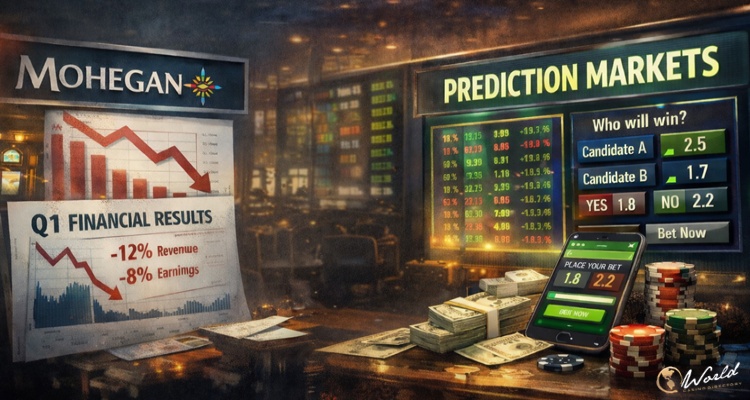
The Mohegan Tribal Gaming Authority confirmed support for Connecticut officials pursuing action against prediction market platforms that executives say interfere with tribal gaming rights. Company leadership discussed the issue while presenting quarterly financial results that reflected a reported profit largely linked to accounting factors rather than operational performance. Tribal representatives and industry groups also raised broader concerns about prediction markets and sweepstakes-style gaming across the United States.
Executives described prediction market activity as a regulatory concern because these platforms allow users to trade contracts tied to real-world outcomes such as sports results. Authorities in Connecticut have already taken enforcement steps. The state Department of Consumer Protection Gaming Division sent cease-and-desist letters in December to KalshiEX LLC, Robinhood Derivatives LLC and Crypto.com, instructing them to stop offering what regulators characterized as illegal sports wagering.
Tribal Gaming Exclusivity And Regulatory Response
During a company earnings discussion, Mohegan Chief Financial Officer Ari Glazer addressed the issue directly. “I think the two Connecticut-based Native American tribes have exclusivity on all forms of gaming in Connecticut, and we are actively working with all of the Connecticut constituents and regulators and government to ensure that that is the case,” Glazer said.
He expanded on that position in separate remarks. “The two Connecticut-based Native American tribes have exclusivity on all forms of gaming in Connecticut, and we are actively working with all of the Connecticut constituents and regulators and government to ensure that that is the case. Sports related event contracts are gambling, plain and simple. I think there is no debate. The state of Connecticut has sent cease and desist letters to the predictive event contract operators. There was a hearing as recently as yesterday as the state of Connecticut. So today, the state is pursuing legal action, and of course, we’re supportive of that.”
In a written statement, tribal officials emphasized cooperation with state authorities. “The Mohegan Tribe deeply values our longstanding partnership with the State of Connecticut, which, through our tribal compact, has contributed billions in revenue and established a stable, regulated gaming market which prioritizes consumer protection and industry integrity,” the tribe said. “We stand with Attorney General Tong and the State of Connecticut in their litigation against predictive markets to ensure full compliance with state law and the Indian Gaming Regulatory Act.”
Connecticut lawmakers have also proposed legislation aimed at limiting prediction market access by minors. The proposal includes civil penalties of up to $50,000 for violations and calls for research into the potential impact of such platforms on problem gambling and licensed operator revenue.
Financial Results And Operating Conditions
Mohegan reported net income of $108.5 million for the quarter ending Dec. 31, compared with a net loss of $85.9 million during the same period a year earlier. A $102 million non-cash accounting gain tied to discontinued operations in South Korea drove most of the improvement after Bain Capital assumed control of the Mohegan INSPIRE project earlier in the year.
When analysts removed that one-time gain, results appeared largely flat. Domestic resort revenue declined 3.9% to $300 million, reflecting fewer arena events and comparisons to a prior year period that included unusually strong table performance. Operating cash flow remained limited.
As reported by the Hartford Business Journal, Kim Noland, an analyst following the company, assessed performance in a research note. “The company’s flagship Mohegan Sun Connecticut and the Poconos Pennsylvania casino both continue to report lackluster operations in the first fiscal quarter,” Noland wrote, calling the results “uninspiring.”
Mohegan Digital delivered stronger numbers, posting revenue growth of 35.9% to $72.2 million. Connecticut operations drove much of that increase, with gross gaming revenue rising 33.5%. Analysts noted recent debt restructuring agreements provided the company with flexibility to use cash flow from both digital and land-based operations to reduce obligations.
Glazer also referenced operational metrics during the earnings discussion. “Adjusted EBITDAR of $95.3m increased 2.4 per cent on flat net revenues. Results were largely driven by Mohegan Digital delivering its strongest quarterly performance to date. Adjusted EBITDA of $86.4m decreased $3.1m, as the prior year comparable period benefitted from favorable table hold at Mohegan Sun and a one-time property tax adjustment at Niagara Resorts. After normalizing for these factors, Adjusted EBITDA would have been up $4.8m, or 5.9 per cent,” said Glazer.
Wider Tribal Industry Concerns
Industry organizations also highlighted prediction markets as a broader policy issue. Indian Gaming Association Chairman David Bean addressed tribal leaders in Washington, D.C., emphasizing economic contributions from tribal gaming and potential risks from emerging platforms.
“I know I cannot fill those shoes,” Bean said. “There will never be another Ernie Stevens Jr. I simply want to walk in his footsteps, as he walked in the footsteps of his elders and ancestors, and carry on that important task of protecting tribal sovereignty and promoting economic self-sufficiency.”
He continued outlining industry stability. “Our goal in traveling throughout Indian Country is to give assurance to our member tribes that the same team remains, the same mission remains, and we continue this work together.”
Bean highlighted industry scale using recent federal data. “Indian gaming remains the most successful economic development tool ever employed by tribal governments,” Bean said. “It provides a consistent and stable source of revenue that supports our communities, our elders, and our youth.”
He described prediction market expansion as a policy challenge. “Tribes and states are distinct sovereigns,” Bean said. “They should be deciding gambling public policy, not foreign companies exploiting loopholes in new technology.”
Bean also warned about potential product evolution. “Nothing could be further from the truth,” Bean said. “These are gambling products and the next step will be casino-style games, if we do not act.”
He concluded with a message about collective advocacy. “We must move like a canoe society. We cannot move forward unless we are paddling in the same direction. Whether the waters are smooth or rough, we keep paddling together.”
