

 United States
 Macau, China
 France
 Philippines
 Singapore
 Netherlands
 United Kingdom
 Canada
 Argentina
 Germany
 Estonia
 Peru
Peru Russia
 Australia
 South Africa
 Nigeria
 Malaysia
 Singapore
 India
India Finland
 China
China Ukraine
 Hong Kong
 Cyprus
 Turkey
 Greece
 Sweden
 South Korea
 Mexico
 Poland
 Ireland lottery results
 New Zealand lottery results
 Puerto Rico lottery results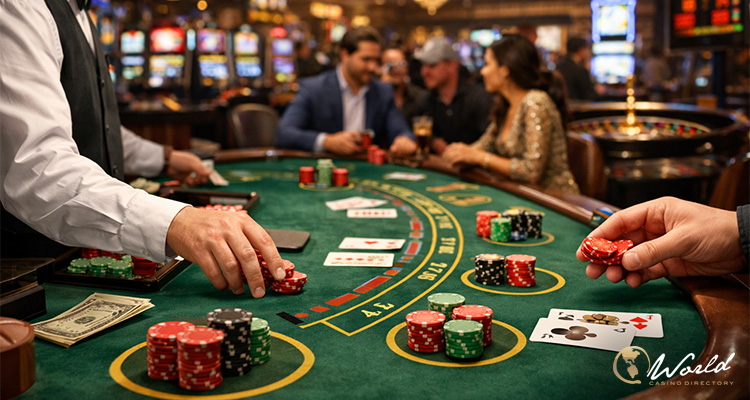
Illinois Governor JB Pritzker has proposed a sweeping change to how most casinos in the state pay taxes on table games, placing the issue of gaming revenue back at the center of budget talks in Springfield. The plan forms part of his $57 billion fiscal year 2027 budget, which seeks to raise $589 million through tax changes across Illinois.
Of that amount, the administration projects $120 million in new annual revenue from adjustments tied to table games and electronic gambling devices. The proposal arrives after lawmakers spent recent sessions debating sports betting taxes and other gambling-related measures.
Proposal Would Align Table Games With Slot Tax Rates
Under current law, table games at 15 of Illinois’ 16 casinos are taxed at 15 percent on adjusted gross revenue up to $25 million. Revenue above that threshold is taxed at 20 percent. That structure, established in 2020, caps the table game rate at 20 percent regardless of how much revenue a property generates.
Slot machines and other electronic gaming devices operate under a steeper graduated scale. The existing slot tax tiers apply as follows:
- 15 percent on the first $25 million
- 22.5 percent on $25 million to $50 million
- 27.5 percent on $50 million to $75 million
- 32.5 percent on $75 million to $100 million
- 37.5 percent on $100 million to $150 million
- 45 percent on $150 million to $200 million
- 50 percent on revenue above $200 million
Pritzker’s budget would require table games to follow that same progressive schedule, lifting the potential top rate from 20 percent to 50 percent for high-performing properties. The change would apply to non-Chicago casinos. Chicago’s casino operates under its own structure that includes separate city taxes and a distinct graduated system.
State budget documents frame the shift as a correction to disparities between different forms of casino gambling. “Over the years, the state and units of local government have received lower revenues from casinos, creating gaps in funding or forcing shifts in resources from other causes,” reads Pritzker’s budget proposal according to SBC Americas.
Illinois casinos outside Chicago also collect a per-person admissions tax, generally $3 per entry, with Bally’s Quad Cities Casino charging $2. In addition to table games and slots, operators generate revenue from video gaming terminals and sports wagering.
Gaming Revenue Remains a Budget Lever
Lawmakers have frequently turned to gambling when addressing fiscal shortfalls. Illinois faces a projected budget gap of about $2.2 billion, and the governor’s plan relies on targeted revenue adjustments rather than broad-based tax increases.
The state’s gaming sector recently recorded a record year, underscoring its growing role in public finance. Table games such as blackjack, baccarat, roulette, and craps provide a steady stream of revenue for brick-and-mortar casinos. Budget writers view that stability as a predictable funding source.
Industry representatives have cautioned that higher rates can affect operational decisions. They argue that additional tax pressure may influence reinvestment plans, capital improvements, hiring, and promotional spending. Illinois casinos compete with properties in Indiana, Missouri, and Iowa, making tax policy a factor in regional competition.
The proposal does not introduce major new sports betting taxes. That marks a departure from 2024, when Illinois adopted a sliding tax scale for licensed sportsbooks. Under that framework, operators pay 20 percent on the first $30 million in revenue, 25 percent on $30 million to $50 million, 30 percent on $50 million to $100 million, 35 percent on $100 million to $200 million, and 40 percent on revenue above $200 million.
The state later enacted a per-wager tax requiring online sportsbooks to pay 25 cents per bet, increasing to 50 cents after the first 20 million wagers accepted annually. In Chicago, sportsbooks also face a 10.25 percent local tax approved under Mayor Brandon Johnson’s budget. Separate legislative proposals have sought to repeal the per-wager tax and block Chicago’s city-level levy.
Regulatory Overhaul Included in Budget
Beyond tax adjustments, the governor’s budget outlines structural changes to gaming oversight. The plan would combine the Illinois Gaming Board and the Illinois Racing Board into a new Department of Gaming Regulation and Enforcement.
The proposed agency would “assume all the powers and responsibilities” of the two current regulators. It would oversee tax collection from sports betting, casino gambling, video gaming, horse racing, and off-track wagering. The department would operate under an executive director with two assistant directors. If lawmakers approve the measure, the merger would take effect July 1, the start of the new fiscal year.
The administration has directed additional revenue from the revised casino tax structure to the Education Assistance Fund, which supports grants and financial aid programs.
The FY2027 budget must move through the legislative process before any of these changes become law. Lawmakers can amend or reject provisions as negotiations continue. Casino operators and industry stakeholders are monitoring the debate closely as Illinois weighs how much more it expects from one of the Midwest’s largest gambling markets.
