

 United States
 Macau, China
 France
 Philippines
 Singapore
 Netherlands
 United Kingdom
 Canada
 Argentina
 Germany
 Estonia
 Peru
Peru Russia
 Australia
 South Africa
 Nigeria
 Malaysia
 Singapore
 India
India Finland
 China
China Ukraine
 Hong Kong
 Cyprus
 Turkey
 Greece
 Sweden
 South Korea
 Mexico
 Poland
 Ireland lottery results
 New Zealand lottery results
 Puerto Rico lottery results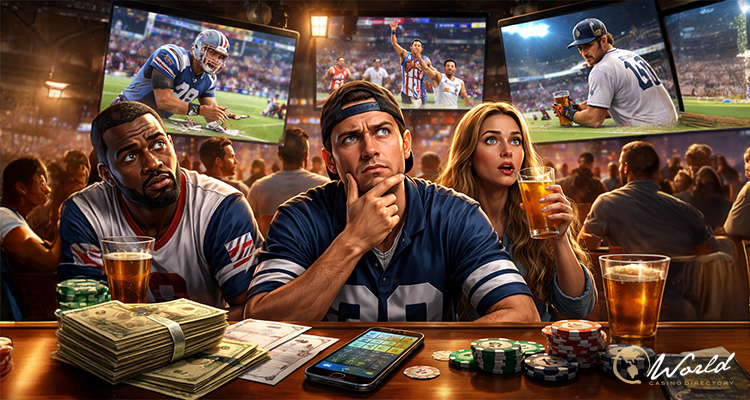
A new national survey indicates that many Americans question whether professional athletes always compete without outside influence, even as sports betting continues to grow across the country.
The Deseret News/Hinckley Institute of Politics poll found that 50% of respondents believe current professional athletes “sometimes” or “often” perform at a pre-determined level to benefit sports gamblers. In contrast, 31% said such actions rarely or never occur, and 18% reported that they were unsure.
Morning Consult conducted the survey of 2,002 registered voters from Feb. 10–13, with a margin of error of plus or minus 2 percentage points.
Generational Divide Emerges in Betting and Beliefs
The survey highlights differences among age groups, both in wagering activity and in perceptions of sports integrity. Overall, 28% of Americans said they have placed a bet on a sporting event using a sportsbook, online platform, or mobile app, while 70% said they have not, according to The Closing Line.
Younger adults reported higher participation rates. Among millennials, 44% said they had bet on sports, and 40% of Gen Z respondents said the same. By comparison, 15% of baby boomers reported placing a sports wager. Men were twice as likely as women to say they had bet on sports.
Suspicion about athlete conduct also ran higher among younger and middle-aged respondents. More than half of millennials, Gen Zers, and Gen Xers said they believe athletes sometimes or often adjust their play to influence betting outcomes. Even so, these same generations are the most active participants in sports gambling.
Attitudes toward the broader impact of gambling on sports vary as well. Nationwide, 41% of respondents said the increased availability of online betting has been bad for sports. Thirty percent described its effect as neutral, and 16% said it has been good. Age again shaped opinion: nearly three in five baby boomers viewed gambling as harmful to sports, while less than one-third of millennials and Gen Zers agreed.
Betting Expansion Since 2018
Sports wagering has expanded rapidly since the Supreme Court struck down a federal ban in 2018. At least 40 states, along with the District of Columbia and Puerto Rico, now permit commercial sports betting in some capacity. Of those, 32 allow wagers through smartphone apps or websites.
Major sporting events feature prominent advertising from sportsbooks such as DraftKings and FanDuel, both of which maintain partnerships with professional leagues and television networks.
The American Gaming Association estimates that Americans wagered $27.6 billion on the NFL and nearly $150 billion across all sports in 2024. The group projected that 42.7 million adults planned to place a traditional sports bet on the Super Bowl in 2024, up from 30 million the previous year. For Super Bowl LX, the association estimated $1.76 billion in legal wagers, excluding bets placed through offshore sportsbooks or prediction markets.
Prediction market platforms have also entered the sports space. Kalshi reported more than $1 billion in trading volume on Super Bowl Sunday, marking a record daily high and a 2,700% year-over-year increase.
Scandals Add to Public Concern
Recent investigations across professional sports have added to public scrutiny. The National Basketball Association has pursued cases involving Terry Rozier and Chauncey Billups, both of whom were charged with crimes following investigations. The league is also examining allegations involving Malik Beasley.
In baseball, Major League Baseball players Luis Ortiz and Emmanuel Clase were accused of manipulating pitch outcomes to assist bettors in winning more than $460,000. Both players were placed on non-disciplinary leave in July 2025 and are scheduled to stand trial.
College and professional basketball, along with professional baseball, have seen dozens of athletes face criminal charges in recent months over accusations such as point shaving or altering play to affect game results.
Despite these cases, sportsbooks continue to report record revenues and rising hold percentages, reflecting sustained consumer demand.
Utah Reflects National Trends
Morning Consult also surveyed 769 registered voters in Utah from Feb. 11–14, with a margin of error of plus or minus 4 percentage points. Although Utah prohibits all forms of gambling, about three in 10 Utahns said they have placed a sports bet using a sportsbook, online platform, or mobile app, mirroring the national figure.
Half of Utah voters said they believe professional athletes sometimes or often adjust their performance to help bettors win, while 30% said that rarely or never happens and 20% said they did not know.
Utah lawmakers are considering legislation to expand prohibitions to include proposition bets, which involve wagers on specific in-game events. Gov. Spencer Cox has also voiced opposition to prediction markets and said he would challenge them in court, calling them “gambling — pure and simple.”
In Utah, 46% of respondents said the wider availability of online gambling has been bad for sports, 31% called it neutral, and 13% said it has been good. Among baby boomers in the state, 65% described sports gambling as harmful to the game, compared with 35% of Gen Z voters.
As legal wagering options expand and betting-related investigations continue, the poll results suggest that skepticism about the integrity of professional sports remains widespread.
