

 United States
 Macau, China
 France
 Philippines
 Singapore
 Netherlands
 United Kingdom
 Canada
 Argentina
 Germany
 Estonia
 Peru
Peru Russia
 Australia
 South Africa
 Nigeria
 Malaysia
 Singapore
 India
India Finland
 China
China Ukraine
 Hong Kong
 Cyprus
 Turkey
 Greece
 Sweden
 South Korea
 Mexico
 Poland
 Ireland lottery results
 New Zealand lottery results
 Puerto Rico lottery results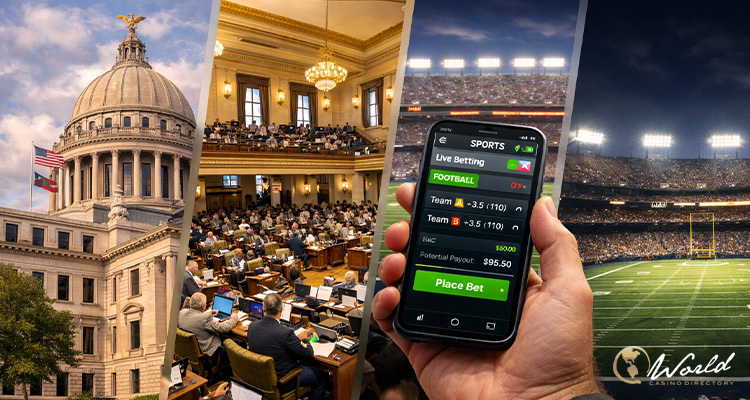
The Mississippi House of Representatives approved new legislation allowing mobile sports wagering, sending the proposal to the Senate after a strong 100 to 11 vote. The measure, known as the “Mississippi Mobile Sports Wagering Act,” aims to reshape how sports betting operates across the state while balancing public revenue goals and casino industry concerns.
Supporters project that online sports betting could generate nearly $100 million annually if lawmakers approve the bill. State Rep. Casey Eure, who chairs the House Gaming Committee, said during debate that “Mobile [sports betting] at 22% is projected to bring in $100 million per year.” He added that tax adjustments would help physical casinos remain competitive. Eure explained that reduced gaming taxes would allow casinos to “reinvest in their properties, give employees pay raises, do things they need to do to keep them up and going to stay competitive in our market.” However, The Greenwood Commonwealth wrote that he clarified that such reinvestment would remain optional for casino operators.
The proposal changes the state’s taxation structure. Mobile wagering would be taxed at 22%, an increase from the prior 18.5% rate applied to in-person sportsbooks. Meanwhile, the general gaming tax for brick-and-mortar casinos would fall from 8% to 6%, producing roughly a $48 million annual tax reduction for casino businesses. Local taxes collected at 4% would stay unchanged. Lawmakers designed the change partly to align Mississippi’s online betting tax level with national averages.
Funding Retirement Systems Through Gaming Revenue
A key component of the bill directs gaming revenue toward public pension funding. Officials expect about $50 million each year to go to the Public Employees Retirement System, or PERS, over the next decade. Eure described this funding stream as “free money that’s not coming out of our budget now that we’ll get off of mobile sports betting.”
State projections were influenced by neighboring states’ gaming performance. Eure noted that Tennessee produced $125 million in mobile sports betting revenue last year, while Louisiana generated $102 million. After consulting with the state Gaming Commission, lawmakers estimated Mississippi could reach about $100 million annually under the proposed tax structure.
The legislation also represents the third consecutive year the House has approved online sports wagering legislation. Previous attempts failed to clear the Senate, reflecting continuing political disagreements over gambling expansion.
Online Betting Rules and Consumer Protection Measures
The new framework establishes strict operational rules for digital betting platforms. Each of Mississippi’s 26 casinos may partner with one online sportsbook operator, a change from earlier drafts that allowed partnerships with up to two operators. Platforms must secure manufacturer and distributor licenses from the Mississippi Gaming Commission before operating.
The bill also includes consumer safety provisions. Online betting is limited to individuals physically located inside Mississippi state boundaries through geofencing technology. Participants must be at least 21 years old, and platforms must enforce age verification procedures. Operators are also required to maintain responsible gaming programs with automated behavior monitoring, phased intervention systems, and access to professional counseling resources.
Regulators must also establish a statewide start date for online wagering services, with a deadline set no later than December 8, 2026.
Competing Interests Between Online Platforms and Casinos
Political and industry resistance has slowed prior efforts to legalize online sports wagering. Some lawmakers and regional casino operators worry that mobile gambling could pull customers away from physical gambling locations.
Senator David Blount, who chairs the Senate Gaming Commission, previously expressed skepticism about online betting expansion. He argued that gambling policy in Mississippi should focus on economic development objectives. “The reason we have gaming in Mississippi is to encourage investment, to create jobs and to grow tourism to bring other people from other places to Mississippi,” Blount said. He further stated, “Mobile sports betting doesn’t do that.”
Blount has also said he would not support online gambling legislation without formal requests from the Mississippi Gaming Commission. He believes revenue gains alone do not justify expanding gambling access.
At the same time, industry stakeholders argue that the bill protects smaller casino businesses from large national competitors entering the state’s gaming market. Supporters claim the reduced tax burden would help local operators maintain profitability while adapting to digital competition.
Criminal and Sweepstakes Gambling Restrictions
Separate legislation also advanced through the state legislature addressing illegal online gambling. Senate Bill 2104 passed unanimously in the Senate by a 52-0 vote. The measure strengthens criminal penalties for unauthorized digital gambling activities.
The bill modifies Mississippi Code Sections 97-33-1 and 97-33-7 to explicitly include digital gaming forms within existing gambling prohibitions. Lawmakers also reclassified online gambling systems as illegal gaming devices. Enforcement penalties are severe. Operating illegal online betting services could result in felony charges, fines up to $100,000, and prison sentences reaching 10 years.
Authorities may also seize assets connected to illegal gambling operations. Prosecutors can file charges either in the county where violations occurred or in Hinds County.
The legislation also targets internet sweepstakes casinos and similar gambling-style online platforms. However, the law provides protection for telecommunications and technology providers that only transmit or display gambling content without directly handling wagers.
Future Outlook for Mississippi Gaming Policy
Both gambling bills must still clear the Senate and receive executive approval before becoming law. Despite strong House support, previous online sports betting proposals have struggled to advance in the Senate due to concerns about casino industry stability and economic impacts.
If approved, the legislation would represent a major shift in Mississippi’s gambling landscape, expanding online betting access while simultaneously strengthening restrictions on unauthorized digital gambling. Lawmakers designed the policy to generate state revenue while maintaining protections for traditional casinos and public retirement funding programs.
