

 United States
 Macau, China
 France
 Philippines
 Singapore
 Netherlands
 United Kingdom
 Canada
 Argentina
 Germany
 Estonia
 Peru
Peru Russia
 Australia
 South Africa
 Nigeria
 Malaysia
 Singapore
 India
India Finland
 China
China Ukraine
 Hong Kong
 Cyprus
 Turkey
 Greece
 Sweden
 South Korea
 Mexico
 Poland
 Ireland lottery results
 New Zealand lottery results
 Puerto Rico lottery results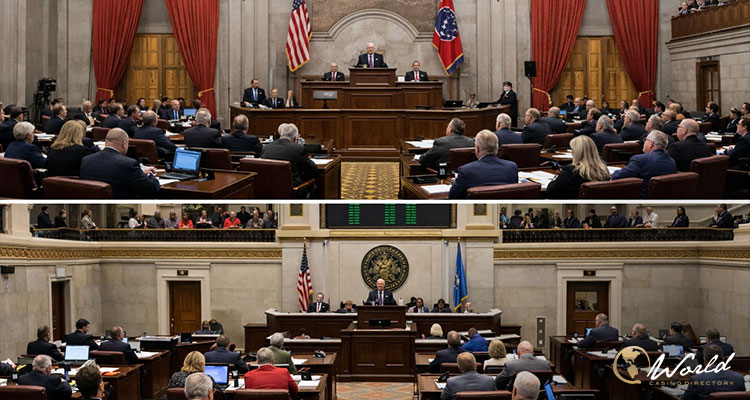
Lawmakers in Tennessee and Oklahoma have taken formal steps to restrict sweepstakes casinos, advancing legislation that would classify certain dual-currency online gaming models as illegal gambling. The measures, each approved unanimously in their respective senates, now head to the House chambers for further consideration.
The votes come as part of mounting activity across several states aimed at addressing unregulated online casino-style platforms that operate outside existing gambling frameworks.
Tennessee Senate Frames Sweepstakes as Consumer Protection Issue
In Tennessee, senators voted 32-0 to approve Senate Bill 2136, sponsored by Sen. Ferrell Haile. The proposal amends the Tennessee Consumer Protection Act to address what Haile described as “growing concerns about illegal online gambling in our state.”
The legislation defines an online sweepstakes game as gambling conducted through the internet that: “Utilizes a virtual-currency system allowing a player to… Exchange the currency for a prize, award, cash, or cash equivalent, or the chance to win a prize, award, cash, or cash equivalent.”
It further states: “Gambling; the operation or possession of gambling devices; and the operation, conducting, or commercial promoting of online sweepstakes games and other forms of online or app-based gambling are unlawful and are offenses against the public health, safety, and welfare of this state.”
By categorizing violations as unfair or deceptive acts under consumer protection law, the bill grants the Tennessee attorney general authority to pursue investigations and enforcement actions against operators. Attorney General Jonathan Skrmetti has already targeted sweepstakes platforms. In late December 2025, his office sent cease-and-desist letters to nearly 40 online sweepstakes casinos operating in the state, prompting many major companies to withdraw.
The measure also describes covered activity as including “gambling of any kind, including, but not limited to, casino-style gaming such as slot machines, video poker, table games, lottery games, bingo, or unlicensed sports wagering,” when offered through virtual currency systems that can later be redeemed for “a prize, award, cash, or cash equivalent.”
SB 2136 now moves to the House, where lawmakers are also reviewing a companion proposal, HB 1885. If enacted, the legislation would take effect immediately upon becoming law, according to Gambling Insider.
Oklahoma Expands Criminal Liability for Online Casino Games
In Oklahoma, senators approved Senate Bill 1589 by a 48-0 vote. The measure, introduced by Sen. Todd Gollihare and Rep. Scott Fetgatter, revises state gambling statutes to address internet-based casino-style offerings.
The bill states that: “‘Online casino games’ means any gambling game that allows a person to access the Internet, World Wide Web, or any part thereof by way of a computer, computer system, computer network, computer software, computer terminal, or similar device including, but not limited to, a cellular or mobile telephone, a smart or electronic watch, or a tablet that, upon risking any representative of value, simulates any gambling game.”
It also defines “representative of value” as “any and all currency used as part of a dual-currency system of payment that allows a person to exchange such currency for any prize, award, cash, or cash equivalent, or any chance to win any prize, award, cash, or cash equivalent.”
Under SB 1589, responsibility would extend beyond operators to include any “geolocation provider, gaming supplier, platform provider, promoter, or media affiliate” who “deals or provides support” for such games. Violations would constitute Class C2 felonies, punishable by fines ranging from $500 to $2,000 and potential imprisonment.
Gollihare said the legislation responds to revenue concerns and broader enforcement efforts. “These illegal offshore entities and foreign operators cost the state of Oklahoma millions of dollars in lost revenue,” he said. He added, “This legislative effort is part of a 41-state effort to confront illegal, offshore internet-based operations that are not regulated, have no consumer protection safeguards, and violate state sovereignty.”
In August, Oklahoma Attorney General Getner Drummond joined other state attorneys general in sending a letter to the U.S. Department of Justice seeking assistance in addressing offshore gambling operations. Lawmakers said they worked with tribal partners while drafting the bill. Fetgatter noted, “The Muscogee Nation, for example, has an online gaming platform that deals with the casino gaming, and so we made sure to put an amendment in there to allow that for our tribal partners.”
If approved by the House and signed by Gov. Kevin Stitt, the measure would take effect Nov. 1, 2026.
Part of Expanding National Effort
The actions in Tennessee and Oklahoma reflect a broader legislative trend. In Indiana, lawmakers finalized HB 1052 and sent it to Gov. Mike Braun after resolving differences in a conference committee. The bill authorizes the Indiana Gaming Commission to issue cease-and-desist letters and impose fines of up to $100,000 per violation. Both chambers approved the revised measure by wide margins, 68-21 in the House and 46-4 in the Senate.
Elsewhere, the Mississippi Senate passed a sweepstakes ban that has stalled in the House. The Iowa Senate recently approved legislation clarifying enforcement authority for the Iowa Racing & Gaming Commission. Utah lawmakers advanced measures expanding enforcement powers under criminal and consumer protection statutes. In Virginia, two online casino bills containing provisions to prohibit sweepstakes casinos continue to move through opposite chambers, though final passage would require approval again in 2027 before taking effect in 2028.
Bills addressing sweepstakes casinos also remain active in Maine, Florida, Maryland, Louisiana, New York, and Illinois.
As more states define dual-currency sweepstakes platforms within existing gambling prohibitions or consumer protection frameworks, legislatures continue to consider how to address unlicensed online casino-style operations ahead of the 2026 legislative cycle.
