

 United States
 Macau, China
 France
 Philippines
 Singapore
 Netherlands
 United Kingdom
 Canada
 Argentina
 Germany
 Estonia
 Peru
Peru Russia
 Australia
 South Africa
 Nigeria
 Malaysia
 Singapore
 India
India Finland
 China
China Ukraine
 Hong Kong
 Cyprus
 Turkey
 Greece
 Sweden
 South Korea
 Mexico
 Poland
 Ireland lottery results
 New Zealand lottery results
 Puerto Rico lottery results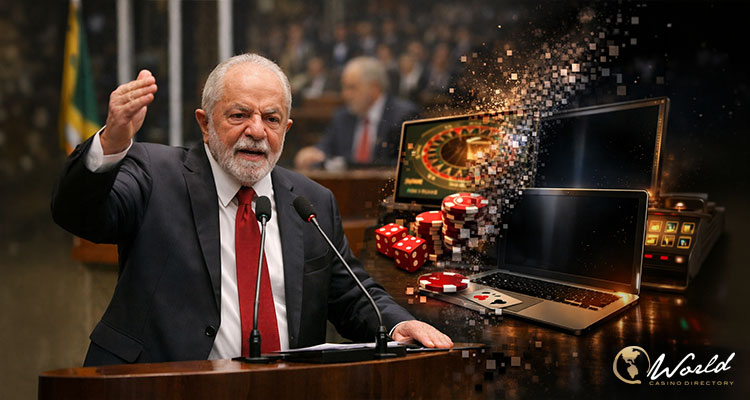
Brazilian President Luiz Inácio Lula da Silva has called for legislation that would prohibit online casino games in the country, raising questions about the future of Brazil’s recently regulated digital gambling market. The remarks came during a national radio and television address connected to International Women’s Day, where Lula discussed the social and financial consequences of gambling.
The president used the broadcast to argue that the growth of online casino-style games has created economic pressure within households. He said the impact often extends beyond individual players and affects family finances more broadly.
President Raises Concerns About Online Gambling
In his televised message, Lula linked gambling addiction to financial strain in Brazilian homes. He argued that betting activity conducted through mobile phones can redirect money intended for everyday household needs.
“Another tragedy affecting Brazilian homes is gambling addiction. Although most addicts are men, the burden falls disproportionately on women. It’s money meant for food, rent, and children’s school that disappears on the cell phone screen,” he stated.
The president also pointed to the longstanding prohibition of land-based casinos in Brazil as part of his reasoning for opposing online casino games. According to Lula, the current situation creates an inconsistency in the country’s gambling policy.
“[Land-based] casinos are prohibited in Brazil. It makes no sense to allow gambling games like “Jogos do Tigrinho” to enter homes, indebting families through their cell phones. We will work together, uniting the Government, Congress, and the Judiciary, to ensure that these digital casinos do not continue to indebt families and destroy homes.”
During the address, Lula said the federal government would seek cooperation from the National Congress and the judiciary in order to pursue measures aimed at preventing the continued operation of certain online casino platforms.
Regulation Approved Under Lula’s Administration
The president’s statements come after Brazil introduced a regulatory framework for online betting that was approved by Congress at the end of 2023 and signed into law by Lula himself.
The legislative initiative was originally designed to establish oversight of fixed-odds sports betting platforms. The proposal came from the Ministry of Finance under Minister Fernando Haddad and was intended to regulate operators that had already been offering betting services in Brazil without a formal legal structure.
However, the scope of the legislation expanded during the parliamentary debate. According to iGaming Brazil, Representative Adolfo Viana introduced an amendment in the Chamber of Deputies that included authorization for online gaming products, which covered digital casino games such as the widely known “Jogos do Tigrinho.”
The Federal Senate later attempted to remove that expansion and limit the bill strictly to sports betting. Before the final vote, however, the Chamber of Deputies restored the broader version of the legislation, allowing online gaming to remain part of the regulatory framework.
Lula signed the final law in December 2023 without vetoing the expanded provisions. The legal framework allowed sports betting operators and online casino platforms to operate under regulated conditions. The regulatory system governing sports betting came into effect in January 2025.
The president’s recent comments therefore represent a departure from the earlier policy direction created by that legislation.
Market Growth and Industry Response
Since the introduction of the regulatory framework, Brazil’s betting market has grown rapidly. Government data indicates that participation has expanded significantly during the first year of regulated activity.
Figures from the Secretariat of Prizes and Betting within the Ministry of Finance show that 25 million unique bettors were recorded in 2025 across licensed platforms. The identification process relied on Brazil’s taxpayer identification numbers, which regulators use to monitor the regulated market.
When counting multiple accounts held by the same individuals across different operators, the number of active betting accounts rises considerably. Authorities reported more than 87 million active accounts during the same period.
Total registrations across platforms exceeded 100 million accounts during the first year of the regulated market. Gross gaming revenue generated by regulated betting operators reached approximately $7 billion during that time.
Independent research has also indicated widespread participation. A survey conducted by PoderData found that 36 percent of Brazilians aged 16 or older have taken part in online betting activities. That share represents roughly 56 million people.
The president’s comments have prompted responses from organizations connected to the gambling sector. The Association of Women in the Gaming Industry (AMIG), which represents professionals working in the industry in Brazil, expressed concern about the remarks.
In a LinkedIn statement, the association wrote: “By criticising the sector, the President reveals ignorance about a market that generates employment, income and revenue for the government itself. And, more importantly: it employs and values female leadership.”
The group highlighted that the regulated gaming sector contributes tax revenue and employment opportunities while supporting professional development for women across various areas of the industry.
AMIG said its membership includes more than 1,400 women working in roles across technology, compliance, legal affairs, marketing, payments, sports integrity and corporate governance. According to the organization, women participate throughout the sector’s production chain and contribute to the development of a regulated market aligned with international standards.
The association also pointed to financial contributions made by operators, stating that the industry generated approximately R$4.5 billion in dedicated payments during the previous year. Those funds help support public policy programs in Brazil.
While Lula’s statements signal a possible shift in government policy, the details of any proposed legislative changes remain unclear. The president indicated that future action would require coordination between the executive branch, Congress and the judiciary.
Brazil heads into a general election scheduled for October 4, 2026, with Lula seeking another term in office. Any move to prohibit online casino platforms would require legislative changes to the framework established under the law signed in 2023.
