

 United States
 Macau, China
 France
 Philippines
 Singapore
 Netherlands
 United Kingdom
 Canada
 Argentina
 Germany
 Estonia
 Peru
Peru Russia
 Australia
 South Africa
 Nigeria
 Malaysia
 Singapore
 India
India Finland
 China
China Ukraine
 Hong Kong
 Cyprus
 Turkey
 Greece
 Sweden
 South Korea
 Mexico
 Poland
 Ireland lottery results
 New Zealand lottery results
 Puerto Rico lottery results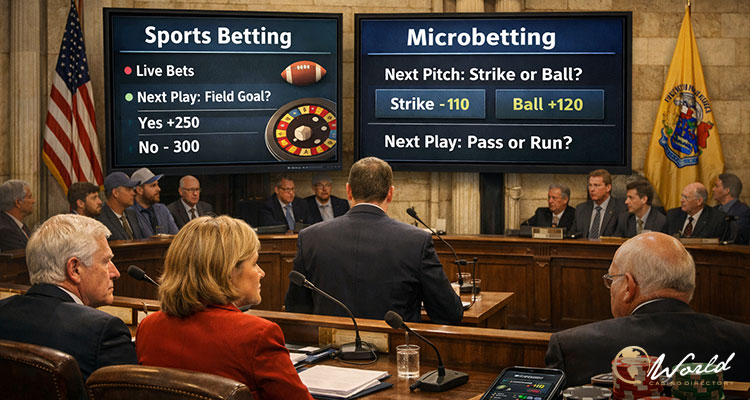
New Jersey lawmakers have taken a step toward prohibiting micro betting, a fast-growing form of sports wagering that allows bets on the next play or action within a game. A Senate committee voted to advance Senate Bill S-2160, sending it to the full Senate for further consideration.
The proposal, sponsored by Senators Paul Moriarty and Patrick Diegnan, would make New Jersey one of the first jurisdictions in the United States to outlaw this specific type of betting. The measure reflects increasing concern among lawmakers about emerging wagering formats that allow rapid, high-frequency bets during live sporting events.
Debate Centers on Risks and Consumer Protections
Supporters of the bill argue that micro betting introduces unique risks compared to traditional wagers placed on game outcomes. Moriarty highlighted concerns about both integrity and addiction.
“Micro-betting poses several risks to New Jersey and its residents. For one, micro-bets can more easily be rigged than betting on the outcome of an entire game, especially by insiders who may know ahead of time how a micro-bet or prop bet could play out, in turn misleading and disenfranchising the average player.”
He also emphasized how the pace of these wagers could lead to harmful behavior.
“They can also be incredibly addictive, as they are made based on short-term outcomes with quick payoffs. This enables bettors to place a higher volume of wagers in a shorter amount of time, leading to a vicious cycle of excessive, impulsive, and financially irresponsible gambling.”
Diegnan echoed those concerns, focusing on how continuous betting opportunities may intensify gambling habits.
“Betting and gambling are already addictive, but goading players with the possibility of endless opportunities to bet during games makes micro-bets significantly more dangerous. Through micro-bets, bettors have the opportunity to spend more money and more time on gambling, an incredibly slippery slope that frequently leads to addiction and major financial losses.”
During the committee hearing, problem-gambling advocate Harry Levant urged lawmakers to act preemptively, saying they are “uniquely in a position to pull people out of the river before they need saving … you can prevent them from falling in.” He argued that removing micro bets would eliminate one of the most addictive elements of online sports betting.
Opponents, however, warned that banning such wagers could have unintended consequences. Zachary Kahn, representing the Sports Betting Alliance, told lawmakers that banning micro-bets would “strip consumer protections from bettors, [and] push them someplace where there are no protections.” According to InGame, he suggested that bettors might turn to unregulated markets without safeguards.
Levant dismissed that argument, saying responsible gambling tools are often industry language for “let us regulate ourselves,” and maintained that existing oversight fails to address the risks tied to micro betting.
Economic Questions and Industry Impact
Beyond public health concerns, lawmakers also discussed possible economic effects. New Jersey’s sports betting industry is closely tied to casinos and racetracks, with online platforms required to partner with physical venues.
Sen. Vincent Polistina raised concerns about competitiveness, noting that nearby markets allow micro betting.
“It troubles me that you would have people not able to do something that they can do 45 minutes up the road,” he said, referencing neighboring Philadelphia.
Industry representatives highlighted the scale of the sector’s contribution to the state. According to Kahn, Sports Betting Alliance members account for 89% of New Jersey’s sports betting revenue and support approximately 2,000 jobs. Tim Murphy of DraftKings pointed to internal data showing extensive use of responsible gambling tools, including millions of user engagements and a rise in bettors setting limits on their activity.
Meanwhile, Moriarty compared micro betting to encouraging risky behavior, likening it to a bar approaching “someone with a drinking problem and inviting them to come in for their favorite drink.”
Wider Trends in Live Betting and Regulation
Micro betting forms part of a broader expansion in live, in-game wagering. Research conducted for New Jersey regulators found that in-game bets represent a significant share of activity, with two-thirds of bettors participating. The studies also showed that high-intensity bettors account for more than half of such wagers and are more likely to overspend.
Industry data underscores the importance of live betting. DraftKings CEO Jason Robins said during a 2025 earnings call that live wagers made up more than half of the company’s handle. In mature European markets, in-game betting reportedly exceeds 60% of total bets.
Concerns about integrity have also surfaced at the league level. Major League Baseball previously introduced limits on certain pitch-level wagers, stating that micro bets carry “heightened” risks because a single player could influence the outcome.
Across the United States, lawmakers have increasingly examined high-risk betting types, including proposition bets involving individual athletes. Several states have already restricted such wagers, particularly in college sports.
Next Steps for the Legislation
If enacted, S-2160 would prohibit sportsbooks from offering or accepting micro bets and impose penalties for violations. Offenses would be treated as disorderly persons violations, with fines ranging from $500 to $1,000 per incident.
The bill now heads to the Senate floor, where lawmakers may approve it, amend it, or send it back to committee. Its progress comes as part of a broader push in New Jersey to tighten oversight of gambling practices, including proposals to limit promotions, require clearer responsible gambling tools, and restrict the use of credit cards for online betting.
