

 United States
 Macau, China
 France
 Philippines
 Singapore
 Netherlands
 United Kingdom
 Canada
 Argentina
 Germany
 Estonia
 Peru
Peru Russia
 Australia
 South Africa
 Nigeria
 Malaysia
 Singapore
 India
India Finland
 China
China Ukraine
 Hong Kong
 Cyprus
 Turkey
 Greece
 Sweden
 South Korea
 Mexico
 Poland
 Ireland lottery results
 New Zealand lottery results
 Puerto Rico lottery results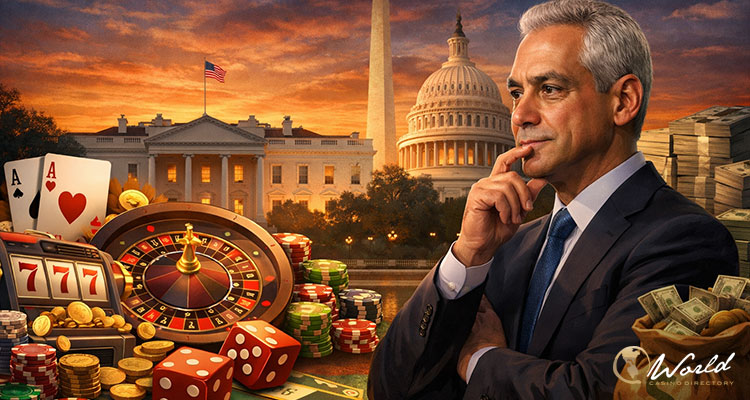
Former Chicago Mayor Rahm Emanuel has introduced a proposal to impose a federal tax on online gambling and prediction markets, outlining the plan as part of a broader policy agenda while weighing a potential run for president in 2028.
The proposal would apply a 10% transaction tax to wagers placed through licensed online sportsbooks, digital casino platforms, and prediction market exchanges. Emanuel has suggested the measure could generate tens of billions of dollars annually, with the funds directed toward strengthening U.S. research and development efforts.
Proposal Targets Betting Industry to Fund Innovation
Emanuel’s plan centers on creating a new revenue stream tied to the expanding online wagering sector. According to estimates tied to the proposal, the tax could produce between $30 billion and $50 billion each year. That money would be allocated to an innovation-focused fund supporting areas such as artificial intelligence, quantum computing, fusion energy, life sciences, and national security technologies.
He has framed the initiative as part of a broader strategy to maintain U.S. competitiveness, particularly in relation to China. Emanuel pointed to concerns about declining federal investment in research, arguing that new funding sources are needed to reverse that trend.
“It doesn’t replace what you spend today. It builds,” he said according to Bloomberg. “It’s new money, not replacing old money.”
The proposal would require congressional approval before taking effect, and details about how the tax would be structured remain unclear. Questions persist about whether the levy would apply to operator revenue, total betting volume, or individual transactions placed by users.
Industry data suggests that state-regulated online sportsbooks and casinos generated roughly $27 billion in gross revenue in 2025, while prediction markets remain a smaller but growing segment. Analysts have noted that reaching Emanuel’s projected revenue range would depend heavily on how the tax is applied.
Policy Rollout Tied to Possible Presidential Bid
Emanuel has not formally entered the 2028 presidential race, though he has acknowledged considering the possibility. “I’m thinking about it,” he said in an interview.
He has begun outlining policy positions in public appearances, opinion pieces, and interviews, presenting a broader argument that Democrats need a more defined agenda. While discussing whether the rollout is connected to potential political ambitions, Emanuel said, “While that may be a side benefit, I’m more interested in the American people getting ahead and America staying ahead.”
During a recent appearance, he described the proposed tax as part of a larger effort to redirect economic activity toward innovation.
“We’re stagnant and worse than stagnant under President Trump. We’re cutting the NIH [National Institutes of Health] and the National Science Foundation,” Emanuel said. “To me, raise a 10% fee. It goes into this Innovation Fund. I’m tired of people betting against America. I want to bet on America. I want to not reward gambling. I want to actually reward the entrepreneur.”
He has also compared the idea to existing taxes on products such as alcohol and tobacco, suggesting that similar approaches could gain support if paired with increased research funding.
Broader Agenda and Industry Reaction
Emanuel’s proposal arrives alongside other policy ideas he has floated, including banning federal employees from participating in prediction markets and restoring funding for research programs that have faced cuts in recent years. He has also discussed proposals related to social media restrictions for minors, government reform measures such as a mandatory retirement age for federal officials, and changes to education policy.
At the same time, the suggested tax could face resistance from both industry stakeholders and consumers. Emanuel has acknowledged that opposition is likely within what he described as a $400 billion online betting and prediction market sector.
Uncertainty also surrounds how such a tax would affect operators and users. Depending on its structure, it could alter pricing, reduce participation, or challenge the financial sustainability of some platforms.
