

 United States
 Macau, China
 France
 Philippines
 Singapore
 Netherlands
 United Kingdom
 Canada
 Argentina
 Germany
 Estonia
 Peru
Peru Russia
 Australia
 South Africa
 Nigeria
 Malaysia
 Singapore
 India
India Finland
 China
China Ukraine
 Hong Kong
 Cyprus
 Turkey
 Greece
 Sweden
 South Korea
 Mexico
 Poland
 Ireland lottery results
 New Zealand lottery results
 Puerto Rico lottery results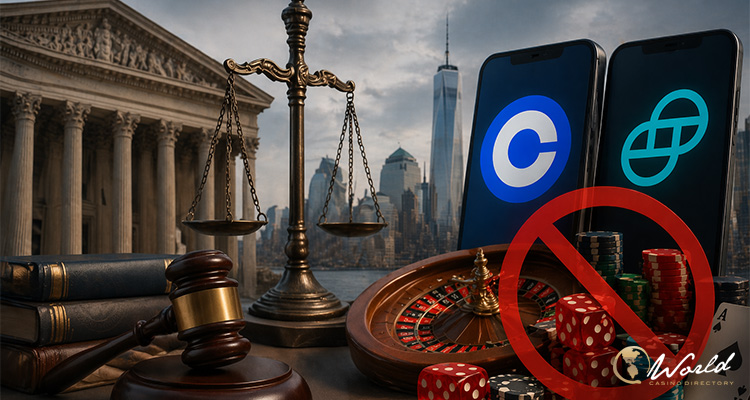
New York Attorney General Letitia James has filed lawsuits against Coinbase Financial Markets, Inc. and Gemini, Titan LLC, arguing that the companies are operating illegal gambling businesses in the state through their prediction market products. The cases add New York to a widening state-level fight over whether event contracts offered through crypto-linked platforms should be treated as federally regulated financial products or as gambling subject to state gaming law.
James said the two companies allow users to place money on the outcomes of future events, including sports, politics, entertainment and other real-world developments, without holding licenses from the New York State Gaming Commission. The AG’s office argues that these offerings meet the legal definition of gambling under New York law because users are staking value on events outside their control and receiving value if their chosen outcome occurs.
“Gambling by another name is still gambling, and it is not exempt from regulation under our state laws and Constitution,” James said in an official gvt press release. “Gemini and Coinbase’s so-called prediction markets are just illegal gambling operations, exposing young people to addictive platforms that lack the necessary guardrails. My office is taking action to protect New Yorkers and stop these platforms from violating the law.”
The lawsuits ask the court to stop the platforms from operating in New York unless they obtain proper licenses. James is also seeking financial penalties, restitution for customers and forfeiture of what her office describes as illegal profits.
State Says Event Contracts Mirror Sports Betting
The complaints point to specific examples that, in the attorney general’s view, closely resemble conventional sports wagering. According to the filings, Coinbase offered contracts on whether the New York Knicks would win a game by more than 6.5 points, who would win the February 8, 2026 Super Bowl, and college basketball games, including a February 14, 2026, matchup between St. John’s University and Providence College. Gemini allegedly offered wagers on whether the New York Mets would win a game by more than 1.5 runs, who would win the same Super Bowl, and college basketball games such as the February 25, 2026 game between St. John’s University and the University of Connecticut.
New York’s attorney general says those products cross several lines under state law. One issue is licensing. Another is age. The lawsuits allege that Coinbase and Gemini made these products available to users aged 18 and older, while New York requires participants to be at least 21 to engage in mobile sports betting. The state also bars betting on games involving in-state college teams, another point the suits raise directly.
James’ office also argues that by operating outside New York’s licensed gaming system, the companies have avoided the tax obligations imposed on legal operators. The state notes that licensed mobile sportsbooks and casinos pay taxes that support public education, youth sports programs and services related to problem gambling.
The attorney general’s office cited studies on gambling harms to support its case for intervention. According to the state, early exposure to gambling can increase the likelihood of depression, anxiety, mood swings and financial stress. The lawsuits also highlight risks of addiction and other mental health consequences.
Coinbase and Gemini Caught in Wider Jurisdiction Fight
The New York cases land in the middle of a broader legal conflict over who has authority over prediction markets. Platforms in this space have argued that they are participating in federally regulated markets overseen by the Commodity Futures Trading Commission (CFTC) rather than state-regulated gambling activity.
Gemini entered this area after an affiliate received CFTC approval as a designated contract market in December 2025, the same month Gemini Predictions launched. Coinbase, meanwhile, is tied to Kalshi as a CFTC-approved futures commission merchant, which it says allows it to host event contracts.
A Coinbase spokesperson pushed back on New York’s position, saying: “Prediction markets are federally regulated national exchanges, registered with the CFTC. This issue is proceeding in New York federal court as we speak. Coinbase will continue to fight for the federal oversight of these markets that Congress intended.”
That federal-state split is not unique to New York. Kalshi has challenged efforts by the New York State Gaming Commission to shut down its operations there. Coinbase has also sued Connecticut, Michigan and Illinois over similar state actions. Earlier this month, the CFTC itself sued Arizona, Connecticut and Illinois in an attempt to block those states from policing prediction markets. In Arizona, a federal judge recently halted that state’s enforcement effort, finding the federal agency had shown a reasonable chance of success on preemption.
New York’s lawsuits do not currently name Kalshi or Polymarket, though both companies have become central to the national argument over prediction markets. It remains unclear whether James will expand enforcement to additional firms.
The suits against Coinbase and Gemini fit into James’ wider enforcement efforts involving both online gambling and digital asset businesses. Her office noted that in January 2026, she sued Valve over alleged gambling promotion through video games popular with children and teenagers. In June 2025, the office announced action against 26 online sweepstakes casinos accused of offering slot-style games, table games and sports betting through virtual coin systems redeemable for cash or prizes.
James also issued a consumer alert in February warning that prediction markets were offering bets “masquerading as event contracts.” That alert came ahead of the Super Bowl and warned that promoting unlicensed wagering violated New York gambling law.
