

 United States
 Macau, China
 France
 Philippines
 Singapore
 Netherlands
 United Kingdom
 Canada
 Argentina
 Germany
 Estonia
 Peru
Peru Russia
 Australia
 South Africa
 Nigeria
 Malaysia
 Singapore
 India
India Finland
 China
China Ukraine
 Hong Kong
 Cyprus
 Turkey
 Greece
 Sweden
 South Korea
 Mexico
 Poland
 Ireland lottery results
 New Zealand lottery results
 Puerto Rico lottery results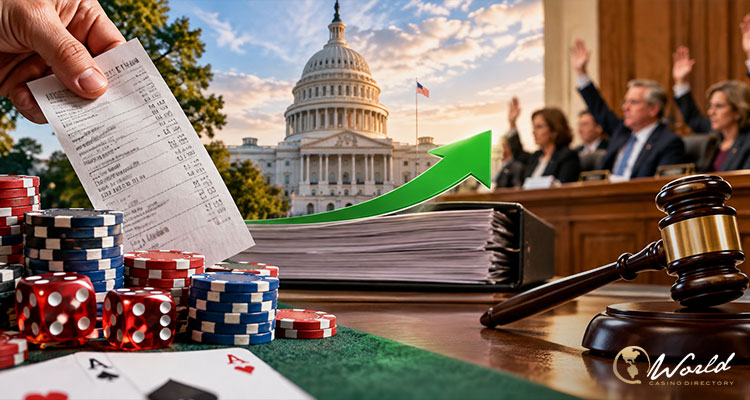
A congressional effort to reverse a federal tax change affecting gambling losses moved forward this week after the House Ways and Means Committee approved legislation aimed at restoring the longstanding 100% deduction for wagering losses.
The committee action advances proposals championed by Nevada lawmakers, including Rep. Dina Titus and Rep. Steven Horsford, who have spent more than a year seeking to overturn a provision contained in the tax-and-spending package known as the One Big Beautiful Bill. The measure reduced the allowable deduction for gambling losses from 100% to 90%, a change critics argue creates tax liability even when gamblers do not realize a net profit.
The legislation now heads to the full House of Representatives, where supporters are urging lawmakers to act before the revised deduction rules take effect on January 1, 2027.
Titus, whose FAIR BET Act seeks to restore the previous deduction framework, welcomed the committee vote after multiple earlier attempts failed to gain sufficient traction.
“After 14 months of fighting to get this commonsense, bipartisan fix through committee, we must now encourage the House to approve this measure before Jan. 1, 2027,” Titus said in a statement cited by KSNV. “This would stop the reduction to 90 percent from taking effect and ensure gamblers across the nation do not pay this tax on phantom money they never won.”
Lawmakers Push to Reverse 2025 Tax Change
For decades, federal tax rules allowed gamblers to deduct losses up to the amount of their winnings. That approach changed when the One Big Beautiful Bill became law in July 2025, reducing the deductible amount to 90% of losses.
Under the current framework, taxpayers can face taxable income despite breaking even. Supporters of the repeal have repeatedly cited examples in which an individual reporting equal amounts of winnings and losses could still owe taxes. A person with $100,000 in winnings and $100,000 in losses, for example, could be taxed on $10,000. Similarly, someone with $10,000 in winnings and $10,000 in losses could owe taxes on $1,000 despite having no net gain.
Nevada lawmakers contend the provision threatens sectors tied to gaming and tourism, industries that play a central role in the state’s economy.
“At a time of economic uncertainty, my job is to protect Nevadans and their jobs,” said Rep. Horsford in an official statement. “From dealers and housekeepers to restaurant workers and small business owners, families across our state depend on visitors choosing Nevada. This unfair tax puts their livelihoods at risk. That’s why I fought to advance my FULL HOUSE Act, and I won’t stop until we get this relief signed into law.”
Horsford’s FULL HOUSE Act was incorporated into a broader tax package approved by the committee following bipartisan negotiations. The proposal received strong support in committee, passing by a vote of 38 to 5.
“No one should pay taxes on money they never earned,” said Rep. Horsford. “This is about the workers supporting their families, the small businesses keeping their doors open, and the communities that make Nevada home. I stayed at the table because they deserve results. Today, we moved closer to delivering.”
Industry Groups and Racing Interests Back Restoration
Support for restoring the full deduction extends beyond lawmakers. Major gaming companies, trade associations, online sportsbook operators, and racing industry representatives have publicly endorsed the effort.
Titus said the FAIR BET Act has support from MGM Resorts International, Caesars Entertainment, Wynn Resorts, the Nevada Resort Association, the American Gaming Association, DraftKings, FanDuel, and the National Thoroughbred Racing Association (NTRA). The legislation currently has 25 co-sponsors.
Craig Billings, Chief Executive Officer of Wynn Resorts, welcomed the committee’s action. “While we all recognize the work is not yet done, today’s Committee action marks a critically important step toward protecting our workforce and restoring fairness to the tax code,” noted Craig Billings, Chief Executive Officer to Las Vegas-based Wynn Resorts. “It has taken bi-partisan leadership from Chairman Smith and hometown Congressman Horsford to get us to this point. We commend them for their efforts, and we look forward to supporting them as they work to pass this important legislation before this Congress comes to a close.”
The American Gaming Association also urged Congress to complete the process. “The American Gaming Association is grateful for this critical step forward in restoring the 100% gambling tax deduction. We encourage Congress to pass the FULL HOUSE Act to ensure that consumers choose the legal market where protections exist and are not taxed on phantom income. Thank you to the Ways and Means Committee as well as Representatives Horsford and Miller for their leadership in advocating for this bi-partisan measure. We look forward to working with our partners in Congress to get this passed,” said Bill Miller, President and CEO of the American Gaming Association
Next Steps in Congress
Although the committee vote marked a significant advance, the legislation still faces several hurdles. The House must approve the measure before it can move to the Senate. In the upper chamber, Nevada Senators Catherine Cortez Masto and Jackie Rosen have joined Senator Ted Cruz as co-sponsors of related legislation.
Titus emphasized the urgency of congressional action, arguing that lawmakers must move quickly if they want to prevent the reduced deduction from taking effect.
“I am disappointed it took the House committee so long to take action,” Titus said. “I spoke at a Ways and Means committee field hearing in Las Vegas in July 2025 to bring the consequences of reducing the deduction to their attention. Over the next several months, I wrote letters to the committee urging it to include the fix in an upcoming package. Nothing happened until now, when the House will be out of session until after the election. The Republican House leadership must bring this provision to the floor, and the Senate must also expeditiously pass it if we are to prevent the tax from taking effect and harming gamblers nationwide.”
If approved by both chambers of Congress, the legislation would then require the president’s signature to become law.
