

 United States
 Macau, China
 France
 Philippines
 Singapore
 Netherlands
 United Kingdom
 Canada
 Argentina
 Germany
 Estonia
 Peru
Peru Russia
 Australia
 South Africa
 Nigeria
 Malaysia
 Singapore
 India
India Finland
 China
China Ukraine
 Hong Kong
 Cyprus
 Turkey
 Greece
 Sweden
 South Korea
 Mexico
 Poland
 Ireland lottery results
 New Zealand lottery results
 Puerto Rico lottery results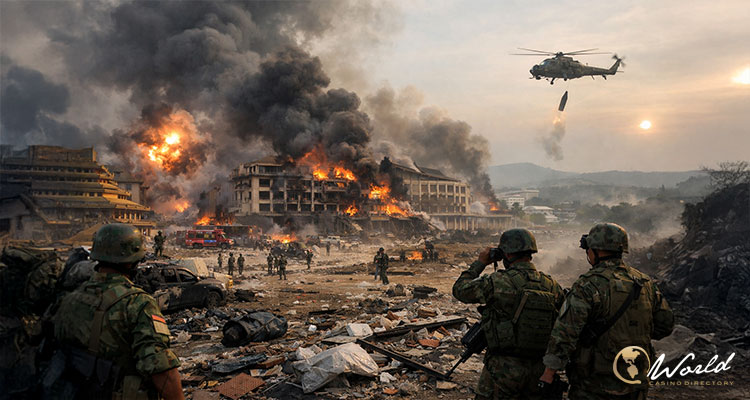
Thailand carried out air strikes near the Cambodian border city of Poipet on Thursday, December 19, intensifying a renewed round of fighting between the two Southeast Asian neighbors and drawing renewed diplomatic attention to a long-running territorial dispute. Cambodian authorities said the strikes occurred near a key border crossing and casino hub that draws large numbers of Thai visitors, while Thai officials described the target as a military logistics site.
The incident unfolded against the backdrop of escalating hostilities that have continued despite recent claims of a ceasefire. Fighting has involved heavy weaponry and air power, with both sides reporting casualties, civilian displacement, and damage to infrastructure along the frontier.
Air Strikes Reported Near Border Casino Hub
Cambodia’s defense and interior ministries said Thai military aircraft dropped bombs in the Poipet municipality of Banteay Meanchey province on Thursday morning, with officials citing a time of about 11am local time. Poipet sits directly on the border with Thailand and hosts a cluster of casinos that cater primarily to cross-border traffic.
According to Cambodian authorities, the attack damaged a warehouse and nearby property and left two civilians with minor injuries. Officials added that at least four casinos elsewhere along the border have sustained damage from Thai strikes during the current escalation, though they did not confirm direct damage to casino properties inside Poipet itself.
Thailand later confirmed carrying out an air operation in the area. Thai air force spokesman Jackkrit Thammavichai told reporters the strike destroyed a “logistics centre” used to store rockets.
“These are facilities that have been used for military purposes,” he said.
Thai authorities have stated that their military has focused on logistical sites and facilities linked to weapons storage, while Cambodia has accused Thailand of targeting civilian areas and commercial zones near the border.
The renewed fighting has resulted in mounting casualties on both sides. Cambodian officials said the latest clashes this month have killed at least 17 people in Cambodia and at least 21 in Thailand, while other official statements placed the Cambodian death toll at 18. Authorities also reported widespread displacement, with around or more than 800,000 people forced to leave their homes due to ongoing combat.
The violence has disrupted cross-border movement in Poipet, one of the busiest land crossings between the two countries. Thailand said earlier this week that between 5,000 and 6,000 Thai nationals remain stranded in the city after Cambodia shut land border checkpoints.
Cambodia’s interior ministry described the closures as a “necessary measure” to reduce risks to civilians amid the ongoing fighting. Officials added that travelers seeking to leave the area could still do so by air.
Poipet’s casinos, which rely heavily on Thai customers, have become an indirect focal point of the conflict. Among the operators with a presence in the wider Poipet casino zone is DNA Star Vegas Resort, linked to Donaco International Limited. Cambodian authorities and the company have not reported damage to that property.
Disputed Ceasefire and Diplomatic Pressure
The current escalation follows a long-standing territorial dispute rooted in colonial-era border demarcations along the countries’ roughly 800-kilometer frontier, which also includes several ancient temple sites. Tensions rose sharply after a border clash on May 28 that killed a Cambodian soldier, an incident that triggered political fallout in Thailand and contributed to the removal of then-prime minister Paetongtarn Shinawatra.
Five days of fighting in July had previously ended with a truce brokered by the United States, China, and Malaysia. That agreement later collapsed. United States President Donald Trump claimed last week that Thailand and Cambodia had reached a new ceasefire, but Bangkok rejected that assertion, and hostilities have continued since a more recent border skirmish earlier this month.
According to Al Jazeera, China announced it was dispatching its special envoy for Asian affairs to both capitals as part of a “shuttle-diplomacy trip” aimed at easing tensions and helping to “rebuild peace”.
“Through its own way, China has been working actively for de-escalation,” Beijing’s foreign ministry said in a statement.
Regional and international actors have stepped up calls for restraint. ASEAN foreign ministers are scheduled to hold emergency talks in Malaysia to seek a diplomatic solution. Malaysian Prime Minister Anwar Ibrahim said regional leaders intended to press both sides to halt the fighting.
“Our duty is to present the facts but more important is to press upon them that it is imperative for them to secure peace,” Anwar said. “We are appealing to them to immediately stop this frontline offensive and if possible, an immediate ceasefire,” he added, saying he was “cautiously optimistic” about the talks.
European Union foreign policy chief Kaja Kallas also weighed in, offering support for monitoring efforts. “The conflict between Thailand and Cambodia must not be allowed to spiral further. That’s why the ceasefire needs to be immediately restored,” Kallas said.
Despite these diplomatic efforts, artillery exchanges, air operations, and troop movements have continued, underscoring the fragility of past agreements and the difficulty of stabilizing one of Southeast Asia’s most persistent border disputes.