

 United States
 Macau, China
 France
 Philippines
 Singapore
 Netherlands
 United Kingdom
 Canada
 Argentina
 Germany
 Estonia
 Peru
Peru Russia
 South Africa
 Nigeria
 Malaysia
 Singapore
 India
India Finland
 China
China Ukraine
 Hong Kong
 Cyprus
 Turkey
 Greece
 Sweden
 South Korea
 Mexico
 Poland
 Ireland lottery results
 New Zealand lottery results
 Puerto Rico lottery results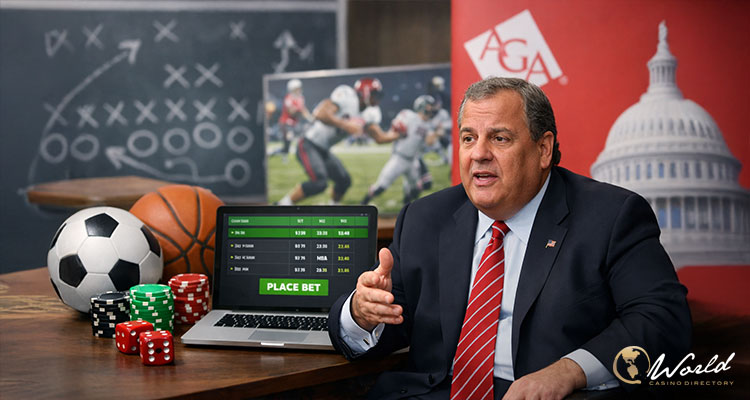
Former New Jersey Governor Chris Christie has taken on a new role in the ongoing debate over sports prediction markets, aligning himself with the American Gaming Association as it intensifies opposition to platforms offering sports-related contracts. Christie’s involvement marks a significant development for the trade group, which has warned that these markets operate outside the regulatory structures established for sports betting in the United States.
Renewed Legal Battle Over Sports Contracts
Christie is widely known for leading the legal effort that resulted in the US Supreme Court overturning the Professional and Amateur Sports Protection Act. That ruling, issued in May 2018, found PASPA unconstitutional and cleared the way for individual states to determine whether to legalize sports betting. Since then, 40 states and Washington, DC, have adopted laws permitting some form of regulated sports wagering.
Now, Christie is directing his attention to prediction markets that allow users to buy and sell contracts tied to sports outcomes. These platforms are licensed by the Commodity Futures Trading Commission and frame their offerings as financial instruments rather than gambling products. Operators such as Kalshi and Polymarket initially focused on areas like elections and weather, but have increasingly moved into sports, including states where traditional sports betting remains illegal.
Christie’s decision to work with the AGA reflects the group’s view that sports prediction markets undermine the legal framework created after PASPA’s repeal. According to the AGA, these platforms effectively offer sports wagering without holding state-issued sports betting licenses, even in jurisdictions that have explicitly chosen not to legalize sports gambling.
“He’s partnered with us as a strategic advisor on sports event contracts,” Dara Cohen, the AGA senior director for strategic communications and media relations, told Casino Reports. “He brings significant expertise and a strong background in the legal framework around state and tribal authority.”
Christie has been vocal in public appearances, including interviews on CNBC, where he has described prediction markets offering sports contracts as incompatible with the Supreme Court’s ruling. “They’re illegal. They are clearly illegal in the sports betting space, and here’s why: The Supreme Court turned this over to the states to do, and the fact is, doing it through the states gives you two things. One, it gives availability to people. Two, in a regulated market,” he said.
He has also argued that prediction platforms bypass state decisions, both in states with legal sports betting and in those that have opted against it. “These are folks that are not being regulated, it’s not in compliance with the law, and it is hurting the 40 states where this is going on. And in those 10 states that don’t have sports gambling, those folks have made a decision not to allow it in their state, and these folks are flouting state law and going in there anyway.”
Industry Divisions and Integrity Concerns
The AGA’s stance has already contributed to visible fractures within the gaming industry. Several major sportsbook operators, including DraftKings, FanDuel, and Fanatics, have withdrawn their AGA memberships as they pursue their own prediction market products. DraftKings Predictions and FanDuel Predicts both launched recently, with FanDuel’s platform going live in five states.
Christie has emphasized that his focus is limited to sports-related contracts, not prediction markets as a whole. “The states have occupied the space to regulate sports gambling,” he said, as CNBC reports. “They were given the opportunity to that by the United States Supreme Court in a case that I fought six years to bring to the U.S. Supreme Court and to win … It’s been done in a way that is regulated and monitored to make sure that the integrity of the game is protected.”
He has contrasted regulated sportsbooks with prediction markets by pointing to integrity monitoring. Licensed sportsbooks routinely report unusual betting activity to regulators and leagues, a process that has helped uncover integrity issues in professional sports. “The things that have happened in the NBA and MLB were discovered because the licensed sportsbooks are partnered with state regulators to look for irregularities. No one is looking for irregularities in sports prediction markets,” Christie said.
Christie has also criticized the CFTC’s oversight, stating, “The CFTC has made it clear they aren’t regulating it with any rigor. The CFTC is not doing the job regarding sports, nor do they claim to be doing the job.” He added, “Just because people brazenly break the law doesn’t mean they should be permitted to do so.”