

 United States
 Macau, China
 France
 Philippines
 Singapore
 Netherlands
 United Kingdom
 Canada
 Argentina
 Germany
 Estonia
 Peru
Peru Russia
 Australia
 South Africa
 Nigeria
 Malaysia
 Singapore
 India
India Finland
 China
China Ukraine
 Hong Kong
 Cyprus
 Turkey
 Greece
 Sweden
 South Korea
 Mexico
 Poland
 Ireland lottery results
 New Zealand lottery results
 Puerto Rico lottery results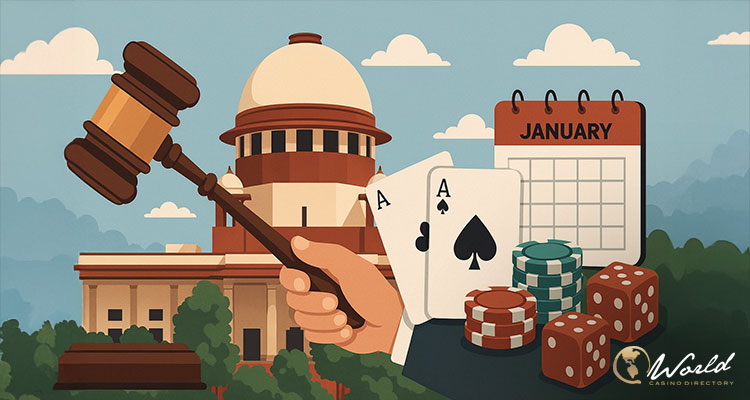
India’s online gaming industry remains in legal limbo after the Supreme Court signaled that challenges to the country’s real-money gaming ban will not be taken up until January 2026. The delay follows pleas from gaming operators seeking urgent judicial review of a law that has effectively halted operations across the sector.
Law passed amid concerns over social and financial harm
On December 11, a bench led by Chief Justice Surya Kant considered an early-listing request from Head Digital Works (HDW), the operator of A23 Rummy. The company, along with other real-money gaming (RMG) operators, is challenging the constitutional validity of the Promotion and Regulation of Online Gaming Act (PROGA), passed by parliament in August. While lawyers pressed for immediate intervention, the court indicated that the matter would be referred to a three-judge bench and scheduled for hearing early next year.
Responding to arguments about the industry’s collapse, the Chief Justice told counsel, “Everything is shut down.… We are listing in January. That is what I am promising.”
PROGA was approved with limited parliamentary debate and prohibits any online platform offering real-money gaming services. The law does not differentiate between games of chance and those commonly classified as skill-based, such as rummy, fantasy sports, poker, and esports. Under the Act, operators face penalties that include prison terms of up to three years and financial fines.
Supporters of the legislation argue that it provides necessary protection against harm linked to money-based gaming. The Centre for the Promotion and Regulation of Online Gaming has connected the “unchecked expansion” of real-money gaming to “financial fraud, money laundering, tax evasion and, in some cases, the financing of terrorism.” Lok Sabha member Bansuri Swaraj also defended the ban, writing that PROGA “unmasked the wolf for what it is” and describing the sector as a corrosive social influence. She added that the law prevents operators from “[hiding] behind the fig leaf of ‘skill’.”
Industry participants, however, have taken a sharply different view. HDW has described the legislation as a “product of state paternalism” and asked the court to strike it down as unconstitutional.
Operators argue delay amounts to enforcement
Senior advocates C. Aryama Sundaram and Arvind Datar, appearing for HDW and other petitioners, told the court that businesses had come to a standstill as a result of the law. They argued that the delay in judicial review effectively amounts to enforcement, even though PROGA has not yet been formally notified.
According to submissions referenced during the hearing, banks, payment processors, and intermediaries began withdrawing services soon after the law’s publication on August 22. HDW said it has generated no revenue for nearly three months while continuing to incur monthly operating costs exceeding Rs100 million ($1.2 million). The company also reported a workforce reduction from 606 employees to 178 and disclosed that foreign investor Clairvest has written off its Rs7.6-billion ($91 million) investment.
The broader industry impact has been significant. As of mid-November, banned RMG platforms reportedly recorded asset write-downs exceeding $840 million, while an estimated 7,000 workers lost their jobs nationwide. The sector previously supported an estimated 200,000 jobs and generated roughly Rs230 billion ($2.75 billion) in annual value.
Court cites constitutional complexity
The Supreme Court said the delay reflects the complexity of the constitutional questions involved. The bench noted that cases concerning the “vires of a statute” are typically assigned to a three-judge bench. The PROGA challenges are closely linked to the previously argued Gameskraft batch, which addresses whether state governments have the authority to regulate or prohibit online gaming. The current petitions raise the corresponding question of whether parliament can impose a nationwide ban.
According to the court, the overlap between these issues requires consolidated consideration by a larger bench. Local media reported that the hearing is expected to take place on January 21, 2026, once the bench is formally constituted.
Industry representatives warned that the continued delay risks accelerating player migration to offshore platforms. According to iGaming Business, Jaya Chahar, founder and CEO of JCDC Sports, said the ban “pushes fan engagement away from regulated Indian platforms into unregulated offshore spaces, which defeats the very intent of consumer protection”.
