

 United States
 Macau, China
 France
 Philippines
 Singapore
 Netherlands
 United Kingdom
 Canada
 Argentina
 Germany
 Estonia
 Peru
Peru Russia
 Australia
 South Africa
 Nigeria
 Malaysia
 Singapore
 India
India Finland
 China
China Ukraine
 Hong Kong
 Cyprus
 Turkey
 Greece
 Sweden
 South Korea
 Mexico
 Poland
 Ireland lottery results
 New Zealand lottery results
 Puerto Rico lottery results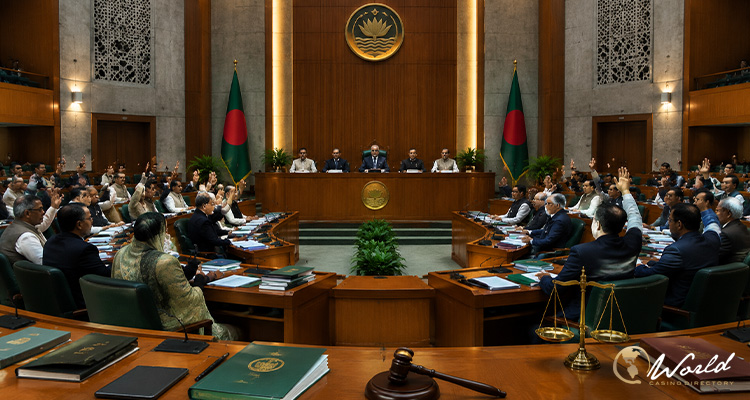
The Bangladeshi government has approved in principle a sweeping overhaul of its gambling legislation, advancing the draft Gambling Prevention Act, 2026 during the 10th Cabinet meeting chaired by Prime Minister Tarique Rahman. The move signals a major revision of a legal framework that dates back more than a century and a half.
The meeting took place at the Cabinet Room in the Jatiya Sangsad Bhaban, where the Ministry of Home Affairs presented the draft legislation. Officials said the proposal is intended to replace and modernise the Public Gambling Act of 1867, which authorities consider outdated in the context of rapidly evolving digital technologies.
According to the cabinet summary, the updated law responds to the expansion of both online and offline gambling activities enabled by modern communication tools, mobile devices and digital payment systems. The government stated that the changes are designed to support public order, reduce criminal behaviour, limit socio-economic harm and address psychological risks linked to gambling activity.
New legal framework for digital gambling environment
A central feature of the draft law is the formal introduction of definitions covering a wide range of gambling-related concepts. These include gambling premises and equipment, digital gambling platforms, online and remote betting systems, digital wallets, digital assets, totalisators, bookmakers, and activities such as match-fixing and spot-fixing.
The law also expands its scope to cover offences connected to gambling operations, including the organisation, facilitation, promotion and technical support of illegal betting systems. Authorities say this reflects the growing complexity of digital gambling networks, which often operate through cross-border platforms, social media channels and online payment services.
The legislation is structured to address both traditional and technology-driven gambling activity. Officials highlighted that cyber-enabled betting systems have created new enforcement challenges that existing legal frameworks were not designed to handle.
Under the proposed act, offenders may face fines, imprisonment, or both, depending on the severity of the offence. Detailed sentencing guidelines and penalty structures will be finalised during the legislative review process.
The draft also includes provisions addressing organised gambling networks, with particular attention to syndicates involved in large-scale illegal betting operations. Law enforcement agencies have previously reported cases involving recruitment of users into foreign betting platforms and the use of digital financial channels to process transactions.
The bill will undergo vetting by the Legislative and Parliamentary Affairs Division before being submitted for final approval.
Addressing risks linked to digital betting growth
Officials and experts have raised concerns about the rapid expansion of online gambling activity, particularly among younger users. Digital platforms have made betting more accessible through smartphones, messaging applications and online financial tools, contributing to increased participation in informal betting markets.
Security and policy experts have also pointed to the difficulty of regulating operators based outside national jurisdiction, where enforcement is more complex. These platforms often operate across multiple countries, making traditional regulatory approaches less effective.
The draft legislation introduces specific criminal provisions targeting match-fixing and spot-fixing. Authorities view these practices as a growing threat to the integrity of sporting events, particularly as illegal betting markets expand alongside major international competitions.
Sports governance observers note that betting-related manipulation can undermine confidence in professional sport and create incentives for corruption within competitive systems.
According to Bangladesh Pratidin, the Gambling Prevention Act, 2026 is part of a wider effort to modernise regulatory structures linked to gambling and related offences. The proposed legislation updates the colonial-era Public Gambling Act of 1867, which remains the foundation of current gambling restrictions in Bangladesh.
The existing law already prohibits most forms of gambling, with limited exceptions such as certain horse racing bets and state-approved lotteries. The new framework is designed to extend legal coverage into digital environments where previous regulations have limited reach.
The cabinet also approved related legislative changes, including amendments aimed at addressing digital manipulation in public examinations and revisions to narcotics control laws. These parallel reforms reflect a broader government focus on updating legal structures to respond to technology-driven crime.
Following in-principle approval, the draft Gambling Prevention Act will be reviewed by parliamentary legislative authorities before final consideration. Officials have not provided a timeline for its full enactment.
If passed, the law would represent one of the most significant updates to gambling regulation in Bangladesh in over 150 years, reshaping enforcement capabilities and expanding the state’s authority over digital gambling activities.
