

 United States
 Macau, China
 France
 Philippines
 Singapore
 Netherlands
 United Kingdom
 Canada
 Argentina
 Germany
 Estonia
 Peru
Peru Russia
 Australia
 South Africa
 Nigeria
 Malaysia
 Singapore
 India
India Finland
 China
China Ukraine
 Hong Kong
 Cyprus
 Turkey
 Greece
 Sweden
 South Korea
 Mexico
 Poland
 Ireland lottery results
 New Zealand lottery results
 Puerto Rico lottery results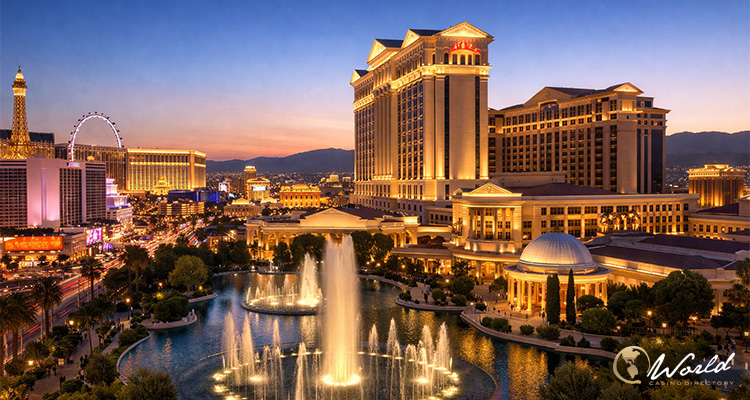
Caesars Entertainment leadership continues to characterize recent tourism softness in Las Vegas as part of a typical economic pattern rather than a structural problem. Company executives presented this view alongside financial updates and development plans affecting both Las Vegas operations and broader company performance.
CEO Attributes Tourism Dip To Economic Cycle
Tom Reeg, chief executive of Caesars Entertainment, addressed investor concerns by stressing that fluctuations in visitation levels reflect broader economic patterns. He stated, “I think this is normal economic cycle activity,” and reinforced that position by adding, “There’s really no crisis happening in Vegas.”
The company reported that visitation to Las Vegas fell about 7.5% during 2025, with declines noted in drive-in travel from California and reduced tourism from Canada. Leisure travel weakened during the summer period, although executives indicated that group bookings later supported occupancy levels. Conference activity and large-scale events contributed positively to results toward the end of the year.
Reeg explained that performance varies depending on the calendar. “Peak events, peak weekends, big conferences. The city’s and all of our properties are doing quite well,” he said, as reported by KLAS 8 News Now. He also acknowledged softer demand outside major events, noting, “It’s the shoulder periods when there’s not a big event or a big conference where demand is challenging.”
Occupancy figures illustrate the trend. Caesars operated around 92% occupancy across roughly 20,000 rooms during the fourth quarter, compared with about 96.5% a year earlier. Average daily room rates declined as well. Despite these shifts, executives described the fourth quarter as among the strongest historically for the company’s Las Vegas properties.
Financial Results And Operational Performance
Caesars reported fourth-quarter net revenues of $2.9 billion, representing a 4.4% increase compared with the same period in 2024. Regional casino operations offset a decline in Las Vegas revenue, which fell 3.4% during the quarter. Companywide earnings for the quarter reached approximately $901 million.
Full-year figures followed a similar pattern. Total revenue for 2025 reached $11.5 billion, up 2.4% year over year. Las Vegas revenue declined 4.7% during the year, while regional operations accounted for a larger share of the business. Annual earnings totaled $3.6 billion, reflecting a 2.7% decrease overall. Las Vegas contributed $1.7 billion, down 8.6% compared with the prior year.
Executives described steady performance linked to major events. Caesars highlighted strong activity tied to Formula 1 racing and New Year’s celebrations. Company leadership also noted that group and convention bookings represented about 17% of room nights during the fourth quarter.
Anthony Carano, president and chief operating officer, pointed to improving trends supported by events and conventions. He said: “During the fourth quarter we benefited from a strong event calendar, which produced a record F1 event for Caesars, a strong New Year’s Eve and 17% group and convention room-night mix during the quarter.”
Property Investments And Market Outlook
Caesars continues to invest in Las Vegas properties during periods of softer demand. Renovations at Caesars Palace include new presidential villas in the Colosseum Tower, additional sky villas in the Octavius Tower, a redesigned Palace Court gaming area, and a planned Omnia Dayclub project. The Augustus Tower renovation temporarily removes about 1,000 rooms from service during slower business periods.
Other projects include rebranding the Cromwell property into the Vanderpump Hotel and redeveloping the former Margaritaville site into Category 10 in partnership with Luke Combs and Opry Entertainment Group. Executives describe these upgrades as preparation for future demand.
Reeg also addressed broader market dynamics, noting that different parts of the Las Vegas Strip perform unevenly. He explained that premium properties often hold value more consistently but location factors also matter. According to him, central Strip locations show stronger resilience than properties at either end.
He commented on assumptions about pricing tiers, stating: “It’s not as simple as the low end’s not doing well, the high end’s doing well. That is part of it, but I think also location in the market plays a part.” He added, “I think it’s too simple to just say premium good, value bad. There’s a little more nuance in there.”
Executives expect convention activity and group travel to support performance through 2026. They also anticipate continued growth in the digital segment, including online gaming operations, which recorded ongoing increases in handle during the fourth quarter.
