

 United States
 Macau, China
 France
 Philippines
 Singapore
 Netherlands
 United Kingdom
 Canada
 Argentina
 Germany
 Estonia
 Peru
Peru Russia
 Australia
 South Africa
 Nigeria
 Malaysia
 Singapore
 India
India Finland
 China
China Ukraine
 Hong Kong
 Cyprus
 Turkey
 Greece
 Sweden
 South Korea
 Mexico
 Poland
 Ireland lottery results
 New Zealand lottery results
 Puerto Rico lottery results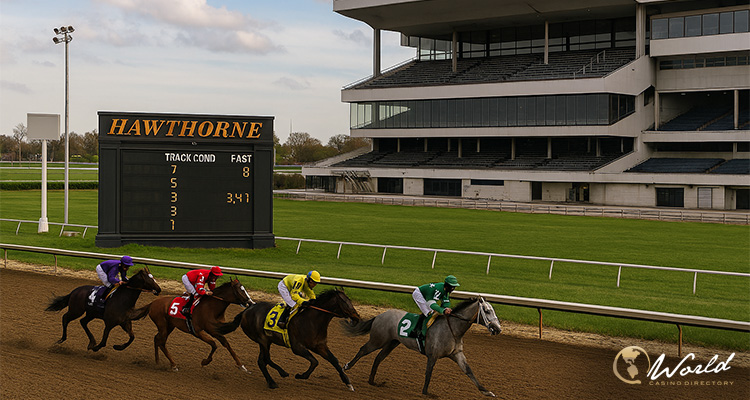
Chicago-area horse racing is approaching a critical moment as Hawthorne Race Course struggles to stabilize its finances amid unpaid obligations, suspended racing, and growing concern from horsemen that the region’s last remaining track may be nearing the end of its operations.
During a meeting of the Illinois Racing Board on January 28, Hawthorne assistant general manager John Walsh acknowledged that the track is currently unable to meet its financial commitments. He told regulators that Hawthorne cannot honor checks issued to horsemen and is using its limited income only to cover payroll and select simulcast signals. Vendors, horsemen, and other creditors remain unpaid as the situation continues to deteriorate.
Casino Project Delays and Mounting Liabilities
The immediate pressure intensified earlier in January when the Illinois Racing Board canceled Hawthorne’s harness racing after determining the track no longer met financial requirements. On January 25, the board followed up by suspending the license of Suburban Downs, the entity under which Hawthorne conducts Standardbred racing. Multiple harness programs have already been canceled, and the suspension has cast doubt on whether any form of racing can continue without an infusion of funds.
Hawthorne’s financial difficulties trace back several years. In 2019, state regulators approved plans for a casino at the track, a project widely viewed as a potential lifeline for Chicago-area racing. Hawthorne demolished much of its grandstand in preparation for construction beginning in 2020, but financing failed to materialize. Despite repeated assurances from track leadership that a deal was close, the project stalled, leaving partially demolished structures and unresolved construction liens.
Walsh told the board that Hawthorne is now pursuing a different approach to revive the casino effort. “We have gone in a different direction in the last month and a half as far as getting the racino up and running,” he said. “We’re working with a new partner, someone nearby, someone that’s trusted in Illinois and in racing, who really wants all of this to succeed.
“So it’s not going to be the same old, same old. We’re actually working on something that is going to happen. I’ve never been so optimistic in the last four years.”
Regulators and horsemen reacted cautiously. Track president and general manager Tim Carey did not attend the January 28 meeting, despite being asked to appear. Instead, Walsh and director of racing Jim Miller fielded questions but said they lacked details on several key issues, including why Hawthorne’s bank froze its accounts.
“That’s something I have no idea,” Walsh said. “What the bank has done, what they’re doing. I don’t understand the whole situation.”
Horsemen Warn of Severe Consequences
Leaders representing Thoroughbred and Standardbred horsemen warned that delays and uncertainty are already affecting business decisions. Chris Block, president of the Illinois Thoroughbred Horsemen’s Association, said owners and trainers must soon decide where to race in 2026, with Hawthorne’s Thoroughbred meet scheduled to begin March 29.
“We want to race this year at Hawthorne,” Block said, as Bloodhorse reports. “But to be clear, our greatest fear at this time would be to start the Thoroughbred meeting at Hawthorne on Sunday, March 29, only for Hawthorne then to abruptly end the meeting because it cannot pay the purses. That would be catastrophic for our members.”
Block urged the board to intervene if Hawthorne fails to provide financial transparency. “If Hawthorne is not forthcoming with financial information, we respectfully urge this board to gather that information and make it available so that owners, trainers, and breeders have reassurance that committing to Hawthorne this year is a sound business decision,” he said. “Above all, we need clarity. We need truth.”
Jeff Davis, president of the Illinois Harness Horsemen’s Association, said members are owed nearly $1 million in purse money dating back to 2025. “The horsemen who depend on Hawthorne for their livelihoods, who have not been paid since before Christmas, deserve to hear directly from the person responsible for that,” Davis said of Carey’s absence. “His absence, I think, is disrespectful not only to horsemen, but to you as a board.”
Regulatory Pressure and Shrinking Timeline
Additional financial strain emerged during the meeting with discussion of a Cook County Circuit Court judgment in favor of Churchill Downs Inc. for approximately $1.6 million in unpaid simulcast settlement fees. Walsh disputed the amount and said no settlement had been reached, while acknowledging that Hawthorne has not paid outstanding obligations.
Illinois Racing Board members explored options to protect remaining revenues. Marc Laino proposed placing Hawthorne’s income into a segregated account for equitable distribution to creditors. Executive director Dominic DiCera said the bank currently controls the process, though staff had begun examining potential steps.
Board chairman Daniel Beiser closed the meeting by expressing frustration with the lack of concrete information. “We don’t need empty words, we need specifics,” he said. “We need stuff that can be verified and we need it in writing from Hawthorne.”
The timeline is tightening. Hawthorne’s harness meet, if resumed, is slated to end February 15, with the racing surface typically converted for Thoroughbred training immediately afterward. Walsh said the track will not proceed with that transition without financial resolution.
