

 United States
 Macau, China
 France
 Philippines
 Singapore
 Netherlands
 United Kingdom
 Canada
 Argentina
 Germany
 Estonia
 Peru
Peru Russia
 Australia
 South Africa
 Nigeria
 Malaysia
 Singapore
 India
India Finland
 China
China Ukraine
 Hong Kong
 Cyprus
 Turkey
 Greece
 Sweden
 South Korea
 Mexico
 Poland
 Ireland lottery results
 New Zealand lottery results
 Puerto Rico lottery results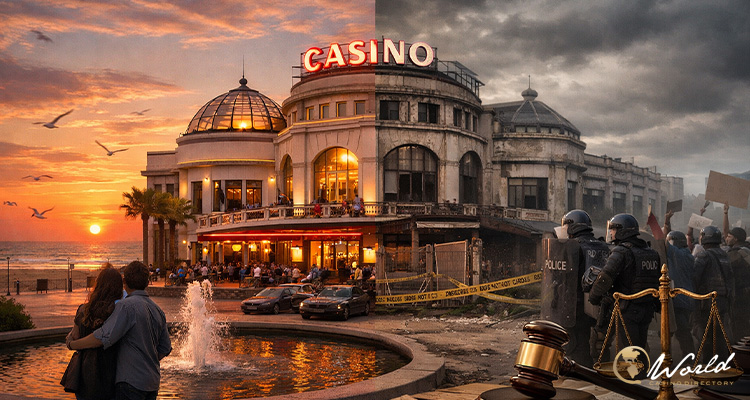
The fate of the Berck-sur-Mer casino in France remains in legal limbo, as a complex dispute over ownership continues to unfold in the courts. At the center of the conflict is a debate over who owns the building, with the city of Berck-sur-Mer and the Partouche Group presenting opposing interpretations of the law. This ongoing legal battle involves both administrative and civil law matters, with the municipality of Berck-sur-Mer seeking control of the casino’s building, while the Partouche Group asserts its legal ownership.
The City’s Claim: A Mistake with Long-Term Consequences
Berck-sur-Mer’s mayor, Bruno Cousein, recently addressed the origins of the dispute in an interview with Radio 6, explaining that the conflict stems from a 1997 decision when the municipality sold the casino building to a private operator to fund its renovation. The mayor argues that this sale created a legal loophole, particularly since the casino operated under a public service delegation agreement. He contends that under the principle of “reversionary assets,” the building should have automatically reverted to the municipality once the contract ended, as confirmed by administrative courts, including the Council of State.
Mayor Cousein expressed frustration with the situation, stating that while the town was recognized as having the right to reopen the casino, it was still denied access to the building. The mayor called this scenario “absurd,” particularly as 39 employees, who were legally transferred to the new operator, remain unable to work. The city’s inability to take possession of the building has put the casino’s future in jeopardy.
According to the French Radio 6, Fabrice Paire, Chairman of the Partouche Group, rejected the mayor’s interpretation, asserting that his group is merely “enduring” the situation created by the mayor’s stance. According to Paire, the 1997 sale was legally conducted, and the city’s argument about the building reverting to municipal ownership is not grounded in law. He emphasized that a city does not sell a property without a thorough legal process, which included city council approval and notary services.
Paire pointed out that the sale was made to Groupe Partouche SA, a private company that became the legal owner of the building. He also clarified that the public service concession, operated by Jean Metz SAS, was separate from the property ownership. Therefore, the Partouche Group argues that the reversionary property regime, which could allow the municipality to claim ownership, is not applicable in this case.
The Partouche Group maintains that it has invested heavily in the casino building, particularly after the discovery of dry rot, and that its legal rights as the building’s owner should be respected. Paire strongly refutes the mayor’s interpretation, arguing that the reversionary property regime, which was codified only in 2019, cannot retroactively apply to a sale that took place in 1997. The Group also disputes the scope of the Council of State’s decisions, claiming they are not legally binding on the ownership question but only pertain to the delegation process.
A Complex Legal Stalemate: Administrative vs. Civil Courts
At present, two legal systems are at odds. The administrative courts, which oversee public service agreements, have sided with the city’s interpretation of the situation, while the civil courts, which govern property ownership, support the Partouche Group’s claim to the building. The situation has led to a legal deadlock, with each side waiting for a decisive ruling from the courts.
In an attempt to resolve the issue, the municipality has appealed to the prefect to bring the matter before the Court of Jurisdictional Disputes. However, in the meantime, the casino remains closed, leaving employees in limbo and depriving Berck-sur-Mer of an important local landmark. This ongoing dispute has sparked frustration on both sides, with the mayor warning that the city’s failure to resolve the situation could result in damage to the casino and its future operator, Infiniti, which plans to invest €8 million in the venue.
While the legal battle rages on in Berck-sur-Mer, the Partouche Group is focusing on its broader expansion plans. In 2025, the company reported strong growth, with a 5.1% increase in gross gaming revenue (GGR) to €748.3 million, up from €712.3 million in 2024. This growth was driven by strong performances in both slot machines and table games.
Partouche is also making significant investments in its other casinos. The company is undertaking renovations at several properties, including Saint Amand-les-Eaux, Forges-les-Eaux, and the Casino Partouche Cannes 50 Croisette. These renovations are part of the group’s strategy to improve its customer experience and enhance its casino portfolio. Additionally, the company has announced plans to relocate its Parisian Gaming Club to a new, larger venue in 2026, marking a new chapter for the brand.
