

 United States
 Macau, China
 France
 Philippines
 Singapore
 Netherlands
 United Kingdom
 Canada
 Argentina
 Germany
 Estonia
 Peru
 Russia
 Australia
 South Africa
 Nigeria
 Malaysia
 Singapore
 India
 Finland
 China
 Ukraine
 Hong Kong
 Cyprus
 Turkey
 Greece
 Sweden
 South Korea
 Mexico
 Poland
 Ireland lottery results
 New Zealand lottery results
 Puerto Rico lottery results
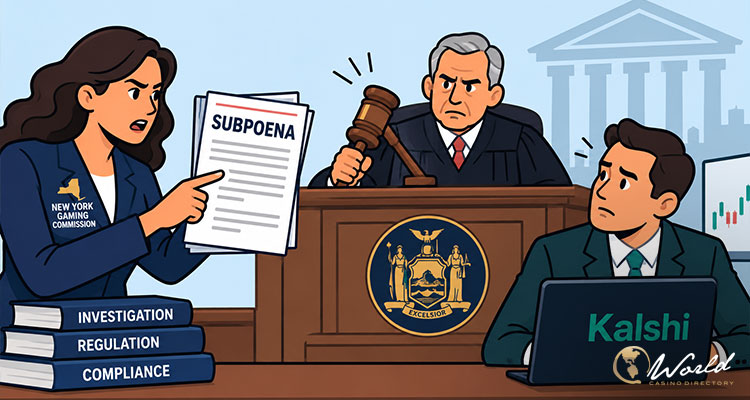
The New York State Gaming Commission has asked a Manhattan court to compel Kalshi to comply with investigative subpoenas tied to possible violations of state gambling law.
The verified petition names Kalshi Inc. and KalshiEX LLC as respondents and was received by the Supreme Court of the State of New York, County of New York, on October 22, 2026. Attorney General Letitia James’ office represents the Commission.
The subpoenas were issued on July 31 under Section 104(7) of New York’s Racing, Pari-Mutuel Wagering and Breeding Law and carried an August 14 return date.
They seek records covering Kalshi’s sports-event contracts, products offered to New Yorkers under 21, advertising that describes its products as wagers or bets, and the company’s ownership and corporate structure.
“The Gaming Commission seeks the documents and information requested in the Subpoenas so it can determine whether to issue civil penalties against Kalshi and others for violations of the Racing Law and, if so, in what amounts,” the petition says.
Regulator Says Kalshi Has Not Fully Complied
The Commission alleges that Kalshi has operated in New York without a sports wagering license and says the requested information is needed to assess the company’s activities.
The petition claims Kalshi has “operated a massive enterprise in New York designed to enable individuals to place wagers relating to sports and other matters.”
According to the filing, Kalshi has declined to provide documents responsive to some requests and supplied insufficient answers to others.
“Despite multiple court rulings declining to enjoin the Gaming Commission from enforcing the Racing Law, Kalshi nonetheless refuses to comply with key Subpoena requests necessary to assess the scope of Kalshi’s operations in New York,” the petition says, as reported by RG.org.
The Commission also argues that the investigation could suffer if the records remain unavailable.
“The Gaming Commission’s investigation into Kalshi’s potential violations of New York’s gambling laws will be irreparably harmed if Kalshi is permitted to defy the lawfully issued Subpoenas,” it says.
The filing also addresses third parties that may facilitate Kalshi’s activity.
“There can be no genuine dispute that the Gaming Commission has a legitimate basis to investigate both Kalshi’s unlicensed activities and the activities of third parties that might facilitate those activities (e.g., Futures Commission Merchants),” states the lawsuit. “The Gaming Commission seeks the documents and information requested in the subpoenas so it can determine whether to issue civil penalties against Kalshi and others for violations of the Racing Law and, if so, in what amounts.”
No ruling had been reported in the supplied material, and no public response from Kalshi to the petition was identified.
Federal Court Ruling Preceded the Subpoenas
The Commission issued the subpoenas after a federal court rejected Kalshi’s attempt to block state enforcement.
On July 7, US District Judge Analisa Torres denied Kalshi’s motion for a preliminary injunction against the Commission and its officials. That ruling allowed New York to continue pursuing enforcement while the wider jurisdictional dispute remained unresolved.
New York later filed a separate lawsuit against Kalshi on July 31, alleging that it operated an unlicensed gambling business. That case seeks to halt the company’s New York activity and recover financial penalties and other amounts.
One report placed the claimed damages at “$36,000,000,000.00 at minimum pending accounting.”
Attorney General James said at the time:
“No matter what they call themselves, prediction markets like Kalshi are gambling platforms, plain and simple,”
Governor Kathy Hochul added:
“Kalshi has chosen to ignore New York’s gaming laws, which exist to protect consumers.”
The subpoena case now focuses specifically on whether Kalshi must turn over the requested records.
Broader Fight Over Prediction Market Regulation Continues
Kalshi maintains that its event contracts fall under federal commodities regulation through the Commodity Futures Trading Commission.
The CFTC sued New York in April, seeking a declaration that federal law gives it exclusive authority over event contracts and asking the court to prevent the state from enforcing rules it considers preempted.
“New York is the latest state to ignore federal law,” CFTC Chairman Michael Selig said when that case was announced, adding that “the CFTC will not allow overzealous state governments to undermine the agency’s longstanding authority over these markets.”
The agency later ordered Kalshi to continue operating in New York after the state filed its July lawsuit.
Selig said that “Congress did not intend for derivatives exchanges to be regulated under a patchwork of state gaming laws.”
Other jurisdictions have also challenged prediction market activity. The supplied material cites actions involving Utah, Connecticut and Ohio, along with restrictions affecting Kalshi sports contracts in Massachusetts, Nevada, Michigan, Washington and several tribal territories in California.
New York has also filed a separate case against Polymarket.
