

 United States
 Macau, China
 France
 Philippines
 Singapore
 Netherlands
 United Kingdom
 Canada
 Argentina
 Germany
 Estonia
 Peru
Peru Russia
 Australia
 South Africa
 Nigeria
 Malaysia
 Singapore
 India
India Finland
 China
China Ukraine
 Hong Kong
 Cyprus
 Turkey
 Greece
 Sweden
 South Korea
 Mexico
 Poland
 Ireland lottery results
 New Zealand lottery results
 Puerto Rico lottery results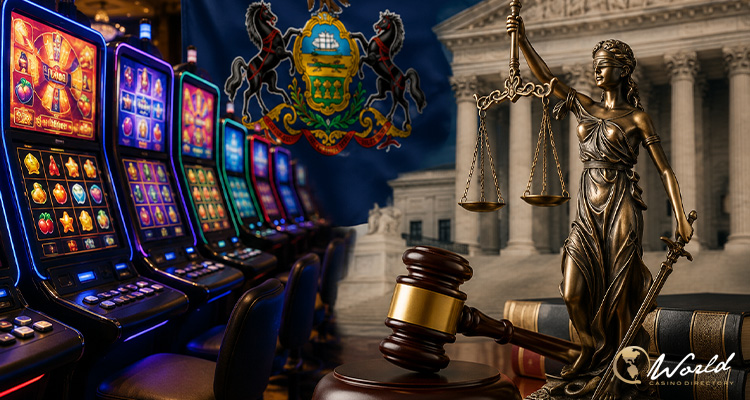
Pennsylvania’s highest court has ruled that skill games fall under the legal definition of slot machines, a decision that could reshape the future of an industry that has expanded across bars, convenience stores, gas stations, and social clubs throughout the state.
The Pennsylvania Supreme Court issued its decision on Monday, June 15, concluding that the machines must comply with existing gambling and criminal laws. At the same time, the court delayed the practical effect of its ruling for 120 days, giving lawmakers an opportunity to establish a regulatory framework before enforcement actions begin.
An estimated 70,000 skill game terminals currently operate in Pennsylvania, where they have existed in a legal gray area for years due to conflicting interpretations by lower courts.
Supreme Court Rejects Earlier Court Findings
The ruling resolves two separate legal disputes that reached the state’s highest court.
One case originated in 2019 after law enforcement seized machines from a bar and a skill game supplier. The dispute focused on whether the devices relied primarily on skill or chance. Lower courts had determined that players could use skill to influence outcomes and therefore the machines did not qualify as slot machines.
The second case involved Pace-O-Matic, one of the largest developers and distributors of skill games. The company sought a legal declaration that Pennsylvania’s gambling laws did not apply to its products. Commonwealth Court had previously agreed that existing gaming statutes were not designed to regulate skill games.
The Supreme Court rejected both conclusions.
Writing for the majority, the justices said the lower court’s interpretation of state law was “deeply flawed” and “incorrect on both points.” According to the ruling, the devices satisfy both the statutory and ordinary definitions of slot machines. The court determined that any element of player skill does not alter that classification.
Justice David Wecht summarized the majority position directly, writing: “The device is a ‘slot machine.’”
Justice Christine Donohue reached a similar conclusion in a separate opinion.
“Because chance predominates both the player’s eligibility for winnings and the magnitude of those winnings, the [skill games] device is a gambling device,” Donohue wrote.
Four-Month Window for Legislative Action
Although the court ruled decisively, it acknowledged the potential disruption the decision could create for businesses currently operating the machines.
For that reason, the justices established a 120-day safe-harbor period before enforcement begins. During that time, the Pennsylvania General Assembly can choose to create a legal framework for licensing, regulating, and taxing skill games.
The court also emphasized that lawmakers remain free to adopt a different policy approach.
“Naturally, because all that follows is a consequence of statutory law, our General Assembly also remains free at any time to take whatever legislative action it may deem appropriate,” the justices wrote.
The decision arrives as state leaders negotiate Pennsylvania’s next budget. Senate Republican leaders quickly described gaming reform as a “critical piece” of those discussions, while Governor Josh Shapiro’s administration and House Democrats said they were reviewing the ruling.
Taxation remains the primary obstacle. Shapiro has proposed taxing skill game revenue at 52%, close to the 55% tax applied to casino slot machines. Senate Republicans have previously supported a 35% rate, while some lawmakers have advocated for a lower 16% rate.
The Independent Fiscal Office has estimated that a regulated skill game market could eventually generate more than $1 billion annually in state revenue.
Industry and Public Policy Debate Continues
The ruling immediately drew criticism from Pace-O-Matic, which said it strongly disagrees with the court’s interpretation.
The company warned that many small businesses, veterans’ organizations, and fraternal clubs rely on income generated by the machines.
According to Pace-O-Matic, operators now face difficult choices involving either the removal of machines or compliance with regulations that could substantially affect profitability.
At the same time, supporters of stronger oversight welcomed the decision. Pennsylvania Attorney General Dave Sunday called the ruling a “significant victory for consumers, taxpayers, and the rule of law.”
“The Supreme Court recognized what our office has argued from the beginning – these machines operate as gambling devices and cannot legally exist without the same oversight, regulation and accountability as other forms of legalized gaming in the commonwealth,“ Sunday added. ”Pennsylvanians deserve protections that ensure games are fair, transparent and operated within the bounds of the law.”
Concerns about public safety have also played a role in the debate. Philadelphia banned skill games in 2023 over concerns about crime, though enforcement was halted while legal challenges worked their way through the courts. Civil lawsuits connected to violent robberies at businesses hosting the machines have further intensified scrutiny.
Some lawmakers are urging caution as the legislature considers next steps.
“What we are talking about here is the potential largest expansion of gambling in Pennsylvania history since the casinos,” state Rep. Ben Waxman (D., Philadelphia) told Spotlight PA this month. “And we cannot make short-term decisions with really long-term consequences.”
Unless lawmakers pass new legislation before the 120-day period expires, skill game machines will become subject to the same legal restrictions and oversight requirements that govern slot machines in Pennsylvania.
