

 United States
 Macau, China
 France
 Philippines
 Singapore
 Netherlands
 United Kingdom
 Canada
 Argentina
 Germany
 Estonia
 Peru
Peru Russia
 Australia
 South Africa
 Nigeria
 Malaysia
 Singapore
 India
India Finland
 China
China Ukraine
 Hong Kong
 Cyprus
 Turkey
 Greece
 Sweden
 South Korea
 Mexico
 Poland
 Ireland lottery results
 New Zealand lottery results
 Puerto Rico lottery results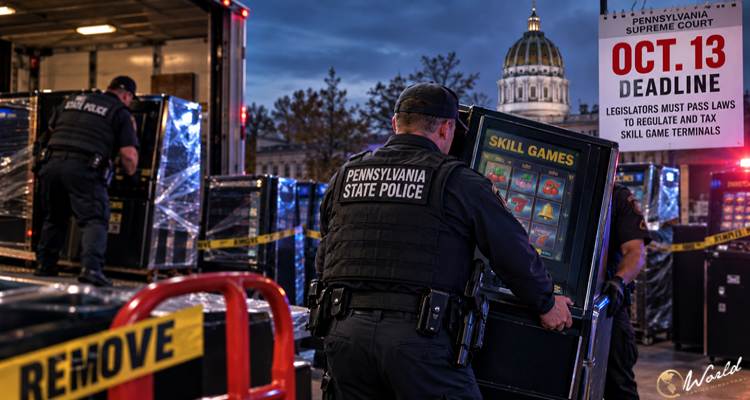
Pennsylvania State Police (PSP) have advised businesses to physically remove skill game machines before enforcement begins on October 14, following a state Supreme Court ruling that classified the devices as slot machines.
The guidance comes as lawmakers approach an October 13 deadline to regulate or tax the machines. The Pennsylvania Supreme Court established the 120-day period after ruling on June 15 that skill games fall under the state’s Gaming Act and qualify as gambling devices under the Crimes Code.
Under the ruling, businesses that own, operate or maintain the machines without a license from the Pennsylvania Gaming Control Board can face criminal prosecution. Current law permits slot machines at licensed casinos and qualifying truck stop establishments, leaving most venues that currently host skill games outside the permitted framework.
The PSP has made clear that simply switching off a machine will not satisfy the law. Businesses have been advised to contact distributors or vendors and arrange for the removal of machines and related equipment, including ticket redemption terminals.
“The PSP strongly recommends that businesses currently hosting such machines discuss their removal with any distributors or vendors who may own the machines and associated equipment, including ticket redemption terminals.”
If a vendor refuses to collect the equipment, businesses can contact State Police for assistance.
Supreme Court Decision Sets New Requirements
The June 15 ruling affects skill game terminals located at various small businesses and community establishments across Pennsylvania. The court determined that the devices meet the statutory definition of slot machines.
The State Police guidance states that establishments continuing to possess, operate or maintain the machines after October 14 could face enforcement action. Authorities may seize and forfeit the machines, associated equipment and money connected to their operation, while criminal charges may also follow where appropriate.
The police recommendation has created a difference between the official enforcement position and the approach described by some vendors. Lena Keares, who operates K&S Games in Lancaster, said the software running the machines would be switched off at midnight on October 13. Operators would then return to remove dongles, which are hardware components that allow the games to function.
Keares said the terminals themselves could remain at the locations.
“There’s nothing to be seized if there’s no software,” Keares said. “It is essentially just a wooden box.”
State Police did not respond to a follow-up question about whether removing the software would be sufficient for businesses to comply.
Pace-O-Matic, a leading skill game manufacturer and a party to the Supreme Court case, has said it will comply with the court-imposed deadline.
“Pace-O-Matic has said since the June 15 Supreme Court ruling, we will abide by the imposed deadline. Our operators and the locations that have our skill games know this is our stance and are prepared to turn off their skill games if needed. The Supreme Court placed regulating skill games into the hands of the legislature, and we are optimistic lawmakers will pass a fair and commonsense skill game regulation bill before October 13. A disruption of skill game revenue will harm American Legions, VFWs, volunteer firefighters, fraternal groups and small businesses. Some will lay off staff, others will close their doors. Community programs will also be in a crisis when these organizations and businesses can no longer donate to them.”
Lawmakers Remain Divided Over Regulation
Pennsylvania legislators have considered taxes and limits for skill games for years, yet recent negotiations failed to produce an agreement. Senate Majority Leader Joe Pittman said in August that lawmakers had not discussed a solution since July.
Gov. Josh Shapiro proposed a framework in February that would cap the statewide number of machines at 40,000 and impose a 52% tax on gross terminal revenue. The Independent Fiscal Office estimated that the proposal could generate $487 million during the 2026-27 fiscal year, with projected annual revenue exceeding $1 billion in subsequent years as the tax gradually took effect.
The Pennsylvania Attorney General’s Office estimated that approximately 70,000 skill game machines operated statewide in June.
Sen. Chris Gebhard introduced legislation in 2025 that would impose a 35% tax. He has said he expects skill game regulation to become a major issue when lawmakers return in late September.
Pace-O-Matic supports a different structure. Its proposal would allow 50,000 machines across Pennsylvania while requiring businesses to pay a $500 monthly fee for each machine. Keares said K&S Games supports the proposal and considers it a workable way to generate state revenue while keeping the machines in operation.
“We have been educating legislators to ensure that they truly understand what skill games are because they are not like other machines,” Keares said. “They truly do help the small businesses and the community.”
Businesses Warn of Lost Revenue
Organizations that host skill games say the machines provide important income. Jim Drier, commander of American Legion Post 34 in Lancaster, said three machines generate between $500 and $1,800 per month for the post. The money supports operating expenses and charitable donations.
Drier said the machines at his post will lose their software at midnight on the deadline before the operator eventually retrieves them.
“The state police sent out these memos, and it made it sound like it’s going to be Prohibition, and they’re going to drag all the machines out in the parking lot and bash them with axes, but it’s not going to be like that,” Drier said.
The Pennsylvania Licensed Beverage and Tavern Association has also warned businesses about the consequences of continuing to operate the machines. According to Lancaster Online, executive director Chuck Moran said skill games became an important source of revenue for some businesses after a 2016 law expanded the availability of beer-to-go sales beyond traditional taverns and bars.
Moran also raised concerns that violations could affect liquor licenses.
“The advice that we’ve been given, now that we know for sure that they’re illegal, is don’t take a chance and do damage to your license,” Moran said. “We hope that they’re listening to us instead of taking bad advice based upon what they want to hear.”
