

 United States
 Macau, China
 France
 Philippines
 Singapore
 Netherlands
 United Kingdom
 Canada
 Argentina
 Germany
 Estonia
 Peru
 Russia
 Australia
 South Africa
 Nigeria
 Malaysia
 Singapore
 India
 Finland
 China
 Ukraine
 Hong Kong
 Cyprus
 Turkey
 Greece
 Sweden
 South Korea
 Mexico
 Poland
 Ireland lottery results
 New Zealand lottery results
 Puerto Rico lottery results
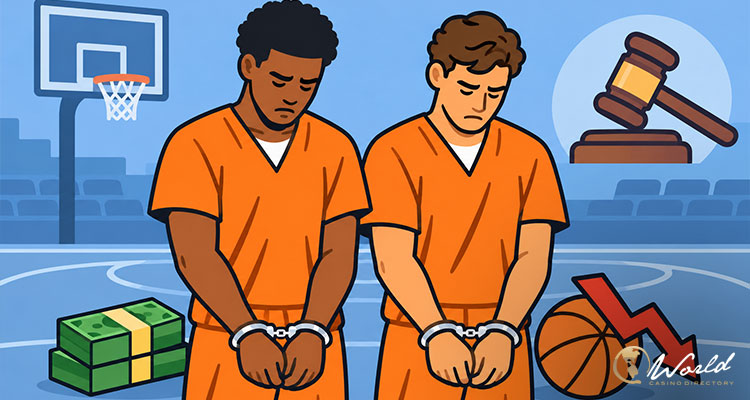
Two former NCAA Division I basketball players have received prison sentences for their involvement in a nationwide point-shaving operation that involved more than 39 college athletes and generated millions of dollars in fraudulent sports wagers.
Dyquavian Short, a former University of New Orleans guard, was sentenced to one day in prison and two years of supervised release by U.S. District Judge Nitza Quiñones Alejandro on November 17. The court also ordered him to complete 100 hours of community service and forfeit $15,000.
Isaiah Adams, a former forward for the State University of New York at Buffalo, received a considerably longer sentence. The 24-year-old was ordered to serve six months in prison, followed by 15 months of supervised release, and forfeit $17,500.
Both players pleaded guilty to bribery charges after participating in a scheme that involved deliberately manipulating performances during NCAA men’s basketball games to help betting syndicates win wagers.
The sentences represent the first penalties imposed on college players in the investigation, which has exposed widespread corruption across multiple Division I basketball programs.
Short Receives First Player Sentence in Federal Investigation
Short, 21, appeared before Judge Quiñones Alejandro in Philadelphia after admitting that he deliberately underperformed in at least three University of New Orleans games during the 2024-2025 season. According to prosecutors, his actions helped the betting syndicate generate approximately $33,741 in gambling profits.
During the hearing, Short expressed remorse for his involvement and accepted responsibility for his conduct. “I take full accountability for what I’ve done,” he said in a prepared statement, while apologizing to those affected by the scheme. The former guard was taken into custody immediately after the hearing to serve his one-day prison sentence. The judge told him: “You will see a place that you don’t want to return to,” adding that he would be released at approximately 5 p.m.
Short had faced a maximum possible prison term of five years. However, prosecutors and his defense team both highlighted his lack of a previous criminal record, cooperation with investigators and willingness to plead guilty relatively early in the proceedings.
Assistant U.S. Attorney Louis Lappen, who led the prosecution, described Short as one of the “least culpable defendants in this case.” The judge acknowledged that determining an appropriate punishment had been difficult, given the seriousness of the wider investigation and Short’s comparatively limited involvement.
In a sentencing memorandum, prosecutors explained that Short admitted his participation during an interview with FBI agents in September 2025. He acknowledged deliberately reducing his effort during three games and helping bettors profit from the resulting performances.
Short also told investigators that he received payments from the individuals behind the operation. According to his account, he collected money from “an unknown white male with a hood and ski mask.” His guilty plea, entered in August, covered one felony count of aiding and abetting bribery in sporting contests. Prosecutors dropped a separate conspiracy charge related to wire fraud as part of the agreement.
Following his indictment, Short returned to Greenville, North Carolina, where he moved back in with his parents. He subsequently found employment as a stocker at a Food Lion grocery store and began saving money with the intention of returning to college. His attorney, Leigh Skipper, said Short wanted to move forward after losing his basketball scholarship as a consequence of the scandal.
Short’s former teammate Cedquavious “Dae Dae” Hunter has also pleaded guilty and is scheduled to receive his sentence on January 19. The NCAA has permanently ruled both players ineligible.
Adams Receives Longer Prison Term Over Greater Involvement
Adams appeared before the same judge one day after Short and received six months behind bars, followed by 15 months of supervised release.
The former Buffalo player was involved in manipulating games during the 2023-2024 season. Prosecutors established that he deliberately underperformed to help betting interests profit from first-half point spreads in games against Western Michigan and Kent State in February 2024. His conduct also included assisting former teammate Shawn Fulcher in recruiting another Buffalo player into the operation. Prosecutors considered this additional involvement when assessing his responsibility.
A presentence memorandum highlighted the financial scale of the operation and the losses suffered by sportsbooks. The betting activity associated with the wider scheme resulted in at least $1.1 million in losses to financial victims, while Adams’ involvement contributed to the group’s broader fraudulent wagering activities.
Before Adams received his sentence, prosecutors had recommended a substantially harsher punishment. Adams was charged through an information filed in December 2025 and pleaded guilty to one count of bribery in sporting contests in February. His sentence includes the forfeiture of $17,500.
Investigation Exposes Widespread College Basketball Corruption
Federal court documents describe an operation that initially focused on professional basketball in China before expanding into American college sports.
The investigation found that, beginning around September 2022, a group of individuals recruited and bribed players in the Chinese Basketball Association during the 2022-2023 season. The participants deliberately manipulated performances through point shaving, allowing the organizers to place substantial wagers against the affected teams through various gambling outlets.
After generating profits from those games, the group shifted its attention to NCAA men’s basketball.
During the 2023-2024 and 2024-2025 seasons, organizers approached college players and offered payments in exchange for influencing specific game outcomes. According to prosecutors, the scheme targeted athletes whose legitimate Name-Image-Likeness compensation opportunities could be supplemented or exceeded by the proposed bribes.
The investigation identified more than 39 players across at least 17 NCAA Division I programmes who fixed or attempted to fix more than 29 games.
The U.S. Attorney’s Office reported that the operation involved more than $3 million in fraudulent wagers and caused over $1.1 million in losses to sportsbooks nationwide. Other reporting on the investigation put the betting syndicate’s total wagering activity at approximately $3.6 million across more than two dozen games.
The affected events included two Buffalo games in February 2024 and a New Orleans fixture the following month.
Federal prosecutors have emphasized the damage caused by players who accepted payments to influence sporting competitions. In a sentencing memorandum concerning Short, Lappen highlighted the responsibilities associated with competing at the highest level of college basketball.
“The corrupt players in this case dedicated their lives to competitive sports, reached the pinnacle of college basketball, earning NCAA Division I scholarships, and were among the top college basketball players in the country,” Lappen said according to the Department of Justice.
“Given their status as scholarship student-athletes, they occupied a position of prominence and trust within their universities, and their teammates, coaches and fans relied on them to compete honestly.
Instead, the corrupt players betrayed that trust and compromised the integrity of the competition for personal financial gain, choosing to accept bribe payments to fix games.”
The penalties imposed on Short and Adams also come after the sentencing of Jalen Smith, identified as one of the operation’s presumed ringleaders. Smith received a 72-month prison term, followed by three years of supervised release, and is scheduled to report to federal prison by December 1.
Two other alleged organizers, Shane Hennen and Marves Fairley, have pleaded guilty to multiple charges in Pennsylvania and separate gambling-related charges in Brooklyn.
The wider proceedings remain ongoing. Twenty-four of the 27 defendants in the main case and related proceedings are scheduled to change their pleas or receive sentences. Former Kennesaw State players Simeon Cottle and Demond Robinson, along with former NBA guard Antonio Blakeney, also remain connected to the investigation, although their cases have different procedural statuses.
Cottle, who was named the 2025-2026 Conference USA Preseason Player of the Year, did not cooperate with an NCAA investigation into sports wagering, according to an announcement by the association in April.
The FBI’s Philadelphia office led the investigation, receiving assistance from FBI New York and the U.S. Attorney’s Office for the Eastern District of New York.
