

 United States
 Macau, China
 France
 Philippines
 Singapore
 Netherlands
 United Kingdom
 Canada
 Argentina
 Germany
 Estonia
 Peru
Peru Russia
 Australia
 South Africa
 Nigeria
 Malaysia
 Singapore
 India
India Finland
 China
China Ukraine
 Hong Kong
 Cyprus
 Turkey
 Greece
 Sweden
 South Korea
 Mexico
 Poland
 Ireland lottery results
 New Zealand lottery results
 Puerto Rico lottery results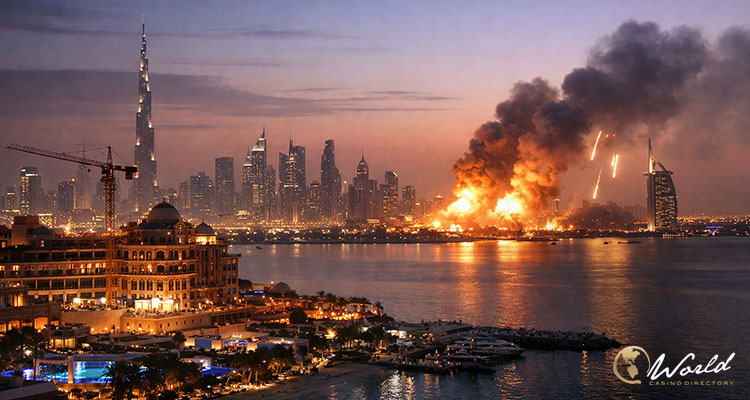
Wynn Resorts and MGM Resorts International are reassessing security conditions in the United Arab Emirates after Iranian drone and missile strikes hit parts of Dubai and Abu Dhabi, escalating tensions across the region. While neither company reported damage to its developments, both confirmed they are maintaining contact with employees as the situation unfolds.
The violence followed weekend airstrikes by the United States and Israel on Iran. In response, Iran launched attacks across several Middle Eastern locations. Two projectiles struck areas in Dubai, damaging multiple hotels and affecting operations at Dubai International Airport. The BBC, cited by Nevada Independent, reported that an explosion hit the five-star Fairmont The Palm on Palm Jumeirah, while debris from an intercepted drone caused a “minor fire” on the outer facade of the Burj Al Arab hotel.
Resort Developers Review Safety Measures
A spokesperson for Wynn Resorts said the company was “closely monitoring the situation and have plans in place to secure the safety of our employees should the situation necessitate.” The company did not disclose how many U.S. citizens are working on its UAE development.
In response to inquiries about whether the conflict could delay construction of Wynn Al Marjan Island in Ras Al Khaimah, Wynn rvealed that it is “closely monitoring the situation” and that it has “plans in place to secure the safety” of the group’s employees in the United Arab Emirates (UAE) “should the situation necessitate”.
MGM Resorts also addressed the conditions on the ground. Company spokesman Brian Ahern said MGM does not currently employ any American citizens on its UAE project. He stated that employees “are safe and sheltering in place, per guidance from authorities. We’re in close contact with them and having regular check-ins.”
Debris from an intercepted drone fell in a residential area of Ras Al Khaimah. Dubai, less than 90 minutes by road from Ras Al Khaimah, has also faced drone and missile activity in recent days. Bahrain and Kuwait were among other Gulf states reportedly targeted.
Governments outside the region have begun issuing advisories. The U.S. State Department urged Americans in 14 Middle Eastern countries, including the UAE, to depart immediately via commercial transportation “due to severe, escalating safety risks.” The United Kingdom has reportedly asked its nationals in Dubai to register with authorities in preparation for possible evacuation.
Major Investments Continue in Ras Al Khaimah and Dubai
Wynn is constructing the $5.1 billion Wynn Al Marjan Island resort in Ras Al Khaimah, about 50 minutes from Dubai International Airport. The resort will introduce the UAE’s first legal casino when it opens in spring 2027. Wynn holds a 40 percent equity stake in the project and is developing it with local partners.
In early December, Wynn said it had spent or “fully bought out” $3.4 billion of the total project budget, representing about two-thirds of the overall cost. The 70-floor hotel tower reached its highest point in December. Plans call for 1,550 accommodations, including rooms, suites, and beachfront villas, along with 22 restaurants and lounges, meeting facilities, and retail areas.
MGM Resorts is working with Wasl Asset Management Group on a separate $1.2 billion development on Jumeirah Beach in Dubai. The 25-acre project will include three hotel towers with a combined 1,500 rooms and will operate under the Aria, MGM Grand, and Bellagio brands. Although the resort is currently planned as a non-gaming property, MGM CEO Bill Hornbuckle has said the site includes nearly 200,000 square feet that could eventually house either a casino or a retail complex.
About three-quarters of the UAE population adheres to Islam, which considers gambling harmful. Even so, the country’s leadership has taken steps toward establishing a regulated commercial gaming industry. Former MGM chairman and CEO Jim Murren now chairs the UAE’s General Commercial Gaming Regulatory Authority, formed to oversee a national lottery and potential casino operations.
Market Reaction and Industry Outlook
Financial markets reflected investor unease after news of the strikes. Wynn shares dropped $4.75 on the Nasdaq to close at $103.44. MGM Resorts stock fell $1.14 on the New York Stock Exchange, ending at $35.72.
Wynn has previously cautioned investors about the sensitivity of its operations to geopolitical instability. In its annual report, the company stated: “our business is particularly sensitive to the willingness of our customers to travel and spend time at our resorts […] Acts or threats of terrorism or concerns over the possibility of such acts have in the past disrupted, and may again severely disrupt, domestic and international travel […] Regional conflicts could have a similar effect on domestic and international travel. Disruptions in air and other forms of travel as a result of any terrorist act, outbreak of hostilities, escalation of war or worldwide infectious disease outbreak have, and could in the future have, a material and adverse effect on our business and financial condition, results of operations and cash flows”.
Advisory firm CBRE Institutional Research estimated two years ago that a legalized gaming market in the UAE could generate as much as $8.6 billion annually, a figure approaching the projected 2025 total for the Las Vegas Strip. Analysts have suggested that casino resorts operated by U.S.-based companies could broaden the country’s visitor base beyond its existing European and Asian tourism markets.
For now, construction continues on both projects, even as regional tensions introduce new uncertainty for companies pursuing expansion in the Gulf.
