

 United States
 Macau, China
 France
 Philippines
 Singapore
 Netherlands
 United Kingdom
 Canada
 Argentina
 Germany
 Estonia
 Peru
Peru Russia
 Australia
 South Africa
 Nigeria
 Malaysia
 Singapore
 India
India Finland
 China
China Ukraine
 Hong Kong
 Cyprus
 Turkey
 Greece
 Sweden
 South Korea
 Mexico
 Poland
 Ireland lottery results
 New Zealand lottery results
 Puerto Rico lottery results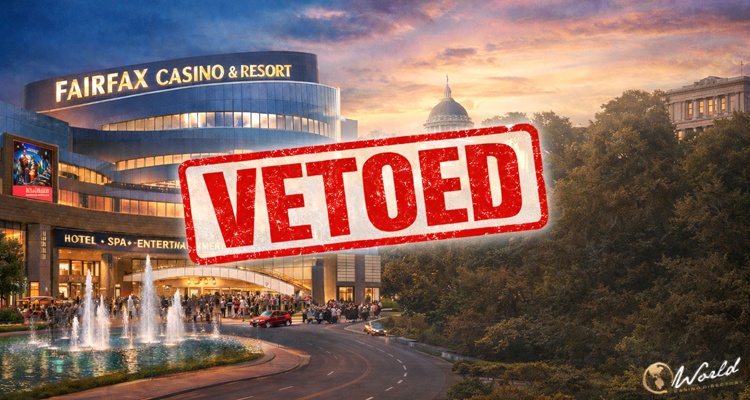
Virginia Governor Abigail Spanberger has rejected legislation that would have opened the door for a casino development in Fairfax County, halting a proposal that had already cleared the state legislature despite strong resistance from local leaders.
The measure, known as Senate Bill 756, aimed to require Fairfax County officials to initiate a referendum process, allowing voters to decide whether to permit a Las Vegas-style casino. Lawmakers passed the bill in March, though many representatives from Northern Virginia opposed it.
Governor cites local opposition and precedent concerns
In her veto statement, Spanberger emphasized that the legislation conflicted with Virginia’s established approach to casino approvals, where local authorities take the lead. She warned that the bill would undermine that framework and shift decision-making power away from local governments.
“Local governing boards should lead on proposed casino development, as has happened in every locality that now has a casino,” Spanberger said. “But in Fairfax County, the Board of Supervisors has explicitly opposed this legislation, and an overwhelming majority of the General Assembly members who represent Fairfax voted against it.”
She further argued that the proposal could create broader implications beyond Fairfax County. In her formal veto explanation, Spanberger wrote: “While this legislation only affects Fairfax County, it would set a precedent that could be used to bring casino referendums to other localities where the local governing boards may similarly oppose such efforts.”
The governor concluded her decision by stating, “Accordingly, I veto this bill.”
Local leaders welcome decision, critics raise concerns
Officials in Fairfax County quickly expressed support for the veto, pointing to longstanding opposition within the community. Board of Supervisors Chairman Jeff McKay said the proposal conflicted with local authority over land use and development decisions.
“Casinos in Virginia have always been authorized to go in places where local governments have requested them, and if this bill had been approved, it would be the first time in Virginia history where the state would tell a local government to do this,” McKay said.
He added that local control remains a core responsibility: “The state has a lot of authority over counties already. But a fundamental responsibility local governments have always had in my lifetime has been control over land-use decisions.”
McKay also criticized the proposed revenue split, which would have allocated 70% to the state and 30% to Fairfax County. He said, “Anything short of at least a 50-50 mix isn’t even worth looking at.”
Community groups opposing the casino echoed that sentiment. Lynne Mulston of the No Fairfax Casino Coalition said, “This was a special carveout for one locality, and Governor Spanberger rejected it. That decision respects local concerns and recognizes the need for transparent, evidence-based policy.” She also described the veto outcome as “absolutely the best outcome that we could have hoped for.”
Some local officials had already voiced objections before the governor’s decision. Supervisor Walter Alcorn said, “This is not a casino we asked for. We don’t want it, and it’s unfortunate the General Assembly has moved forward with this.”
Supporters vow to continue push for casino project
Despite the setback, advocates for the casino plan signaled they will continue pursuing the idea. State Sen. Scott Surovell, who has supported the proposal, indicated that the effort is not over, writing, “I will not stop … We will be back.”
Surovell and other backers argued that the development could generate substantial economic benefits, including jobs and tax revenue. The project proposal included a large-scale mixed-use complex spanning roughly 1.5 million square feet, with plans for a convention center, hotel, entertainment venues, and other attractions. Potential locations included areas near the Spring Hill Metro station or a site used for Cirque du Soleil events.
Supporters have frequently pointed to competition from neighboring Maryland, where attractions such as MGM National Harbor draw visitors and revenue. Surovell highlighted the economic stakes in a statement, saying, “The Sphere — one of the most iconic and transformative entertainment venues in the world — is going to MGM National Harbor, not Tysons.”
He added: “An independent analysis by (Ernst & Young) projects that venue alone will generate $1.5 billion in annual economic activity for Maryland and nearly 8,000 jobs. That is $1.5 billion every single year flowing to our neighbors across the Potomac — jobs, tax revenue and tourism that belong in Virginia, serving Virginia families. Maryland is competing aggressively for the large-whyscale entertainment investments of the future. We just handed them another win.”
Even so, critics have continued to question the need for a casino in Tysons, raising concerns about traffic, crime, and overall suitability for the area. Dranesville Supervisor Jimmy Bierman described the proposal in stark terms, calling it “ill-conceived, unwanted and corrupt.”
He added, “Casino proponents have consistently promised the moon, but their arguments have always fallen apart faster than a house of cards in a light wind.”
Debate reflects broader tensions over development
The dispute over the Fairfax casino also exposed political divisions within the state legislature. Some Northern Virginia lawmakers pointed to significant local opposition during the debate. “We’ve had enormous local opposition for this,” said state Sen. Barbara Favola.
Others countered that resistance was inconsistent with broader legislative actions. Republican state Sen. Mark Peake criticized opponents, saying, “Do you think somebody in Augusta wants to be represented in Congress by somebody from Fairfax? And you have the gall to talk about us passing a bill to put a casino in Fairfax when we’ve got four or five in the rest of the commonwealth.”
While the veto halts the current proposal, the broader discussion around casino expansion in Virginia is likely to continue. For now, the decision preserves the state’s existing approach, which places the responsibility for initiating such projects with local governments.
