

 United States
 Macau, China
 France
 Philippines
 Singapore
 Netherlands
 United Kingdom
 Canada
 Argentina
 Germany
 Estonia
 Peru
Peru Russia
 Australia
 South Africa
 Nigeria
 Malaysia
 Singapore
 India
India Finland
 China
China Ukraine
 Hong Kong
 Cyprus
 Turkey
 Greece
 Sweden
 South Korea
 Mexico
 Poland
 Ireland lottery results
 New Zealand lottery results
 Puerto Rico lottery results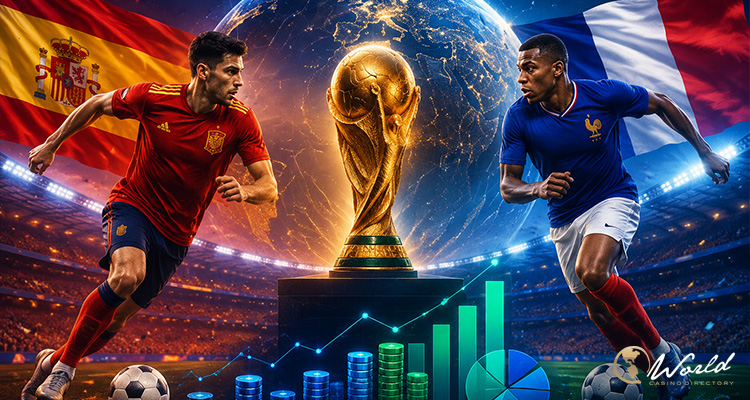
The 2026 FIFA World Cup has become one of the largest events in the prediction market sector, with traders having committed over $2 billion to contracts forecasting the tournament winner even before the opening match on June 11. Polymarket and Kalshi, two leading platforms, report that Spain and France share the frontrunner position, reflecting a tight market for the championship outcome.
Market Dynamics and Leading Teams
According to CryptoSlate, data from Polymarket show Spain trading at 16.5% implied probability and France slightly behind at 16.1%. England and Portugal follow around 11% and 10%, while defending champion Argentina sits at 9%. Kalshi’s US-regulated market exhibits a similar pattern, with Spain at 17.4% and France at 16.1%. The high volume has placed the World Cup among the largest sports events for prediction markets, surpassing many prior benchmarks for early liquidity in sports-focused contracts.
Unlike traditional forecasts, these numbers reflect traders’ willingness to buy and sell contracts tied to event outcomes. A contract purchased at 40 cents implies a 40% probability and pays $1 if the team wins. This approach allows market participants to adjust positions in response to injuries, tactical developments, and match results. Traders can sell or reduce holdings as the tournament progresses, which transforms the market into a continuously updated trading platform rather than a fixed betting board.
Expansion of Prediction Markets into Sports
The 2026 tournament represents the first men’s World Cup where prediction markets have moved beyond crypto and political contracts to mainstream sports speculation. With 48 teams, 104 matches, and global attention, the event provides a comprehensive test of whether prediction platforms can compete with traditional sportsbooks. Sports contracts now account for a significant portion of monthly trading volumes, with Polymarket and Kalshi reporting combined figures rising from less than $5 billion in September 2025 to $24 billion in April 2026.
Platforms like Polymarket have also signed partnerships with major sports organizations. A recent agreement with Mexico’s Liga MX designates Polymarket as the exclusive prediction market partner for the league in the US. Genius Sports provides official data and integrity monitoring, ensuring contract settlement aligns with verified outcomes.
Regulatory Scrutiny and Platform Integrity
The surge in sports-related trading coincides with scrutiny from regulators. Kalshi operates under the Commodity Futures Trading Commission (CFTC), whereas Polymarket’s international exchange remains largely outside US regulation. Concerns include whether sports contracts are gambling products, potential market manipulation, insider information, and fraud prevention. Platforms maintain surveillance tools and identity verification systems to monitor trading and detect suspicious activity. The World Cup provides a large-scale test of these systems, covering 104 matches over 39 days with constantly evolving information streams.
The markets have drawn attention from institutional analysts as well. Bernstein forecasts the World Cup could drive $5 billion to $10 billion in consumer volume across prediction markets, noting that the expanded tournament format adds about 60% more betting opportunities than previous editions.
In addition to traditional trading activity, crypto-focused exchanges and wallets are creating World Cup-themed products to engage users. Alvin Kan, chief operating officer at Bitget Wallet, highlighted the interactive aspect of these markets: “The World Cup shows why this matters: billions of people are not only watching the same moments, but forming views, debating outcomes and acting on conviction in real time.”
As Spain and France maintain their positions as joint favorites, the World Cup prediction markets demonstrate both the scale and sophistication of event-driven trading. The tournament is not only a global sports spectacle but a benchmark for how financial-style speculation can intersect with major sporting events.
