

 United States
 Macau, China
 France
 Philippines
 Singapore
 Netherlands
 United Kingdom
 Canada
 Argentina
 Germany
 Estonia
 Peru
Peru Russia
 Australia
 South Africa
 Nigeria
 Malaysia
 Singapore
 India
India Finland
 China
China Ukraine
 Hong Kong
 Cyprus
 Turkey
 Greece
 Sweden
 South Korea
 Mexico
 Poland
 Ireland lottery results
 New Zealand lottery results
 Puerto Rico lottery results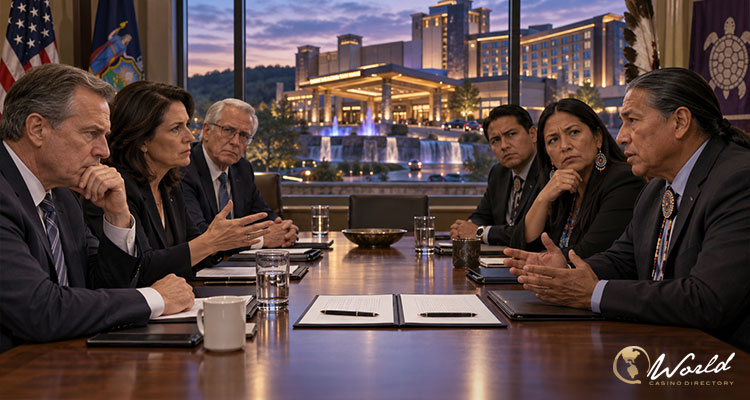
Conflicting statements from the Seneca Nation and New York State have created uncertainty over the status of negotiations for a new gaming compact, with questions remaining about whether an agreement has been reached and whether future casino revenue-sharing payments will continue to flow to local governments.
The debate intensified after Seneca Nation President J. Conrad Seneca announced that negotiators had reached what he described as an agreement in principle with the state. According to the Nation, the proposed framework does not include a revenue-sharing provision, a significant departure from the arrangement that has governed casino operations in Western New York for more than two decades.
State officials, however, have disputed suggestions that a deal is complete, saying discussions are still underway and that no final agreement has been reached.
The disagreement has drawn attention from state lawmakers and local officials, particularly in Buffalo, Niagara Falls and Salamanca, municipalities that have historically benefited from casino-related payments tied to the compact.
Nation Describes Framework Without Revenue Sharing
President Seneca said the Nation negotiated a preliminary understanding with New York that excludes revenue sharing after the state declined to provide protections or benefits that Nation officials sought during negotiations.
“We negotiated an agreement in principle that, right now, contains no revenue sharing provision with New York State,” said President J. Conrad Seneca, according to WGRZ-TV. “We expect this agreement will be finalized and sent to the New York State Legislature sometime in the spring.”
The Nation argued that revenue sharing could not be justified without receiving additional value in return, citing requirements under the federal Indian Gaming Regulatory Act.
“Throughout the prolonged negotiations, the Seneca Nation consistently advocated to protect the host communities of Buffalo, Niagara Falls and Salamanca under the terms of the new agreement,” Seneca explained.
The Nation also said it pushed for continued support for the host communities where its casinos operate. According to Seneca, negotiators sought mechanisms that would allow funding to continue reaching those municipalities.
“Throughout our prolonged negotiations, the Seneca Nation has consistently advocated to protect the cities of Buffalo, Niagara Falls and Salamanca to ensure that funding would continue to come to them under a new agreement,” he said. “New York State told us that wasn’t any of our business.”
Seneca also criticized the state’s negotiating position. “Because of Governor Hochul’s continued hostility toward the Seneca Nation and her team’s unwillingness to provide us anything of value in return for a revenue share provision, we negotiated an agreement in principle with no revenue share agreement,” Seneca said. “That is the path New York and Governor Hochul chose. The Governor just wanted to keep taking advantage of the Seneca Nation and taking money that the State isn’t entitled to.”
Any proposed compact would still require approval from both the Seneca Nation’s governing bodies and New York lawmakers before taking effect.
State Says No Deal Has Been Reached
While Nation officials characterized negotiations as having produced a framework, the governor’s office offered a different assessment. A spokesperson for Governor Kathy Hochul said discussions remain active and that reports of a completed agreement are premature.
“State officials have been engaged in productive discussions with the Seneca Nation on a new gaming compact that would be fair for all parties,” the spokesperson said. “There is currently no agreement and conversations are ongoing with stakeholders. Any public discussion of specific terms and details is premature. We will share further details on an agreement as the ongoing negotiations warrant.”
The conflicting messages have left elected officials seeking clarity on the status of negotiations. New York State Senate Minority Leader Rob Ortt said he was aware of earlier indications that a potential deal framework existed but had not received further information.
“I know for a fact the Governor’s Office called certain elected leaders — myself not a part of that — last month to tell them that there was a deal, or at least the framework of a deal. But then I heard nothing after that,” Ortt said. “Now you have the Seneca Nation saying there’s an agreement in principle, whatever that means, in substance, right? And yet the Governor’s Office is now saying no, that would be premature.”
Ortt also questioned the direction of negotiations if both exclusivity protections and revenue-sharing payments are absent from a future arrangement.
“This has dragged on with almost no information, and now you’re getting these conflicting reports,” he said. “The whole point of the compact was exclusivity and a payment, so if there’s no exclusivity and no payment, that sounds to me like there’s an agreement that we’re not going to have an agreement.”
Financial Stakes for Host Communities
The issue carries major implications for communities that receive funding linked to Seneca casino operations. Under the original 2002 gaming compact, the Seneca Nation shared slot-machine revenue with New York State. Portions of those payments were distributed to Buffalo, Niagara Falls and Salamanca. The agreement expired in December 2023 but has remained in effect through a series of quarterly extensions while negotiations continue.
Niagara Falls Mayor Robert Restaino said he has not received official confirmation regarding any agreement and remains concerned about the potential budget impact if revenue-sharing payments end.
“My concern is getting more information on the accuracy on what’s been reported. What’s really going to be happening? Has an agreement been reached? I can honestly say to you that I have not been advised that that has happened.” The mayor said the loss of casino revenue could create a sizable budget challenge for the city, which currently receives approximately $10 million to $13 million annually through the arrangement.
“If you think about the fact that the city’s budget is a little more than $100 million, and if you think about the fact that we have an amount in the budget that is almost 10 percent — not 10 percent but almost — you’re thinking about a substantial gap to fill.”
The current negotiations follow years of disputes between the Seneca Nation and New York State over gaming exclusivity. The Nation has long argued that the introduction of video lottery terminals at several racetracks reduced the value of the exclusivity protections promised under the 2002 compact. The state maintained those terminals were authorized under the lottery system and did not violate the agreement, leading to years of litigation and arbitration.
With both sides publicly offering different interpretations of the current negotiations, questions remain over whether a final compact can be completed and what financial arrangements, if any, will replace the revenue-sharing model that has shaped relations between the Seneca Nation, New York State and Western New York host communities for more than two decades.
