

 United States
 Macau, China
 France
 Philippines
 Singapore
 Netherlands
 United Kingdom
 Canada
 Argentina
 Germany
 Estonia
 Peru
Peru Russia
 Australia
 South Africa
 Nigeria
 Malaysia
 Singapore
 India
India Finland
 China
China Ukraine
 Hong Kong
 Cyprus
 Turkey
 Greece
 Sweden
 South Korea
 Mexico
 Poland
 Ireland lottery results
 New Zealand lottery results
 Puerto Rico lottery results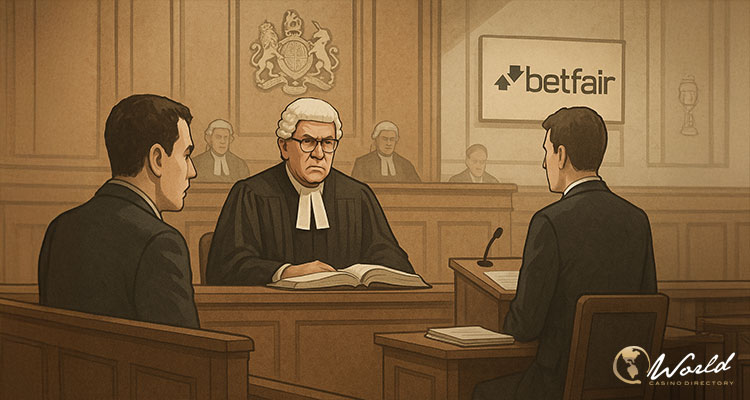
A long-running legal fight in the United Kingdom between property investor Lee Gibson and Betfair reached its conclusion after the Court of Appeal ruled that the operator bore no responsibility for Gibson’s gambling losses. The decision, delivered by Chancellor of the High Court Sir Colin Birss alongside Lord Justice Popplewell and Sir Julian Flaux, upheld an earlier High Court judgment that Betfair neither knew nor should have known that Gibson was struggling with a gambling problem during the decade he used the platform.
Gibson, who had amassed considerable wealth through a portfolio of rental properties in Leeds, placed tens of thousands of bets on Betfair’s exchange between 2009 and 2019. While his account would sometimes show periods of profit, his losses grew steadily over the years, eventually approaching £1.5m. His betting activity focused heavily on football, including “correct score” wagers on unfamiliar matches, at times reaching individual stakes of up to £20,000.
Judges Back Earlier Findings on Operator Conduct
His legal claim centered on whether Betfair’s license obligations required the company to intervene. Gibson argued that his spending pattern and financial behavior should have alerted Betfair to a gambling disorder. His appeal maintained that Betfair “knew or ought to have known” he was a problem gambler and that the operator breached social responsibility standards.
However, the appellate judges found no basis to overturn the ruling from Judge Nigel Bird, who had concluded last year that Gibson repeatedly presented himself as a customer who could handle both the volume and scale of his betting. Judge Bird noted that Gibson had “consistently and often reassured Betfair that he was able to fund his gambling (including his losses) and none of the information he provided to Betfair painted a different picture.” He also stated: “The fact that he consistently satisfied AML checks (and raises no complaint about that) makes it impossible for Mr Gibson to argue that the size of his losses was, of itself, enough to raise reasonable concerns.”
In the High Court ruling, Bird found that Gibson not only avoided sharing concerns about his behavior, but “took steps actively to hide it and to portray to the world at large, and to Betfair in particular, a wholly inaccurate picture.” Evidence from his Betfair VIP manager supported that view, as the manager described Gibson as “calm, level-headed and rational” and someone who appeared to enjoy his betting.
Heavy Losses Not Enough to Prove Knowledge
The appeal panel agreed with Bird’s assessment and emphasized that large financial losses do not automatically prove an operator should identify problem gambling. Sir Colin Birss stated: “I can see no justification for allowing the appeal against the conclusion that Betfair neither knew nor ought to have known that Mr Gibson was a problem gambler.”
The judges also highlighted the limits of data-driven analysis during much of the period in question, according to Racing Post. Before 2019, the relevant licensing requirements were described as “relatively undemanding by today’s standards,” making it even less likely that Betfair would have been expected to detect a hidden problem solely from betting patterns.
Gibson’s legal team argued that the scale of his activity—more than 20,000 bets within a six-year span—and his disposal or refinancing of property assets should have signaled risk. They also attempted to frame certain bets as void under statutory illegality principles. The Court of Appeal rejected those points and noted that the Gambling Act does not nullify bets placed with an operator simply because license conditions may have been breached.
With the appeal dismissed, Gibson’s attempt to recover roughly £1m in losses from the six-year period preceding his claim has come to an end. The ruling leaves unresolved broader questions about whether gambling operators might owe a wider duty of care to customers in future cases, though the judges indicated that such issues should only be considered when the facts genuinely require it.
