

 United States
 Macau, China
 France
 Philippines
 Singapore
 Netherlands
 United Kingdom
 Canada
 Argentina
 Germany
 Estonia
 Peru
Peru Russia
 Australia
 South Africa
 Nigeria
 Malaysia
 Singapore
 India
India Finland
 China
China Ukraine
 Hong Kong
 Cyprus
 Turkey
 Greece
 Sweden
 South Korea
 Mexico
 Poland
 Ireland lottery results
 New Zealand lottery results
 Puerto Rico lottery results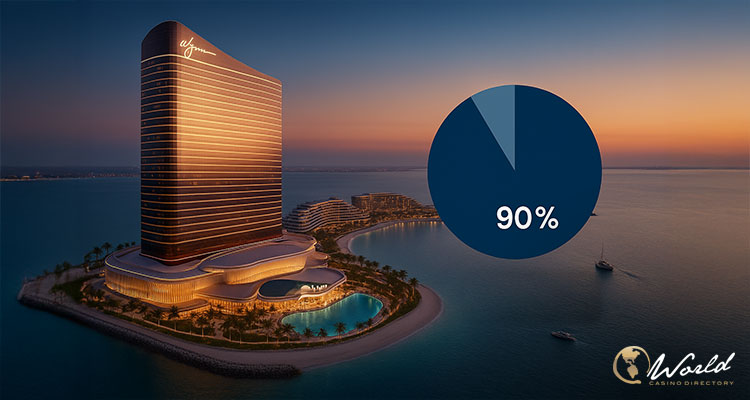
Wynn Resorts’ multibillion-dollar development on Al Marjan Island continues to take shape, with new financial disclosures and construction updates offering one of the clearest looks yet at the scale and expectations surrounding the project. Recent investor presentations delivered during a UAE market tour outlined strong revenue projections, rapid progress on site, and rising demand across Ras Al Khaimah’s hospitality sector as the emirate prepares for its first integrated resort with a casino.
Across multiple briefings, Wynn reported that roughly US$3.4 billion of the project’s US$5.1 billion budget has already been spent or contractually committed, equal to about two-thirds of total costs. Executives described a strategy built on broad buyouts, fixed-price arrangements, and contingency planning to manage cost and scheduling risks.
The tower’s structural concrete is complete, and both low-rise structures and guest-room frameworks are nearly finished. Hotel room fit-outs are underway, while exterior glazing on the tower has reached about 70%, according to Inside Asian Gaming. Daily on-site staffing sits at approximately 18,000 workers and specialists.
In late November, the company noted that construction on the 305-meter tower had “reached the 70th floor,” with roof deck work in progress. The updated plan keeps the opening timeline aligned with early 2027.
Revenue Expectations and Operating Assumptions
Financial projections emphasize gaming as the principal driver of the resort’s performance. In a low-case scenario, annual gross gaming revenue (GGR) is expected to reach US$1 billion; in a high-case estimate, GGR could rise to US$1.66 billion. Depending on the model, gaming may account for 73% to as much as 89% of total net revenue, which is forecast to fall between US$1.38 billion and US$1.88 billion.
Adjusted Property EBITDA is projected at US$390 million to US$570 million once management fees between US$110 million and US$230 million are included. Wynn’s own modeling also places annual net revenue for the resort at just under US$1.63 billion in its base case, producing “adjusted property ‘earnings before interest, taxation, depreciation, and amortisation (EBITDA) of at least US$465 million.”
The firm expects a project ROI between 9.8% and 15.7%, and a return on equity ranging from 16.7% to 34.3% at stabilization. Executives reiterated a familiar pattern across the company’s global portfolio, stating, “Wynn properties have historically ramped in about three years, typically with a significant jump from the first to second year, as we fine tune operations and marketing.”
Market Positioning and Regional Outlook
The integrated resort will feature 1,530 rooms and suites, 22 dining and lounge venues, a theater, nightclub, spa, and a gaming area with 275 tables and more than 2,000 machines. Its 225,000-square-foot gaming floor will represent about 4% of the total built area. Wynn holds a 15-year exclusive casino license for Ras Al Khaimah; only one land-based license is permitted per emirate.
Wynn anticipates the UAE may eventually host three integrated resorts, collectively generating an estimated US$3 billion to US$5 billion in annual GGR. The company’s modeling assumes that even a modest penetration of the regional market—0.04% of the 2.4 billion people within a four-hour flight—could translate into frequent travel, with an expected 2.8 to 3.1 annual trips per visitor.
Infrastructure, Tourism Growth, and Future Development
Ras Al Khaimah’s broader expansion plans appear poised to support the project’s ambitions. Authorities estimate that total visitors could climb from 1.3 million in 2024 to more than 5 million by 2030, while overnight stays may rise from 4.5 million to 9.6 million. A Colliers study referenced in the presentations suggests hotel demand will exceed supply by more than 8,400 rooms in 2027, the year Wynn opens, and by 6,269 rooms in 2030.
Infrastructure upgrades are underway, including a US$200 million expansion of the E111 highway to shorten travel times from Dubai by 45%, and a major upgrade at Ras Al Khaimah International Airport that will raise capacity to 3 million passengers by 2028. Electric air taxis are planned between Dubai and Al Marjan Island by 2027, creating what Wynn described as the UAE’s first “vertical take-off and landing” air taxi network, reducing travel time to around 15 minutes.
Real estate activity around the island has intensified as well; land prices have nearly tripled since 2021, drawing new luxury hotel and residential brands. The development consortium also holds rights to additional land for future projects, including a second casino resort on a nearby plot.
