

 United States
 Macau, China
 France
 Philippines
 Singapore
 Netherlands
 United Kingdom
 Canada
 Argentina
 Germany
 Estonia
 Peru
Peru Russia
 Australia
 South Africa
 Nigeria
 Malaysia
 Singapore
 India
India Finland
 China
China Ukraine
 Hong Kong
 Cyprus
 Turkey
 Greece
 Sweden
 South Korea
 Mexico
 Poland
 Ireland lottery results
 New Zealand lottery results
 Puerto Rico lottery results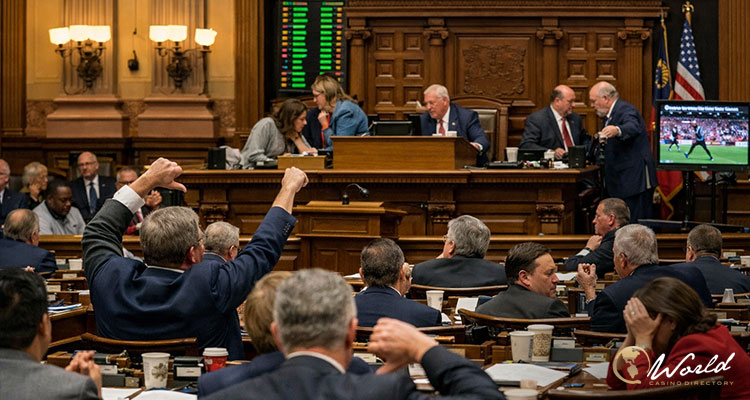
Georgia lawmakers voted down a proposal that would have advanced sports betting in the state, ending this year’s effort to change the law and leaving the issue unresolved for at least another legislative cycle.
The measure failed Friday in the Georgia House of Representatives, receiving far fewer votes than required to move forward. Because sports betting remains illegal under state law, residents who place wagers on sporting events must still rely on offshore websites or illegal bookmakers.
The proposal, known as House Resolution 450, required 120 votes to pass but received only 63 in favor and 98 against. The vote came on Crossover Day, the deadline for legislation to pass from one chamber of the Georgia General Assembly to the other if it is to move smoothly through the legislative process. The session is scheduled to end April 2.
Vote Ends Proposal to Put Sports Betting Before Voters
House Resolution 450 would not have immediately authorized sports betting. Instead, it would have allowed voters in Georgia to decide the matter through a constitutional amendment.
The proposal included ballot language asking residents: “Shall the Constitution of Georgia be amended so as to authorize sports betting in this state to provide additional funding for pre-kindergarten and HOPE scholarships?”
If voters had approved the amendment, the state planned to direct most tax revenue from sports wagering to education programs. Georgia’s lottery already funds similar initiatives. Since the lottery began in 1993, more than 2.25 million students have received HOPE Scholarships.
Despite the potential funding stream, the proposal failed to gather enough legislative support. Because constitutional amendments require a two-thirds majority in both chambers of the legislature, the margin of defeat effectively ended the measure’s chances this year.
Georgia remains among the states with the strictest gambling restrictions. The state currently allows only the lottery, and it does not permit commercial or tribal casinos. Across the United States, sports betting has become widely available since the U.S. Supreme Court allowed states to legalize the practice. At the moment 39 states and Washington, D.C. now permit some form of sports wagering.
Lawmakers Divided Over Economic and Social Impacts
Debate around sports betting at the Georgia Capitol often crosses party lines. Some lawmakers argue that legalization could generate tax revenue and provide consumer protections for people who already gamble through offshore sites or local bookies.
Others raise concerns about addiction, moral considerations, and whether the state would actually receive meaningful financial returns.
Midway Democratic state Rep. Al Williams said he supports expanding gaming in the state but opposed the resolution because Democrats did not have input on how the money from sports betting would be distributed.
“This is in need of bipartisan support, and to get bipartisan support, you need to let the folks on this side of the aisle have some say on how the money is going to be divided,” he said, according to Georgia Recorder. “The last time I was handed a plate of food and told ‘Eat this,’ I was quite young and didn’t have any choice. Since then, I get to decide what to eat.”
Hartwell Republican Rep. Alan Powell, who has long supported broader gambling expansion, also urged colleagues to vote against the bill. Powell argued the proposal was too limited and said larger gambling developments would provide greater economic benefit.
“You hear all this pie in the sky about how much money they’re going to raise – no. … because most of these sports betting (services) are off-shore, in other states, and you can’t audit them, and that’s the way it is,” he said.
Some critics pointed to concerns about increased gambling problems, particularly among younger men, and warned that making sports wagering legal could increase participation.
Personal Stories and Security Concerns Shape Debate
Several lawmakers framed their positions around broader concerns, including addiction and data security.
Dunwoody Democratic Rep. Long Tran described sports betting as a potential national security issue, suggesting that offshore platforms could expose users’ information.
“In this chamber, for the last three years I have heard ‘Foreign adversaries, we cannot have foreign adversaries buy our farmland, we cannot have foreign adversaries do this or that,’ and yet here we are letting foreign adversaries get our children, our young men, addicted to gambling and getting access to their data. It’s time that we realized that this is a real thing that happens, and we need to regulate it, and the best way to do that is to legalize it.”
The debate took a more personal turn when Dalton Republican Rep. Kasey Carpenter spoke about his own struggles with gambling addiction.
“I am an addict,” he said. “I started picking football games when I was 8 years old. This bill, to me, is about safety. Legalizing sports betting eliminates the chase. You got $100, you can bet $100. The bookie, he gives you until Monday, so you lose $100, then you turn it to $200, then you turn it to $400, next thing you know, you’re down $1,200. This eliminates that.”
Sports Culture Keeps Issue in Spotlight
Georgia’s strong sports culture continues to keep the topic of sports betting in public discussion. The state is home to several major professional teams, including the NFL’s Atlanta Falcons, MLB’s Atlanta Braves, the NBA’s Atlanta Hawks, WNBA’s Atlanta Dream, and MLS’s Atlanta United. College sports also attract major audiences through the University of Georgia and Georgia Tech.
Atlanta regularly hosts large sporting events such as the Super Bowl and NCAA March Madness, and the city is scheduled to serve as a host location during the 2026 FIFA World Cup. The state also hosts annual events including The Masters golf tournament at Augusta National and races at Atlanta Motor Speedway.
Despite the prominence of sports in Georgia, lawmakers once again declined to move forward with sports betting legislation. The outcome means supporters will likely need to try again in a future legislative session if they want voters to weigh in on the issue.
