

 United States
 Macau, China
 France
 Philippines
 Singapore
 Netherlands
 United Kingdom
 Canada
 Argentina
 Germany
 Estonia
 Peru
Peru Russia
 Australia
 South Africa
 Nigeria
 Malaysia
 Singapore
 India
India Finland
 China
China Ukraine
 Hong Kong
 Cyprus
 Turkey
 Greece
 Sweden
 South Korea
 Mexico
 Poland
 Ireland lottery results
 New Zealand lottery results
 Puerto Rico lottery results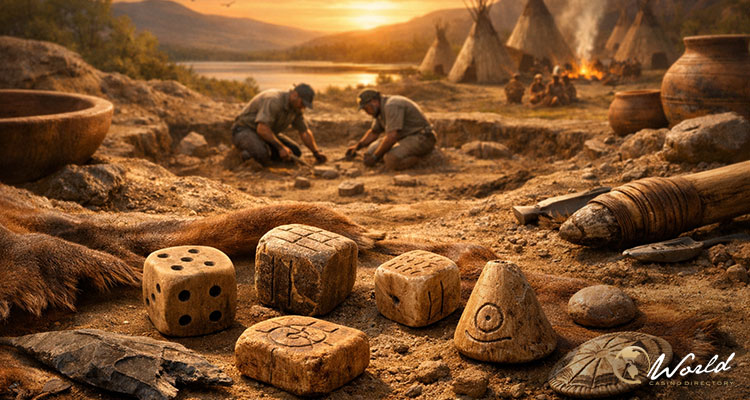
Archaeologists have uncovered evidence that Native Americans were using dice more than 12,000 years ago, significantly pushing back the known origins of gambling and games of chance. The findings, published in American Antiquity, suggest that early hunter-gatherer societies in North America were engaging with randomness and structured play thousands of years earlier than previously believed.
The study challenges long-held assumptions that dice and probabilistic thinking first emerged in Old World civilizations such as Mesopotamia or the Indus Valley around 5,500 years ago. Instead, the research points to much earlier developments in the western Great Plains during the closing stages of the last Ice Age.
Evidence from Ice Age Archaeological Sites
The research, led by Colorado State University Ph.D. student Robert J. Madden, draws on artifacts recovered from Folsom-period sites in present-day Wyoming, Colorado, and New Mexico. These objects date to approximately 12,800 to 12,200 years ago and represent the earliest known examples of dice-like tools.
“Historians have traditionally treated dice and probability as Old World innovations,” Madden said according to SciTechDaily. “What the archaeological record shows is that ancient Native American groups were deliberately making objects designed to produce random outcomes, and using those outcomes in structured games, thousands of years earlier than previously recognized.”
Unlike modern cube-shaped dice, these early tools were two-sided objects known as binary lots. Typically made from bone, they were shaped to fit comfortably in the hand and marked to distinguish between two outcomes. When thrown together, multiple pieces would produce results based on how many landed with a designated “counting” side facing up.
“They’re simple, elegant tools,” Madden said. “But they’re also unmistakably purposeful. These are not casual byproducts of bone working. They were made to generate random outcomes.”
New Method Identifies Overlooked Artifacts
A key part of the study involved developing a systematic method to identify ancient dice. For decades, archaeologists had encountered similar objects but lacked clear criteria to classify them as gaming tools.
To address this, Madden created an attribute-based framework using characteristics shared by 293 documented sets of historic Native American dice. This reference material came from early 20th-century ethnographic research compiled by Stewart Culin.
By applying this method to existing archaeological collections, the study identified more than 600 artifacts as likely dice. Many of these had been previously cataloged as ambiguous “gaming pieces” or overlooked entirely.
“In most cases, these objects had already been excavated and published,” Madden said. “What was missing wasn’t the evidence, it was a clear, continent-wide standard for recognizing what we were looking at.”
The artifacts were examined across museum collections, including those held by the Smithsonian Institution, the University of Wyoming Archaeological Repository, and the Denver Museum of Nature and Science.
Rethinking the Origins of Probability
The findings have broader implications for understanding early human thought. Dice games are often seen as one of the earliest ways people engaged with randomness, laying the groundwork for probability and statistical reasoning.
“These findings don’t claim that Ice Age hunter-gatherers were doing formal probability theory,” Madden said. “But they were intentionally creating, observing, and relying on random outcomes in repeatable, rule-based ways that leveraged probabilistic regularities, such as the law of large numbers. That matters for how we understand the global history of probabilistic thinking.”
The research suggests that early Native American groups may have been exploring complex ideas about chance and uncertainty long before such concepts were formally developed elsewhere.
A Long-Standing Cultural Practice
The study also traces the use of dice across thousands of years of North American history. Evidence has been identified at 57 archaeological sites spanning multiple cultural periods, from the Late Pleistocene through the Archaic and Late Prehistoric eras and into the time of European contact.
This continuity indicates that games of chance were deeply embedded in social life. According to Madden, these activities served important functions beyond entertainment.
“Games of chance and gambling created neutral, rule-governed spaces for ancient Native Americans,” he said. “They allowed people from different groups to interact, exchange goods and information, form alliances, and manage uncertainty. In that sense, they functioned as powerful social technologies.”
Researchers also suggest that such games may have played a role in gatherings between different groups, facilitating trade and communication. Archaeological evidence indicates that these practices persisted for millennia and continue to influence modern expressions of Native American culture, including contemporary tribal gaming.
The discovery reshapes the timeline of gambling and highlights a previously underrecognized contribution to early intellectual history. By demonstrating that structured games of chance existed in North America more than 12,000 years ago, the study opens new perspectives on how ancient societies understood randomness and probability.
