

 United States
 Macau, China
 France
 Philippines
 Singapore
 Netherlands
 United Kingdom
 Canada
 Argentina
 Germany
 Estonia
 Peru
Peru Russia
 Australia
 South Africa
 Nigeria
 Malaysia
 Singapore
 India
India Finland
 China
China Ukraine
 Hong Kong
 Cyprus
 Turkey
 Greece
 Sweden
 South Korea
 Mexico
 Poland
 Ireland lottery results
 New Zealand lottery results
 Puerto Rico lottery results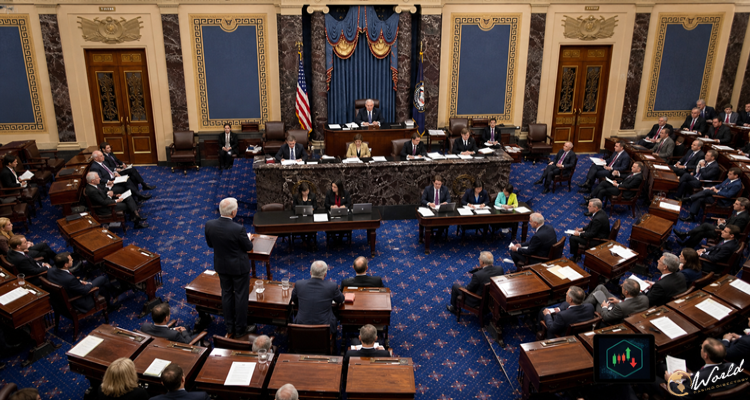
The U.S. Senate has moved to prohibit its own members and staff from participating in prediction markets, approving a bipartisan resolution that took effect immediately after a unanimous voice vote on Thursday. The measure alters Senate rules to stop lawmakers and their aides from wagering on real-world outcomes through platforms that allow bets on political, economic, or military developments.
Republican Senator Bernie Moreno of Ohio introduced the resolution, arguing that access to confidential information makes such activities inappropriate. “United States senators have no business engaging in speculative activities like prediction markets while collecting a taxpayer-funded paycheck, period,” Moreno said according to Associated Press. He also warned that participation in these markets could erode public trust, adding that “engaging in any way in a prediction market or trying to place bets where we might have inside information deteriorates our confidence that our constituents have in us.”
An amendment from Democratic Senator Alex Padilla of California expanded the prohibition to include Senate staff and other officers, broadening the scope beyond elected officials. Senate Democratic Leader Chuck Schumer backed the move, describing it as straightforward. “We must never allow Congress to turn into a casino where members representing the public can gamble on wars or economic crises or elections,” Schumer said.
Lawmakers are also urging other parts of government to adopt similar restrictions, with calls directed at the House of Representatives as well as the executive and judicial branches.
Insider concerns and recent cases fuel action
The Senate’s decision follows mounting scrutiny of prediction market activity, particularly cases where participants appeared to benefit from privileged knowledge. One recent example involved a U.S. Army soldier who pleaded not guilty to fraud charges after reportedly earning about $400,000 from wagers tied to the anticipated removal of Venezuelan President Nicolas Maduro. The activity occurred shortly before a January 3 military operation that led to his ousting.
Another case highlighted suspicious trading patterns tied to geopolitical events. Reports described a surge in bets on whether the United States and Iran would reach a ceasefire on April 7, with new accounts placing highly targeted wagers that resulted in significant profits. Concerns have also been raised about trades linked to potential military actions, including activity related to Iran’s leadership.
Authorities have taken enforcement steps in response. The Commodity Futures Trading Commission charged a U.S. soldier over insider trading on one platform, while Kalshi fined three political candidates for placing bets on their own races. These developments contributed to growing bipartisan concern that prediction markets could be exploited by individuals with access to nonpublic information.
The issue connects to a broader debate in Congress over financial activity by lawmakers. Efforts to restrict stock trading by members have been under discussion for years, with advocates pointing to the advantages lawmakers may have due to closed briefings and early knowledge of legislation. In 2024 alone, 113 members of Congress reportedly made thousands of trades involving hundreds of millions of shares. Past disclosure requirements have not always been followed consistently.
Expanding industry draws attention and support
Prediction markets have grown rapidly in recent years, drawing attention from regulators and lawmakers alike. Platforms such as Polymarket and Kalshi allow users to place bets on a wide range of outcomes, from elections to international conflicts. Polymarket has faced criticism for hosting offshore trades that fall outside U.S. regulatory oversight.
Despite the scrutiny, both companies expressed support for the Senate’s decision. Kalshi CEO Tarek Mansour described the rule as a “great step to increase trust in our markets by making it an industry standard.” Polymarket also endorsed the move, stating, “We’re in full support of this. Our Rulebook & Terms of Service already prohibit such conduct, but codifying this into law is a step forward for the industry.”
At the same time, the industry has received backing from figures connected to the Trump administration. Donald Trump Jr. serves as an adviser to both Polymarket and Kalshi, while the president’s social media platform, Truth Social, is preparing to launch its own cryptocurrency-based prediction market called Truth Predict.
President Donald Trump commented more broadly on the rise of betting platforms, saying, “The whole world, unfortunately, has become somewhat of a casino, and you look at what’s going on all over the world and Europe and every place, they’re doing these betting things.”
The Senate’s action marks an early step in addressing concerns over the intersection of public office and speculative markets. Some lawmakers are pushing for broader legislation that would extend similar restrictions across the federal government, aiming to limit the use of insider knowledge in all forms of wagering tied to real-world events.
