

 United States
 Macau, China
 France
 Philippines
 Singapore
 Netherlands
 United Kingdom
 Canada
 Argentina
 Germany
 Estonia
 Peru
Peru Russia
 Australia
 South Africa
 Nigeria
 Malaysia
 Singapore
 India
India Finland
 China
China Ukraine
 Hong Kong
 Cyprus
 Turkey
 Greece
 Sweden
 South Korea
 Mexico
 Poland
 Ireland lottery results
 New Zealand lottery results
 Puerto Rico lottery results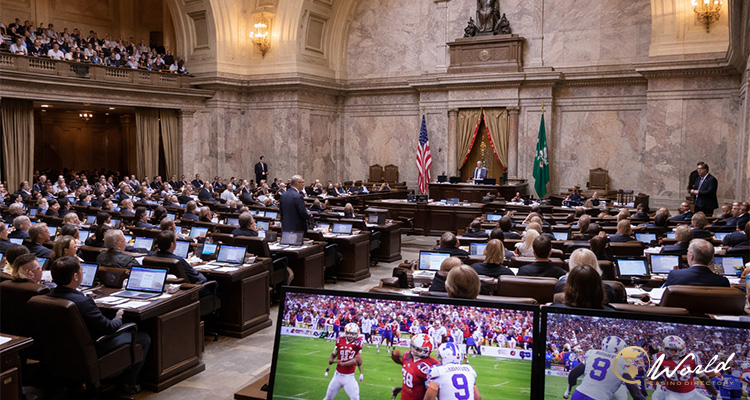
In a significant step toward expanding legal sports betting, the Washington State Senate has approved legislation that would allow residents to place wagers on in-state college sports teams at tribal casinos. Senate Bill 6137 passed with strong support on February 11, 2026, by a vote of 41-8, despite vocal opposition from various groups. The bill now moves to the House of Representatives for further deliberation.
The Proposed Changes to Sports Betting Regulations
The bill would modify existing laws to permit betting on college sports involving Washington-based universities, such as the University of Washington, Washington State University, and Gonzaga University. However, the legislation prohibits wagers on individual player performances, meaning bettors cannot place prop bets on student-athletes, a measure intended to protect athletes from undue pressure and potential harassment.
Under the new rules, residents would only be allowed to place bets at tribal casinos, as all sports wagering in Washington is currently confined to these venues. The bill would take effect 90 days after the legislature adjourns in mid-March 2026, meaning the measure would not apply to the upcoming NCAA basketball tournament.
Supporters of the bill, including tribal leaders and casino operators, argue that the legislation will bring existing underground betting activities into the regulated market, addressing concerns about the growing prevalence of illegal gambling. “We currently offer sports betting for professional Washington teams but not college teams,” Rep. Sharlett Mena, a sponsor of the House companion bill, explained. “This bill would bring college sports wagering under the state’s regulatory structure.”
The legislation has also garnered backing from the Washington Indian Gaming Association, which represents the state’s 29 tribes. Ron Allen, the chair of the association, highlighted that Washingtonians are already placing illegal bets on college teams through prediction markets. He pointed out that the bill would legalize and regulate this activity, making it safer for consumers.
However, the proposal has not been without controversy. Many critics, particularly from the state’s universities, have expressed concern about the potential risks to student-athletes’ well-being. Washington State University’s Chris Mullick argued that the bill could lead to increased harassment and exploitation of student athletes, particularly given the accessibility of college athletes both on campus and online. Mullick also emphasized the results of a recent NCAA survey, which found that a significant portion of Division I athletes, particularly in basketball, had been harassed or even threatened by bettors. He stated, “This is not a mere shift of gambling from the black market to the regulated market; this is a dramatic expansion that opens a massive new market to wagers on WSU games.”
Addressing Mental Health and Athlete Welfare
The Washington State colleges have raised strong objections to the bill’s provision allowing betting on in-state college games, but without including wagers on player performance. University of Washington’s Morgan Hickel also expressed concerns about how gambling could impact student-athletes’ mental health, noting that while the university provides ample resources for wellness, the risk of harassment from bettors is a real issue.
The Senate bill, however, ensures that players’ performances would not be directly wagered on, in a bid to protect their mental and emotional well-being. State Senator Jeff Holy, who supported the bill, stressed the importance of structuring the state’s gambling laws in a way that could minimize the potential harms of illegal gambling while also allowing Washington to benefit from the tax revenue generated by legal sports betting.
Washington is not alone in considering a shift in sports betting laws. As reported by SBC Americas, in Virginia, Delegate Garrett McGuire has introduced a bill that would allow betting on in-state NCAA Division I schools, with a 50% tax on revenue generated from wagers on Virginia-based college teams. McGuire, who argues that the current ban encourages residents to place bets in neighboring states, pointed out that “revenue is going to D.C. or North Carolina and Maryland” due to the state’s prohibition.
Much like Washington, Virginia would allow college sports betting but still prohibit wagers on the performance of individual athletes. The proposal reflects growing concerns across the U.S. about the impact of sports betting on college athletes’ safety and integrity.
