

 United States
 Macau, China
 France
 Philippines
 Singapore
 Netherlands
 United Kingdom
 Canada
 Argentina
 Germany
 Estonia
 Peru
 Russia
 Australia
 South Africa
 Nigeria
 Malaysia
 Singapore
 India
 Finland
 China
 Ukraine
 Hong Kong
 Cyprus
 Turkey
 Greece
 Sweden
 South Korea
 Mexico
 Poland
 Ireland lottery results
 New Zealand lottery results
 Puerto Rico lottery results
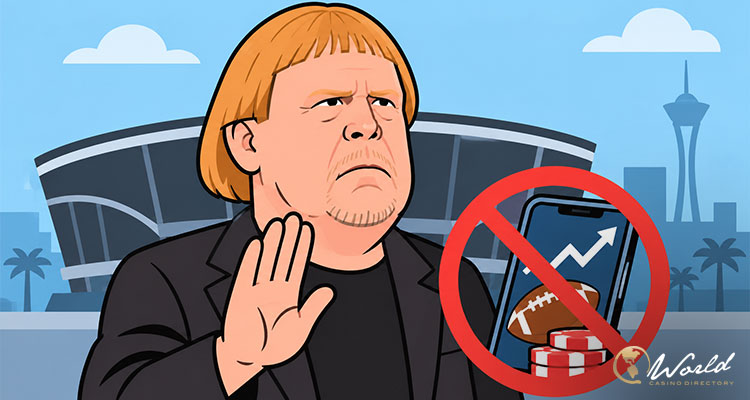
Las Vegas Raiders owner Mark Davis has questioned the expanding role of sports betting in professional sports, expressing particular concern about proposition wagers and the potential damage gambling could cause to public confidence in competition.
Speaking to CNBC Sports, Davis said he remained uncomfortable with certain forms of sports wagering despite the substantial commercial benefits they generate for leagues and team owners. His comments come as prediction markets gain traction in the United States and the NFL faces growing questions about how these platforms should be regulated.
“I’m not a fan per se of gambling on sports, especially the one-on-ones, the proposition types of betting,” Davis said.
The Raiders owner identified sporting integrity as the central issue, arguing that fans must retain confidence in the authenticity of results. He also questioned whether the financial returns from gambling partnerships justify the potential consequences for professional competitions.
“People have to believe in the game,” Davis said. “Is it worth the risk? I don’t know. I can’t answer that.”
Davis Questions the Risks of Expanding Sports Wagering
Davis’ position carries particular significance given his ownership of the Raiders, who relocated from Oakland to Las Vegas in 2020, bringing the NFL to the country’s most prominent gambling destination. He also owns the WNBA’s Las Vegas Aces.
Despite his association with the city, Davis recalled a period when the NFL maintained a much stricter policy toward gambling. He described the warnings players encountered during his younger years, when the league treated betting as a serious disciplinary matter.
“I remember growing up that there was a big sign in the locker room as you walked out that door that said, ‘No gambling whatsoever,’ or there’s suspension or you’re out of the league,” he said.
Davis also raised questions about the oversight surrounding the industry’s expansion across the country. He recalled that the Raiders conducted research before moving to Nevada, which indicated that Las Vegas had particularly strong safeguards against gambling-related integrity concerns.
“When we moved to Las Vegas, we did a study,” Davis explained. “And it showed that Las Vegas was probably the one place in the country where it was safe for gambling (concerns) because they had so much oversight.”
However, he suggested that the wider availability of sports betting has created additional challenges for leagues seeking to maintain proper supervision of gambling activity and ensure compliance among athletes.
His remarks come against a backdrop of gambling-related controversies across North American sports, including investigations involving player betting violations and suspected attempts to manipulate sporting events. Such incidents have increased scrutiny of the relationship between gambling operators and professional competitions.
NFL Maintains Cautious Position on Prediction Markets
The growth of prediction markets has added another dimension to the debate. These platforms allow customers to trade contracts linked to sporting outcomes, creating questions about their regulatory classification and the extent to which sports leagues should cooperate with their operators.
The NFL has adopted a more reserved approach to prediction market partnerships than some other professional leagues. Although it has established commercial relationships with traditional sports betting companies, it has so far declined to enter official agreements with prediction market operators.
Commissioner Roger Goodell outlined the league’s position in September, emphasizing the need for stronger regulatory oversight before the NFL considers participating in the sector.
The NFL subsequently filed an amicus brief with the Supreme Court in October, arguing that prediction markets should be classified as gambling and fall under state regulatory authority.
Concerns about the relationship between wagering activity and sporting outcomes have also featured in earlier NFL statements. Before the league embraced the commercial opportunities offered by legal sports betting, Goodell warned that widespread gambling could encourage doubts about the legitimacy of ordinary events during games.
His previous position highlighted the possibility that routine mistakes or controversial decisions could trigger speculation about match manipulation, particularly when spectators have financial interests tied to specific plays or results.
Commercial Partnerships Complicate the Integrity Debate
The Raiders owner acknowledged that gambling has become an important source of revenue for professional sports organizations. However, he believes leagues must consider the financial advantages alongside the possibility of reputational damage.
“The revenue that is coming from gambling and those types of entities is large so there has to be a balance between integrity and what the good things that it can bring to the league,” he said.
Davis’ business interests also illustrate the close relationship between professional sports and gambling companies. Both the Raiders and the Las Vegas Aces maintain partnerships with BetMGM, while Davis has credited MGM Resorts CEO Bill Hornbuckle with playing an important role in his decision to purchase the WNBA franchise.
The debate also extends beyond direct sponsorship agreements. Gambling activity can increase audience engagement, as viewers with wagers connected to a particular game or player may have additional reasons to follow the action. These commercial considerations have made it difficult for leagues to reconsider their broader approach to betting.
Davis acknowledged the competing interests but returned to the importance of the sporting product itself. For him, the priority remains ensuring that players and teams can compete without raising doubts about the legitimacy of results.
