

 United States
 Macau, China
 France
 Philippines
 Singapore
 Netherlands
 United Kingdom
 Canada
 Argentina
 Germany
 Estonia
 Peru
Peru Russia
 Australia
 South Africa
 Nigeria
 Malaysia
 Singapore
 India
India Finland
 China
China Ukraine
 Hong Kong
 Cyprus
 Turkey
 Greece
 Sweden
 South Korea
 Mexico
 Poland
 Ireland lottery results
 New Zealand lottery results
 Puerto Rico lottery results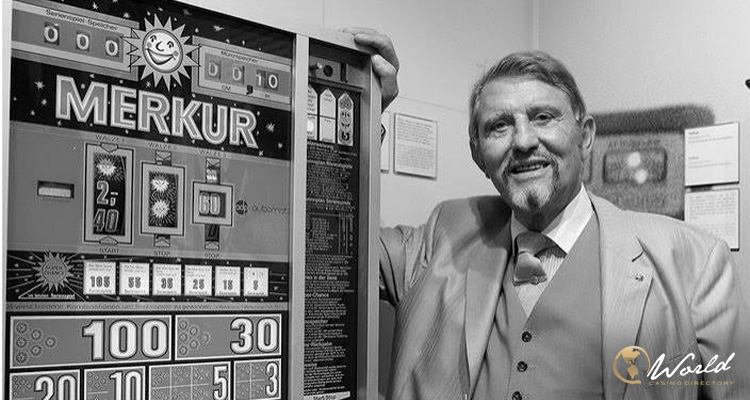
Paul Gauselmann, founder and longtime chairman of Merkur Group, died on August 21 at the age of 91, shortly before his 92nd birthday. During a 67-year career, he turned a one-man business into an international gaming company with more than 15,000 employees and annual turnover of around €2.1 billion.
Gauselmann remained closely involved with the company even after leaving its top management in 2024. For several months afterward, he continued visiting the office twice a week to oversee day-to-day operations.
His career began in postwar Germany and eventually led to a major role in the development of the country’s gaming machine industry.
From Technical Work to Gaming
Born in 1934 in Borghorst near Münster, Gauselmann lost his mother at two and was raised by relatives in Münster, separated from his father and four brothers. He experienced the Second World War as a child and later recalled how games helped him cope during air raids.
In 1950, he graduated at the top of his class and began an apprenticeship as a telecommunications inspector. He subsequently joined a vending machine manufacturer that imported Wurlitzer jukeboxes. During that period, he developed a remote selection unit for German jukeboxes.
The work led to a position at Harting in Espelkamp. He joined the company as a technician and became head of its machine development department by the age of 26.
Gauselmann began operating jukeboxes independently in 1957 while still employed. He became fully self-employed as a gaming machine operator in 1964 and opened his first gaming arcade in Delmenhorst in 1974.
The company’s first internally developed gaming machine, Merkur B, arrived in 1977. Its introduction provided the foundation for further product development and the group’s later international expansion. Hundreds of patents followed, alongside the creation of the smiling Merkur sun that became the company’s trademark.
Gauselmann also became a major representative of Germany’s amusement and gaming machine sector. He spent more than 38 years working within industry associations and served for 28 years as chairman of the Association of the German Vending Machine Industry.
Family Ownership and Continued Development
In 2016, ownership of the Gauselmann family’s companies moved to the Gauselmann Family Foundation, making it the sole owner of Merkur Group. According to iGaming Business, Gauselmann remained chairman of the foundation’s board until 2024, when his son Michael succeeded him.
The company now employs more than 2,000 people in Espelkamp and Lübbecke, where it remains an important regional employer.
Gauselmann’s family life remained closely connected to his work. He met his wife Karin in 1967, and they later settled in Espelkamp. He is survived by Karin, four sons, nine grandchildren and seven great-grandchildren.
He formally stepped down as chairman on October 1, 2024, ending his direct leadership of the group after 67 years. His continued visits to the company’s offices after that transition reflected his ongoing involvement in its affairs.
A Legacy Beyond the Gaming Business
Gauselmann devoted significant resources to charitable and community projects. His activities included support for healthcare, emergency services, sports, culture and social welfare. The charitable organization he established later became the Paul and Karin Gauselmann Foundation.
Among his regional contributions, he provided around €6 million for two childcare centers in Espelkamp. He later donated €8.7 million to the city during financial difficulties and gave a further €5 million to neighboring Lübbecke.
As published in the obituary, in 2010, Gauselmann acquired the 500-year-old Schloss Benkhausen in Espelkamp. After restoration, the property became a training center with hotel facilities. Its estate barn houses the German Coin-Op Museum – Gauselmann Collection.
His public service received national and local recognition. Germany awarded him the Federal Cross of Merit, First Class, in 2003, while Espelkamp and Lübbecke named him an honorary citizen in 2004.
The wider gaming industry has also marked his death. WorldGaming Managing Director Stuart Hunter described Gauselmann as an entrepreneurial figure whose support helped the ICE event during its move from London to Barcelona in 2025. Gaming Arts, which became part of Merkur Group in 2025, said his influence remained relevant to the group’s development in North America.
Gauselmann leaves behind a family-owned gaming group, an extensive record of industry involvement and a substantial portfolio of community projects. His career connected the postwar German gaming machine business with Merkur Group’s later international operations.
